
INSIGHTS
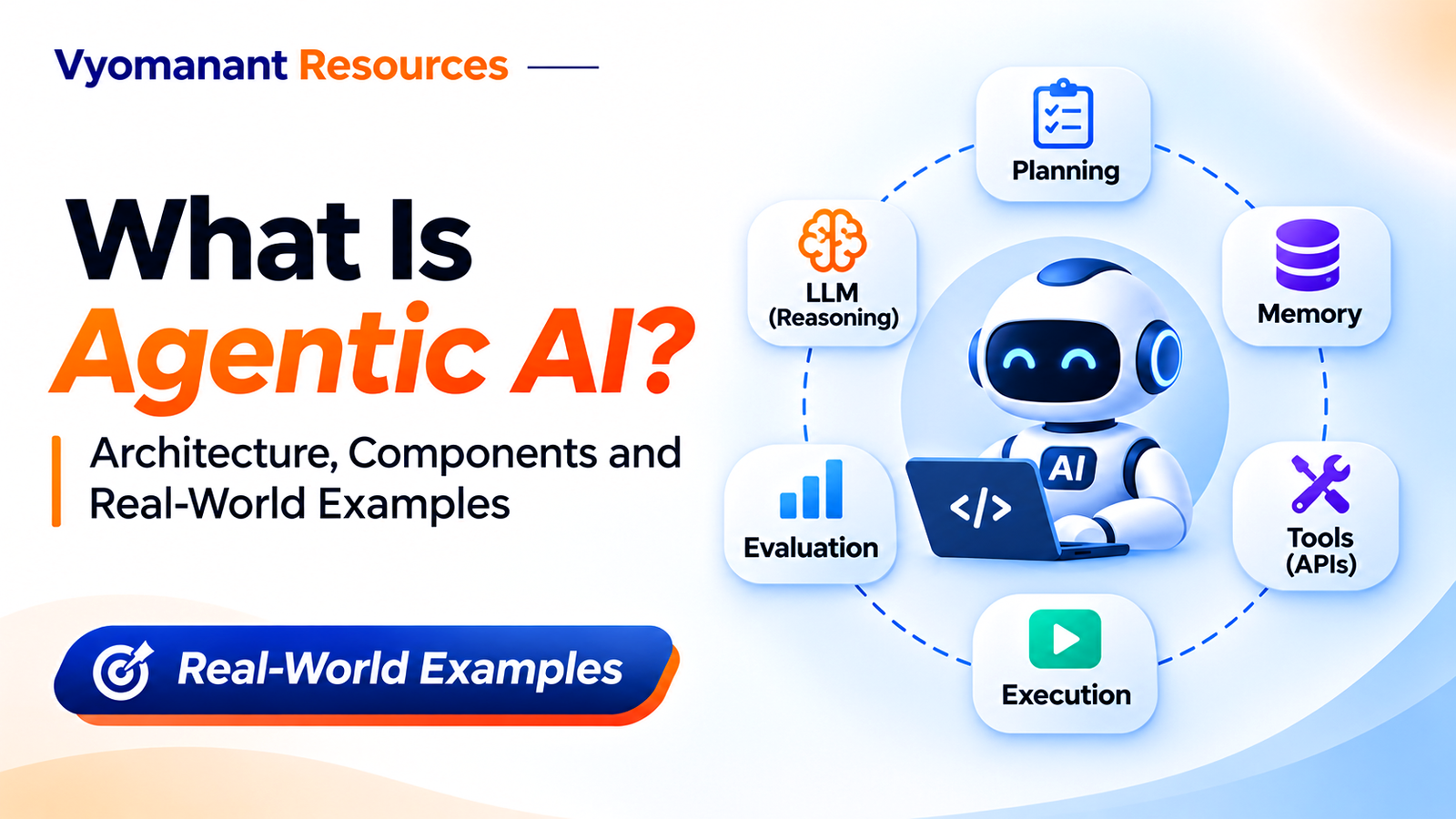
What Is Agentic AI? Architecture, Components and Real-World Examples
Learn what Agentic AI is, how its architecture works, and the key components behind AI agents. Understand planning, memory, tools, and real-world applications through simple explanations and practical examples.
Engineering support
Need help applying this?
Discuss your engineering requirements with Vyomanant Technologies.
Talk to UsOn this page
Imagine having an AI assistant that doesn't just answer your questions but can also plan tasks, use tools, make decisions, and take actions to complete a goal.
For example, instead of simply explaining how to fix a software bug, an AI agent could investigate the error, modify the code, run tests, and prepare a solution for your review.
This is the idea behind Agentic AI.
Let's understand how it works, its architecture, important components, and practical applications.
1. What Is Agentic AI?
Agentic AI refers to artificial intelligence systems designed to achieve goals by planning and performing actions with a degree of autonomy.
Unlike a basic AI chatbot that primarily generates responses, an AI agent can interact with tools, access relevant information, and execute multi-step workflows.
Simple Example
Imagine you ask an AI system:
"Find the reason my website is running slowly."
Traditional AI Assistant:
- Explains common reasons for slow websites.
- Suggests troubleshooting steps.
- Provides commands you can execute.
Agentic AI System:
- Checks application performance metrics.
- Analyzes server logs.
- Identifies possible bottlenecks.
- Suggests or implements an authorized fix.
- Tests whether performance has improved.
Key Difference: Traditional AI primarily provides information, while Agentic AI can use tools and perform actions to achieve a goal.
The actions an agent can perform depend on its tools, permissions, and configuration.
2. How Does Agentic AI Work?
Agentic AI generally follows a repeating process:
Goal → Plan → Act → Observe → Evaluate → Repeat
Let's understand this with an example.
Goal: Fix a failing CI/CD pipeline.
- Understand the Goal: Identify what the user wants to achieve.
- Create a Plan: Decide which logs, configurations, and files to investigate.
- Take Action: Use available tools to examine the pipeline.
- Observe Results: Analyze error messages and command outputs.
- Evaluate: Determine whether the issue has been resolved.
- Repeat or Finish: Try another approach if needed, or report the result.
Example:
A Jenkins pipeline fails because of an incorrect dependency version.
An AI agent with the required access could inspect the logs, identify the dependency conflict, update the configuration, and rerun the build.
If the build succeeds, it can prepare the changes for developer review.
This repeated process is commonly called an Agentic Loop.
3. Agentic AI Architecture
Agentic AI architecture describes how different components work together to understand goals, make decisions, and execute tasks.
Basic Architecture
                USER
                  |
                  v
           +-------------+
           |  User Goal  |
           +-------------+
                  |
                  v
        +-------------------+
        |   AI Agent / LLM  |
        | Reason & Decide   |
        +-------------------+
                  |
          +-------+-------+
          |               |
          v               v
    +-----------+   +-----------+
    |  Memory   |   | Planning  |
    | & Context |   |           |
    +-----------+   +-----------+
          |               |
          +-------+-------+
                  |
                  v
          +---------------+
          | Tools & APIs  |
          +---------------+
                  |
                  v
          +---------------+
          | Execute Task  |
          +---------------+
                  |
                  v
          +---------------+
          | Check Results |
          +---------------+
                  |
          +-------+-------+
          |               |
      Not Done           Done
          |               |
          v               v
     Retry/Adjust     Final Output
          |
          +----> AI Agent
How to read this architecture:
The user provides a goal. The AI agent uses its reasoning capabilities, available context, and planning process to decide what to do.
It then interacts with external tools, checks the results, and either continues working or returns the completed output.
Important: This is a simplified reference architecture. Actual implementations may combine components or use different workflows.
4. Key Components of Agentic AI
1. Large Language Model (LLM) — The Brain
The LLM helps the agent understand instructions, reason about problems, and decide what action to take next.
Example: An agent reads a Python error and determines which files should be investigated.
Role: Understanding, reasoning, and decision-making.
2. Planning — The Task Organizer
Planning allows the agent to divide a complex goal into smaller, manageable steps.
Example:
Goal: Deploy an application.
The agent may plan to:
- Check the application code.
- Build a Docker image.
- Run automated tests.
- Prepare deployment configuration.
- Deploy after approval.
- Verify application health.
Role: Organizing tasks in a logical sequence.
3. Memory and Context — The Information Store
Memory and context help agents use information from previous steps, conversations, documents, or connected systems.
Example: An agent remembers that an application uses Python 3.12 and avoids suggesting incompatible dependencies.
Memory may be short-term, long-term, or retrieved when needed. Not every agent has persistent memory.
Role: Maintaining relevant information for better decisions.
4. Tools and APIs — The Hands
Tools allow AI agents to interact with external systems and perform actions.
Common examples include:
- GitHub: Read code and create pull requests.
- Jenkins: Inspect CI/CD pipeline results.
- AWS: Retrieve cloud infrastructure information.
- Databases: Query authorized data.
- Web Search: Retrieve current information.
Example: An AI agent uses a GitHub integration to inspect a repository and prepare a code change.
Role: Connecting AI reasoning with real-world operations.
5. Execution — The Action Performer
Execution is where the agent carries out planned tasks using available tools.
Example: An agent modifies a configuration file, runs tests, and records the results.
Role: Turning decisions into actions.
6. Feedback and Evaluation — The Quality Checker
Feedback helps the agent determine whether an action produced the expected result.
Example: After fixing a bug, the agent runs unit tests.
- If tests pass, it reports the outcome.
- If tests fail, it investigates further.
Role: Checking progress and improving subsequent actions.
5. Real-World Examples of Agentic AI
Example 1: Software Development
Scenario: A developer wants to add a login feature.
An AI coding agent can:
- Analyze the application structure.
- Generate login-related code.
- Add input validation.
- Create test cases.
- Run tests.
- Prepare a pull request.
Benefit: Reduced repetitive coding and faster development.
Example 2: DevOps and CI/CD
Scenario: A deployment pipeline fails.
An AI agent can:
- Read pipeline logs.
- Identify possible errors.
- Check configuration files.
- Suggest or prepare corrections.
- Rerun authorized tests.
Benefit: Faster troubleshooting and reduced manual investigation.
Example 3: IT Support
Scenario: An employee cannot access an internal application.
An AI support agent can:
- Collect basic troubleshooting information.
- Check service availability.
- Review permitted account-status information.
- Suggest troubleshooting actions.
- Create or update a support ticket.
Benefit: Faster support and less repetitive work for IT teams.
Example 4: Cloud Infrastructure
Scenario: A cloud application is experiencing high CPU usage.
An AI agent can:
- Retrieve CPU metrics.
- Analyze application logs.
- Identify potential causes.
- Recommend scaling or configuration changes.
- Verify results after approved changes.
Benefit: Improved infrastructure troubleshooting and operational efficiency.
6. Agentic AI vs Generative AI
| Generative AI | Agentic AI |
|---|---|
| Primarily generates content | Works toward goals through actions |
| Creates text, images, or code | Plans and executes workflows |
| Usually responds to prompts | Can perform multiple connected steps |
| Often requires users to take action | Can use tools to take authorized actions |
| Example: Generates Python code | Example: Writes, tests, and revises Python code |
Remember: Agentic AI often uses Generative AI models as its reasoning engine. These technologies are related, not completely separate.
7. Benefits of Agentic AI
- Automation: Reduces repetitive manual tasks.
- Productivity: Helps teams complete selected workflows faster.
- Problem-Solving: Supports multi-step troubleshooting.
- Consistency: Can follow defined processes and checks.
- Scalability: Can assist with multiple workflows when properly designed.
However, these benefits depend on the agent's reliability, integration quality, and task complexity.
8. Challenges and Limitations
Agentic AI is powerful, but it is not always accurate or reliable.
Important challenges include:
- Incorrect Decisions: Agents may misunderstand instructions.
- Security Risks: Excessive permissions can cause unsafe actions.
- Unexpected Results: Automated changes may introduce new issues.
- Cost: Repeated model calls and tool executions consume resources.
- Human Oversight: Critical operations require proper approvals.
Example: An AI agent investigating a database issue should not be allowed to delete production data without explicit authorization.
A reliable Agentic AI system needs access controls, testing, monitoring, and human approval for high-risk actions.
9. Where Is Agentic AI Used?
Agentic AI can support many industries and workflows.
| Industry | Example Use Case |
|---|---|
| Software Development | Coding, testing, and debugging |
| DevOps | CI/CD troubleshooting |
| Cloud Computing | Infrastructure monitoring |
| Cybersecurity | Security alert investigation |
| Customer Support | Ticket classification and resolution |
| Business Operations | Workflow and document automation |
These examples represent possible applications; the level of automation varies by implementation.
10. Final Thoughts
Agentic AI takes artificial intelligence beyond generating answers by enabling systems to plan, use tools, and perform actions toward a goal.
Its architecture combines LLMs, planning, memory, tools, execution, and feedback to support multi-step workflows.
From software development to DevOps and cloud operations, Agentic AI can help reduce repetitive tasks and improve productivity.
However, successful adoption requires reliable tools, controlled permissions, testing, and human oversight.
Key Takeaway: Generative AI helps create content. Agentic AI helps get tasks done.
CONTINUE EXPLORING
Recommended next
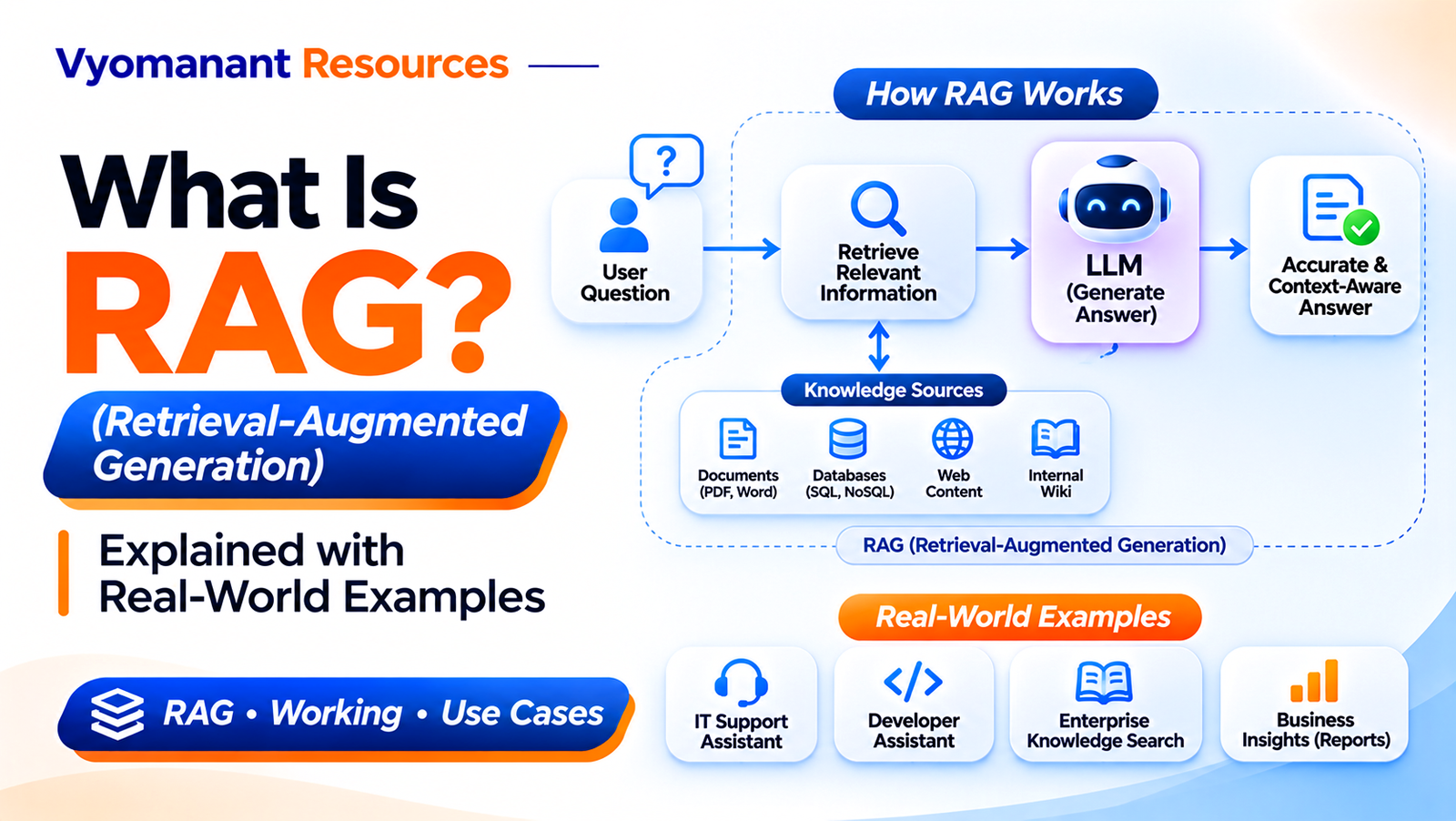
What Is RAG? Explained with Real-World Examples
Learn what Retrieval-Augmented Generation (RAG) is, how it works, and why it is important for AI applications. Understand RAG architecture, embeddings, vector databases, and real-world use cases through simple explanations and practical examples.
Read insight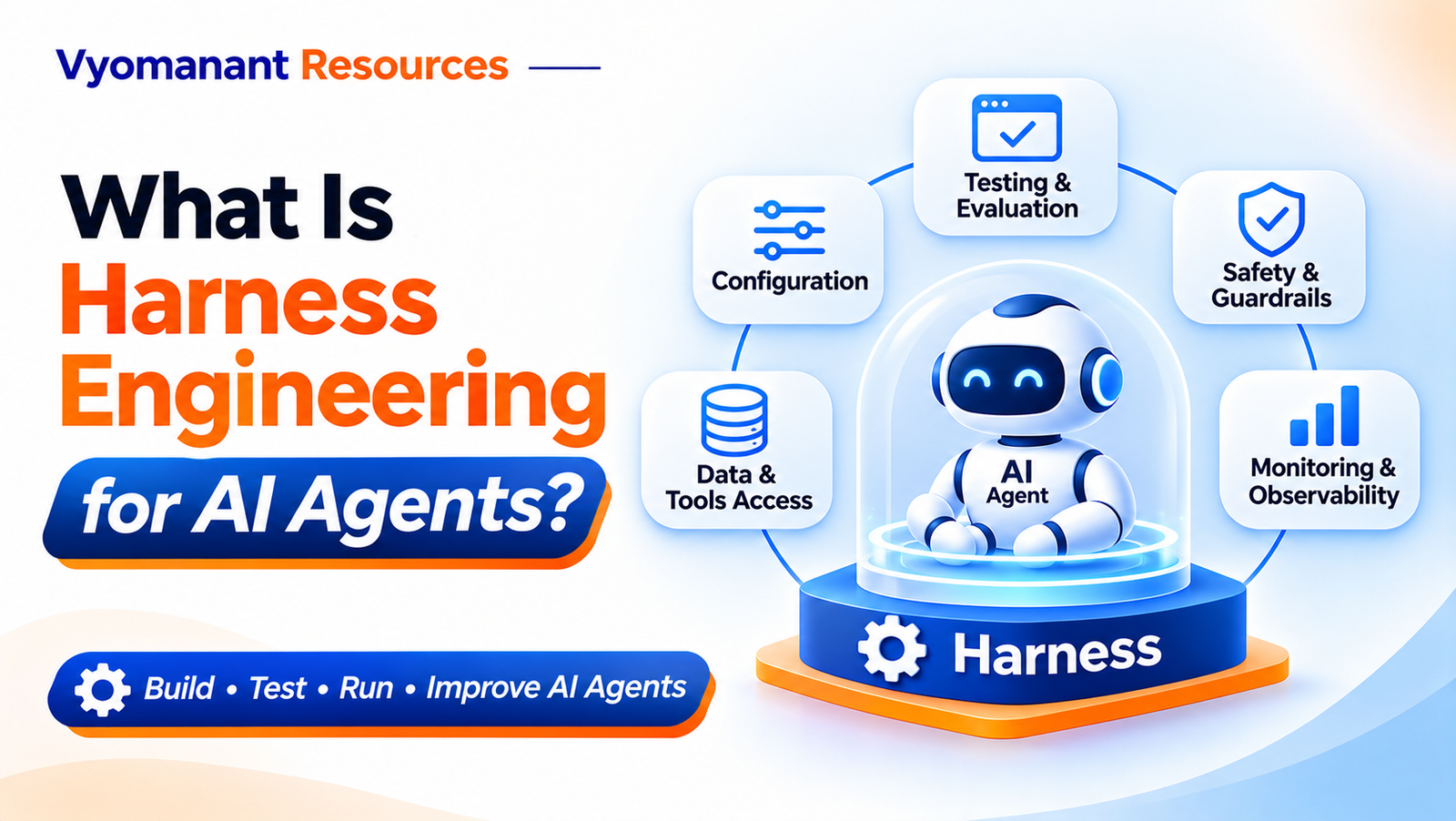
What Is Harness Engineering for AI Agents?
Learn what Harness Engineering is, why AI agents need it, and how it improves reliability, security, and automation. Explore agent harness architecture, key components, and real-world software development examples in simple, beginner-friendly language.
Read insight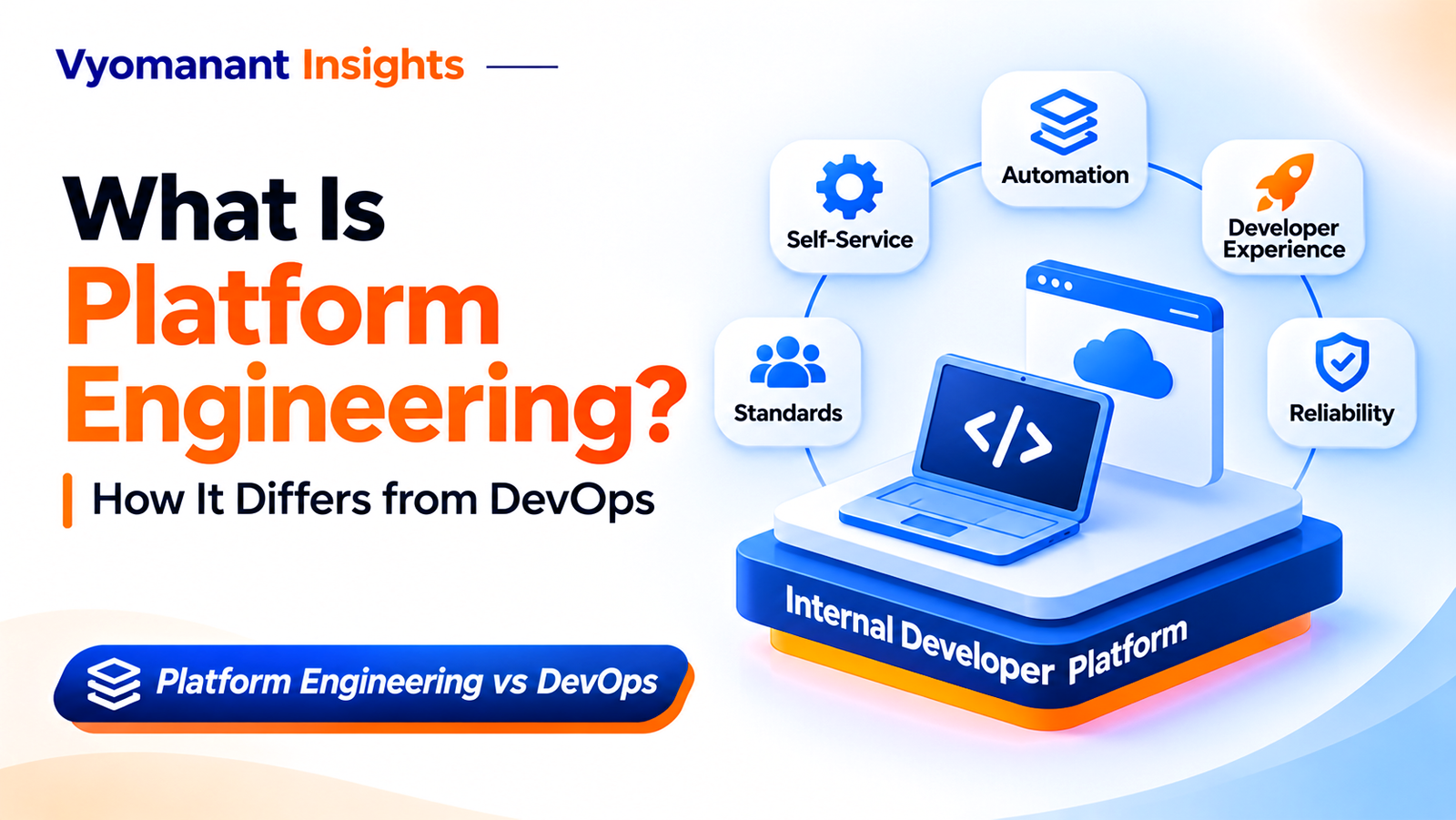
What Is Platform Engineering? How It Differs from DevOps
Learn what Platform Engineering is, how it works, and how it differs from DevOps. Explore Internal Developer Platforms (IDPs), self-service infrastructure, real-world examples, benefits, and the roles of platform engineers.
Read insight