
RESOURCES
How to Structure Clear and Concise Interview Answers: Practical Frameworks, Examples & IT Interview Tips
Learn how to structure clear, concise IT interview answers using PREP, STAR, and step-by-step techniques, with technical examples, HR questions, and practice exercises.
Vyomanant Academy
Build these skills hands-on
Explore structured, practical technology programs from Vyomanant Academy.
Explore CoursesOn this page
How to Structure Clear and Concise Interview Answers: A Practical Guide for IT Professionals
Introduction
Imagine attending an interview for a software developer, DevOps engineer, cloud engineer, cybersecurity analyst, or IT support role.
The interviewer asks:
"Can you explain how a CI/CD pipeline works?"
You know the answer. You understand Git, Jenkins, automated testing, Docker, and deployment.
But you start explaining everything you know about these tools. After several minutes, you realize that you have not clearly answered the original question.
This is a common interview communication challenge.
A strong interview answer is not necessarily a long answer. It is an answer that directly addresses the question, provides relevant details, and is easy to follow.
Clear and concise communication helps interviewers understand your technical knowledge, decision-making, and problem-solving approach.
In this guide, you will learn how to organize interview answers, choose the right response framework, explain technical concepts, describe projects, answer behavioral questions, and practice speaking with clarity.
1. What Does a Clear and Concise Interview Answer Mean?
A clear answer is easy to understand.
A concise answer includes the information needed to address the question without unnecessary details.
These qualities work together.
An answer can be short but incomplete. It can also be detailed but confusing.
The goal is to provide enough information for the interviewer to understand your point.
Example: What Is Docker?
Too Short:
"Docker is a container tool."
This answer is brief, but it provides limited information.
Too Long:
"Docker was introduced many years ago, and it has many commands, images, networks, volumes, registries, plugins, and different configuration options..."
This answer includes related information but does not explain the main concept effectively.
Clear and Concise:
"Docker is a platform used to build, package, and run applications in containers. Containers help package an application with its required runtime components so it can run consistently across compatible environments."
The final answer is direct, accurate, and focused.
Clear vs Concise
| Clear Communication | Concise Communication |
|---|---|
| Uses understandable language | Avoids unnecessary details |
| Follows a logical order | Focuses on the question |
| Explains technical terms | Removes repetition |
| Uses relevant examples | Keeps examples focused |
| Makes the main point obvious | Stops when the answer is complete |
Key Principle: Concise does not mean incomplete. Provide enough detail to demonstrate understanding.
2. Understand the Question Before Answering
The first step in structuring a good answer is identifying what the interviewer wants.
Different questions require different response styles.
Common Interview Question Types
| Question Type | Example | Best Approach |
|---|---|---|
| Definition | What is Kubernetes? | Definition + purpose |
| Comparison | Docker vs Kubernetes? | Main differences + example |
| Process | How does CI/CD work? | Ordered steps |
| Project | Explain your AWS project. | Objective + contribution + outcome |
| Behavioral | Tell me about a challenge. | STAR framework |
| Troubleshooting | Why is a server slow? | Investigation steps |
| Opinion or Decision | Why did you choose Terraform? | Choice + reasoning + trade-off |
Identify the Question Word
Pay attention to words such as:
- What: Define or identify.
- Why: Explain the reason.
- How: Describe the process.
- Compare: Explain similarities and differences.
- Describe: Provide relevant details.
- Tell me about a time: Share a real experience.
Example
Question: "Why did you use Docker in your project?"
A weak answer might explain Docker's entire architecture.
A stronger answer focuses on the decision:
"I used Docker to package the application and its dependencies into a reusable image. This made the application easier to run in different compatible environments and simplified our deployment process."
Practical Tip
Before answering, silently ask:
"What is the one main thing the interviewer wants to know?"
This helps prevent unrelated explanations.
3. Use the Direct Answer First Method
One of the simplest ways to improve interview answers is to begin with the conclusion.
Do not make the interviewer wait several minutes to understand your point.
Recommended Structure
        Interview Question
                |
                v
          Direct Answer
                |
                v
       Supporting Details
                |
                v
       Relevant Example
                |
                v
       Short Conclusion
Example: Why Is Linux Used in DevOps?
Direct Answer:
"Linux is widely used in DevOps because many servers, cloud workloads, and automation tools run on Linux."
Supporting Details:
"It provides command-line tools, scripting capabilities, and flexible system configuration."
Example:
"For example, engineers can use Linux shell scripts to automate server maintenance and deployment tasks."
Why This Works
The interviewer immediately understands your main point.
Additional details then support the answer rather than distracting from it.
When to Use It
This approach works particularly well for:
- Technical definitions.
- Technology comparisons.
- Tool-selection questions.
- General knowledge questions.
- Short explanations.
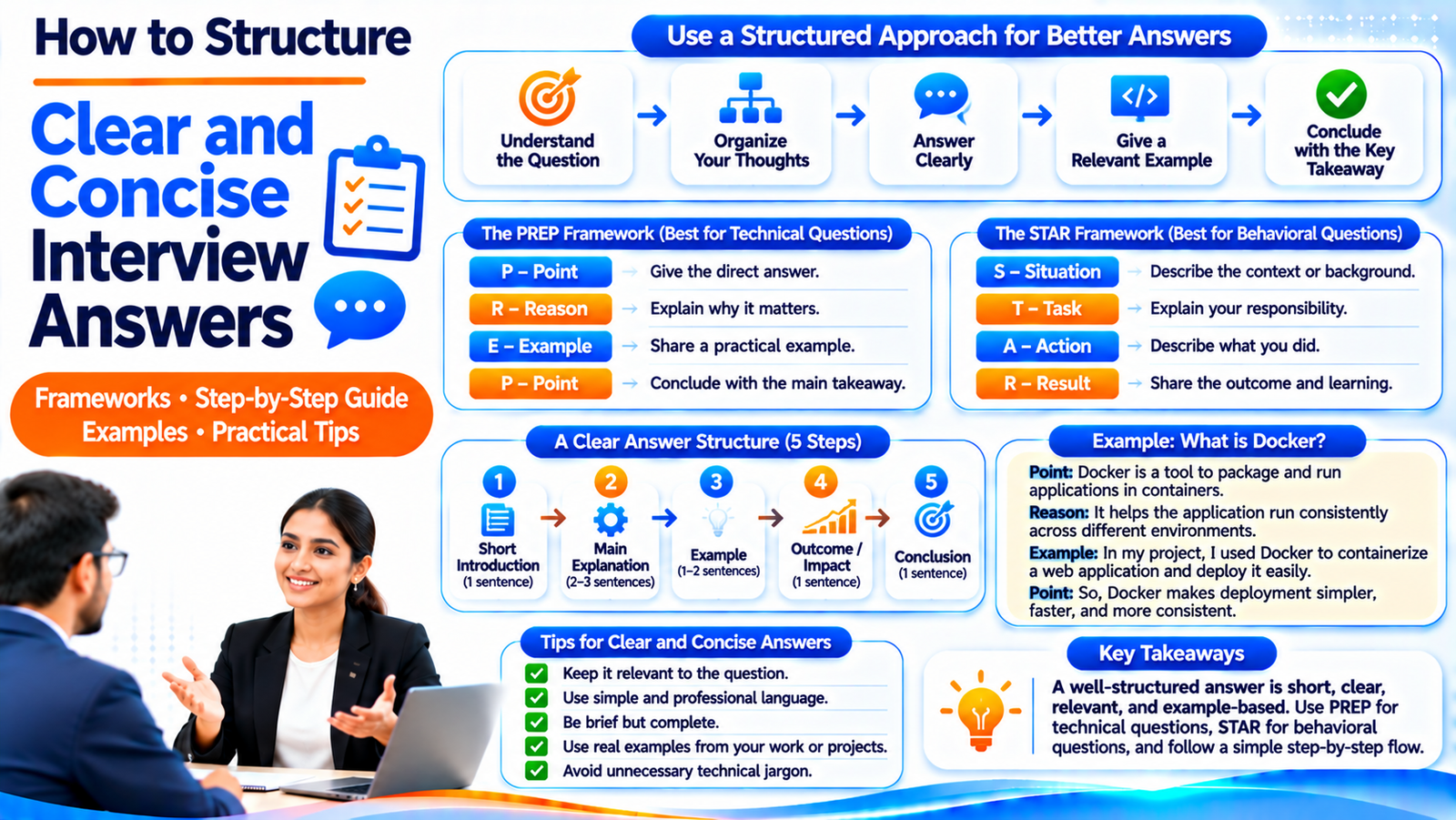
4. Use the PREP Framework for Technical Answers
The PREP framework helps organize explanations into four parts.
PREP stands for:
- P — Point: State your main answer.
- R — Reason: Explain why.
- E — Example: Give a practical example.
- P — Point: Reinforce the main takeaway.
Example: Why Is Monitoring Important?
Point:
"Monitoring helps engineers understand the health and performance of applications and infrastructure."
Reason:
"It helps teams detect failures, unusual resource usage, and performance problems."
Example:
"For example, Prometheus can collect server metrics, while Grafana can display dashboards that help engineers investigate problems."
Point:
"So monitoring provides useful information for detecting and responding to operational issues."
PREP Structure
P — Main Point
      |
      v
R — Supporting Reason
      |
      v
E — Practical Example
      |
      v
P — Final Takeaway
When Is PREP Useful?
Use PREP for questions such as:
- Why is cloud computing useful?
- Why do teams use Git?
- What are the benefits of automation?
- Why is security important in CI/CD?
- Why did you choose a particular tool?
Avoid Mechanical Repetition
You do not need to announce each PREP step.
The framework should guide your thinking while your answer sounds natural.
5. Use the STAR Framework for Behavioral Questions
Behavioral questions ask about situations you have experienced.
The STAR framework helps you tell a focused story.
STAR Meaning
| Step | Meaning | What to Explain |
|---|---|---|
| S | Situation | What was happening? |
| T | Task | What was your responsibility? |
| A | Action | What did you do? |
| R | Result | What happened afterward? |
Example: Tell Me About a Technical Challenge
Situation:
"During a practice project, our application failed to start after deployment."
Task:
"I was responsible for investigating the issue."
Action:
"I checked the application logs and found that a required environment variable was missing. I corrected the configuration and restarted the application."
Result:
"The application started successfully, and I documented the issue to prevent it from happening again."
Why STAR Works
It keeps the answer focused on a real situation rather than vague statements.
Instead of saying:
"I'm good at solving problems."
You explain how you solved one.
Common STAR Questions
- Tell me about a difficult problem you solved.
- Describe a time you worked with a team.
- Tell me about a mistake you made.
- How did you handle a disagreement?
- Describe a time you had to learn something quickly.
Important Advice
Spend enough time on the Action section to explain your contribution.
Avoid describing the entire team's work as if you completed it alone.
6. Use the Problem–Action–Result Method for Short Stories
Sometimes a full STAR answer is unnecessary.
For a quick project or troubleshooting example, use:
Problem → Action → Result
Example: Jenkins Pipeline Failure
Problem:
"The Jenkins pipeline failed during the build stage."
Action:
"I reviewed the console logs, identified an incorrect dependency version, and updated the build configuration."
Result:
"The pipeline completed successfully after the correction."
Why This Method Is Useful
It is especially effective when the interviewer asks:
- What issue did you face?
- How did you fix it?
- What was the outcome?
- Can you give a quick example?
Comparison: STAR vs Problem–Action–Result
| STAR | Problem–Action–Result |
|---|---|
| Better for detailed behavioral questions | Better for short technical examples |
| Includes context and responsibility | Focuses on the issue and solution |
| Often needs more explanation | Usually faster to deliver |
| Useful for teamwork and leadership | Useful for troubleshooting |
Choose the structure that matches the question.
7. Structure Technical Definitions in Three Parts
Technical definitions are easier to understand when they follow a consistent pattern.
The Three-Part Method
- What is it?
- What does it do?
- Where is it used?
Example: What Is Terraform?
What is it?
"Terraform is an Infrastructure as Code tool."
What does it do?
"It allows engineers to define and manage supported infrastructure resources using configuration files."
Where is it used?
"For example, Terraform can provision cloud resources such as virtual networks and servers in AWS or Azure."
Example: What Is an API?
"An API is an interface that allows software components to communicate.
It defines how one system can request information or actions from another.
For example, a shopping application may use an API to retrieve product information from a backend service."
Example: What Is Kubernetes?
"Kubernetes is a container orchestration platform.
It helps deploy, manage, and scale containerized workloads.
For example, a company can use Kubernetes to manage multiple application replicas and replace failed Pods."
Practical Tip
Start with a short definition.
Add technical depth only when the interviewer requests it or when it is needed to answer the question accurately.
8. Structure Comparison Questions Clearly
Comparison questions are common in IT interviews.
Examples include:
- Docker vs Kubernetes.
- Git vs GitHub.
- AWS vs Azure.
- SQL vs NoSQL.
- Virtual machines vs containers.
- Continuous delivery vs continuous deployment.
Recommended Comparison Structure
- Define both technologies briefly.
- Explain the main difference.
- Compare two or three important features.
- Give an example when useful.
Example: Docker vs Kubernetes
"Docker is commonly used to build and run containers, while Kubernetes manages containerized workloads across a cluster.
Docker focuses on container packaging and execution.
Kubernetes provides orchestration capabilities such as scheduling, scaling, and recovery.
For example, a team can build an application image using Docker and deploy it using Kubernetes."
Comparison Table
| Docker | Kubernetes |
|---|---|
| Builds and runs containers | Orchestrates containerized workloads |
| Provides container tooling and runtime capabilities | Manages deployment and scheduling |
| Commonly used during packaging and local development | Commonly used for cluster-level operations |
Avoid This Mistake
Do not list ten differences when the interviewer asks for the main difference.
Start with the most important distinction.
9. Structure Process Questions Step by Step
When an interviewer asks "How does something work?", an ordered explanation is usually effective.
Example: How Does a CI/CD Pipeline Work?
"A CI/CD pipeline automates steps in software integration and delivery.
First, a developer pushes code to a repository.
Next, the pipeline checks out the code, builds the application, and runs automated tests.
If the required checks pass, the pipeline can package the application and prepare or perform deployment.
Finally, the team verifies the release."
Simple Process Structure
Trigger
   |
   v
Build
   |
   v
Test
   |
   v
Package
   |
   v
Deploy or Prepare Release
   |
   v
Verify
Example: How Would You Deploy a Web Application?
"First, I would confirm the application requirements and target environment.
Next, I would prepare the infrastructure and required configuration.
Then I would build and deploy the application.
After deployment, I would test the application and review logs or monitoring data to verify that it works."
Key Principle
Use the sequence that reflects the actual workflow.
Do not add steps simply to make the answer longer.
10. Structure Project Explanations Without Overloading Details
Project explanations can become lengthy because they involve many technologies.
A useful structure is:
Goal → Architecture → Contribution → Challenge → Result
Example: AWS Cloud Infrastructure Project
Goal:
"The project aimed to deploy a web application on AWS."
Architecture:
"We used an EC2 instance for the application and a security group to control network access."
Contribution:
"I configured the EC2 instance, installed the required software, and deployed the application."
Challenge:
"Initially, the application was not accessible because the required inbound network rule was missing."
Result:
"I corrected the security group configuration, verified access, and documented the deployment steps."
Short Interview Version
"I deployed a sample web application on AWS EC2. I configured the server, installed the application dependencies, and set up the required network access. During testing, I resolved a security group configuration issue and verified that the application was reachable."
Detailed Interview Version
If the interviewer asks for more information, explain:
- Network design.
- Server configuration.
- Application deployment.
- Security considerations.
- Testing and troubleshooting.
- Cost and operational limitations.
Important Reminder
You do not need to explain every configuration file in your opening project answer.
Begin with the overall picture and expand through follow-up questions.
11. Structure Troubleshooting Answers Logically
Troubleshooting questions evaluate how you approach uncertain technical problems.
A structured answer should show investigation rather than guesswork.
Recommended Framework
Scope → Evidence → Hypothesis → Action → Verification
Example: A Website Is Not Loading
Scope:
"First, I would check whether the problem affects one user or everyone."
Evidence:
"Then I would check DNS resolution, network connectivity, web server status, and application logs."
Hypothesis:
"Based on the results, I would identify possible causes such as a stopped service or incorrect network configuration."
Action:
"I would apply the appropriate fix after confirming the likely cause."
Verification:
"Finally, I would test the website and check whether the error has stopped."
Why This Works
It shows:
- Problem understanding.
- Evidence gathering.
- Logical reasoning.
- Controlled changes.
- Result verification.
Avoid Random Troubleshooting
A weak answer might be:
"I will restart the server, reinstall the application, and check everything."
Restarting or reinstalling without investigating may create additional problems.
Explain how you would gather evidence before taking action.
12. How Long Should an Interview Answer Be?
There is no universal ideal duration.
The right length depends on the question, the interview format, and the level of detail requested.
The following ranges are useful practice targets.
| Question Type | Suggested Starting Length |
|---|---|
| Simple definition | 20–40 seconds |
| Technical comparison | 30–60 seconds |
| Process explanation | 45–90 seconds |
| Self-introduction | 45–90 seconds |
| Project overview | 60–120 seconds |
| Behavioral STAR answer | 1–2 minutes |
| Detailed architecture discussion | As needed, guided by follow-up questions |
These are guidelines, not strict rules.
Use Progressive Detail
Think of your answer in layers.
Layer 1: Direct Answer
Give the main point.
Layer 2: Supporting Explanation
Add important details.
Layer 3: Practical Example
Demonstrate understanding.
Layer 4: Deeper Technical Discussion
Expand if requested.
Example: Explain Load Balancing
Short Answer:
"Load balancing distributes incoming requests across multiple servers to help manage traffic and improve availability."
Expanded Answer:
"A load balancer receives client requests and forwards them to suitable backend servers according to its configuration. It can also perform health checks and avoid sending traffic to unhealthy targets."
Further Detail:
If requested, discuss algorithms, health checks, session persistence, TLS termination, and high availability.
This approach avoids overwhelming the interviewer at the beginning.
13. Remove Filler Words and Repetition
Filler words are common in natural speech.
Examples include:
- "Actually..."
- "Basically..."
- "You know..."
- "Like..."
- "So, so..."
- "I mean..."
Occasional filler words are normal.
The problem occurs when they make an answer difficult to follow.
Example
Less Clear:
"Actually, basically, Jenkins is like a tool that we use, you know, for automation and basically for pipelines."
Clearer:
"Jenkins is an automation server commonly used to build, test, and deploy software through pipelines."
How to Improve
- Pause briefly instead of filling every silence.
- Start with the main point.
- Avoid repeating the same explanation.
- Use one strong example instead of several unrelated examples.
- End when the question has been answered.
Editing Exercise
Write a 150-word answer to a technical question.
Try reducing it to approximately 80–100 words without removing essential information.
The goal is not to meet an exact word count. It is to identify unnecessary repetition.
14. Use Simple English Without Losing Technical Accuracy
Clear communication does not require advanced vocabulary.
However, explanations should remain technically correct.
Example: Kubernetes
Too Vague:
"Kubernetes does everything automatically."
Clear and Accurate:
"Kubernetes helps manage containerized workloads. Based on the configuration, it can schedule Pods, maintain desired replica counts, and replace failed Pods."
Example: Cloud Computing
Too Vague:
"Cloud means everything is on the internet."
Clear and Accurate:
"Cloud computing provides access to computing resources such as servers, storage, and databases through network-based services."
Example: DevSecOps
Too Vague:
"DevSecOps makes applications completely secure."
Clear and Accurate:
"DevSecOps integrates security practices into software development and operations to help identify and manage risks throughout delivery."
Important Advice
Do not simplify a concept so much that the explanation becomes misleading.
Use simple language while preserving the correct meaning.
15. How to End an Answer Professionally
A good conclusion tells the interviewer that your main explanation is complete.
You do not need to end every answer with a formal summary.
However, a short final sentence can be useful for longer explanations.
Useful Closing Phrases
- "So the main difference is..."
- "That is why we used this approach."
- "This helped us solve the problem."
- "The result was a more repeatable deployment process."
- "That was the main lesson from the project."
Example
Question: "Why did you use Terraform?"
Answer:
"We used Terraform to define cloud infrastructure through configuration files.
This helped us manage infrastructure changes in a repeatable way and review those changes through version control.
So Terraform made our infrastructure setup easier to document and reproduce."
Avoid Unnecessary Endings
You do not need to say:
"That's all I know."
Or:
"I hope my answer is correct."
Finish naturally once you have addressed the question.
16. Common Mistakes When Structuring Interview Answers
| Mistake | Better Approach |
|---|---|
| Starting with unrelated background | Give the direct answer first |
| Explaining every feature of a tool | Focus on relevant features |
| Using one-word answers | Add a short explanation |
| Speaking without a clear order | Use a suitable framework |
| Repeating the same point | Use one clear statement |
| Giving too many examples | Choose the strongest example |
| Using complicated vocabulary | Prefer understandable language |
| Ignoring the question type | Match the structure to the question |
| Inventing technical details | Acknowledge uncertainty |
| Continuing after answering | Stop or invite follow-up |
Important Principle
Structure should support natural communication, not turn every answer into a memorized speech.
17. Ten Practice Questions with Recommended Structures
| Interview Question | Recommended Structure |
|---|---|
| What is Docker? | Definition + purpose + example |
| Why do companies use cloud computing? | PREP |
| Docker vs Kubernetes? | Comparison |
| How does CI/CD work? | Step-by-step process |
| Explain your Terraform project. | Goal–Architecture–Contribution–Challenge–Result |
| Tell me about a difficult problem. | STAR |
| How would you troubleshoot a slow server? | Scope–Evidence–Hypothesis–Action–Verification |
| Why did you choose Jenkins? | Choice–Reason–Benefit |
| Tell me about yourself. | Background–Skills–Experience–Goal |
| What would you do if you didn't know a tool? | Honest limitation + relevant knowledge + learning approach |
Practice Method
For each question:
- Identify the question type.
- Select a framework.
- Write three to five key points.
- Answer aloud.
- Record yourself.
- Remove unnecessary details.
- Repeat the answer naturally.
18. Seven-Day Clear Answer Practice Plan
| Day | Focus | Suggested Time |
|---|---|---|
| 1 | Direct answers and definitions | 20 minutes |
| 2 | PREP technical explanations | 25 minutes |
| 3 | STAR behavioral answers | 25 minutes |
| 4 | Technical comparisons and processes | 25 minutes |
| 5 | Project explanations | 30 minutes |
| 6 | Troubleshooting and follow-up questions | 30 minutes |
| 7 | Mock interview and review | 40 minutes |
Day 1: Practice Direct Answers
Choose five technical questions.
Answer each in two or three sentences.
Day 2: Practice PREP
Explain why three technologies are useful.
Include a point, reason, example, and conclusion.
Day 3: Practice STAR
Prepare two genuine experiences involving challenges, teamwork, or problem-solving.
Day 4: Practice Comparisons
Compare Git and GitHub, Docker and Kubernetes, or other technologies relevant to your role.
Day 5: Practice Project Explanations
Prepare one-minute and three-minute versions of a project you completed.
Day 6: Practice Troubleshooting
Explain how you would investigate two technical problems.
Ask someone to interrupt with follow-up questions.
Day 7: Complete a Mock Interview
Record your answers and evaluate clarity, accuracy, relevance, and length.
Repeat the weakest answers after reviewing feedback.
19. Practical Exercise: Improve a Long Interview Answer
Interview Question
"What is a CI/CD pipeline?"
Unstructured Answer
"CI/CD is used in DevOps and there are many tools like Jenkins, GitHub Actions, Docker, Kubernetes, and Git. Developers write code and use GitHub, and Jenkins has many plugins and pipelines, and Docker is used for containers, and Kubernetes can deploy applications, and we can also do security scanning..."
Step 1: Identify the Main Question
The interviewer wants to understand what a CI/CD pipeline is.
Step 2: Remove Unnecessary Details
Tool names are optional unless they support the explanation.
Step 3: Organize the Answer
Use:
- Definition.
- Main steps.
- Example.
Improved Answer
"A CI/CD pipeline is an automated workflow that helps teams integrate, test, and deliver software changes.
When developers push code, the pipeline can build the application and run automated tests.
If the required checks pass, it can package the application and prepare or perform deployment.
For example, Jenkins can automate these steps for a web application."
Why This Answer Is Better
It is direct, organized, and technically relevant.
It gives enough detail to demonstrate understanding without listing unrelated tools.
Your Turn
Rewrite this answer:
"I used AWS and EC2 and security groups and Docker and GitHub, and there were different services and settings, and I created a project to host an application."
Try using:
Goal → Tools → Contribution → Result
20. Frequently Asked Questions
How can I make my interview answers shorter?
Start with the direct answer, include only relevant supporting details, and avoid repeating points.
How can I structure answers when I feel nervous?
Use a familiar framework such as PREP, STAR, or Problem–Action–Result. Take a brief pause before speaking.
Is it acceptable to give a short answer in a technical interview?
Yes, if the answer addresses the question accurately. Be prepared to provide more detail when requested.
Should I use the STAR method for every question?
No. STAR is most useful for behavioral questions. Technical definitions and comparisons usually need simpler structures.
How can I avoid speaking for too long?
Prepare a short opening answer and expand only when the question requires more detail.
What if the interviewer interrupts my answer?
Stop, listen to the new question, and respond directly. An interruption may simply mean the interviewer wants to explore a particular detail.
Can simple English make an answer sound professional?
Yes. Clear and accurate language is professional, even when the vocabulary is straightforward.
How do I know whether my answer is clear?
Ask someone unfamiliar with the topic to summarize your explanation. If they understand the main point, your structure is likely effective.
21. Key Takeaways
- Clear answers are easy to understand.
- Concise answers focus on necessary information.
- Direct Answer First helps interviewers understand your main point quickly.
- PREP works well for technical explanations and reasoning.
- STAR works well for behavioral questions.
- Problem–Action–Result is useful for short troubleshooting examples.
- Definition–Purpose–Example helps explain technical concepts.
- Step-by-step structures work well for process questions.
- Progressive detail prevents information overload.
- Simple English can be professional and technically accurate.
- Regular speaking practice helps improve answer structure and delivery.
22. What Should You Learn Next?
Continue with these related resources:
- How to Answer Interview Questions in Simple English
- How to Speak Confidently During an Interview
- How to Improve Communication Skills for IT Interviews
- How to Introduce Yourself in an IT Interview
- How to Answer Scenario-Based IT Interview Questions
Continue Learning with Vyomanant Academy
Clear communication helps you demonstrate technical knowledge, explain project experience, and discuss problem-solving decisions.
At Vyomanant Academy, learners can develop practical skills in software development, cloud computing, DevOps, cybersecurity, and IT fundamentals.
Combine hands-on projects with structured interview practice to improve how you communicate your knowledge.
Learn. Build. Grow.
CONTINUE EXPLORING
Recommended next

What Is Artificial Intelligence? A Simple Beginner's Guide
Learn what Artificial Intelligence (AI) means, how it works, and where we use it in everyday life, with simple examples that anyone can understand.
View resource
What Is Machine Learning? A Simple Beginner's Guide
Discover what Machine Learning is, how computers learn from data, and how predictions work. Explore key ML concepts, learning types, and real-world examples in this beginner-friendly guide.
View resource
What Is Information Technology? A Beginner's Guide
Discover what Information Technology (IT) is, how it works, its main components, everyday applications, and how beginners can start learning IT.
View resource