
RESOURCES
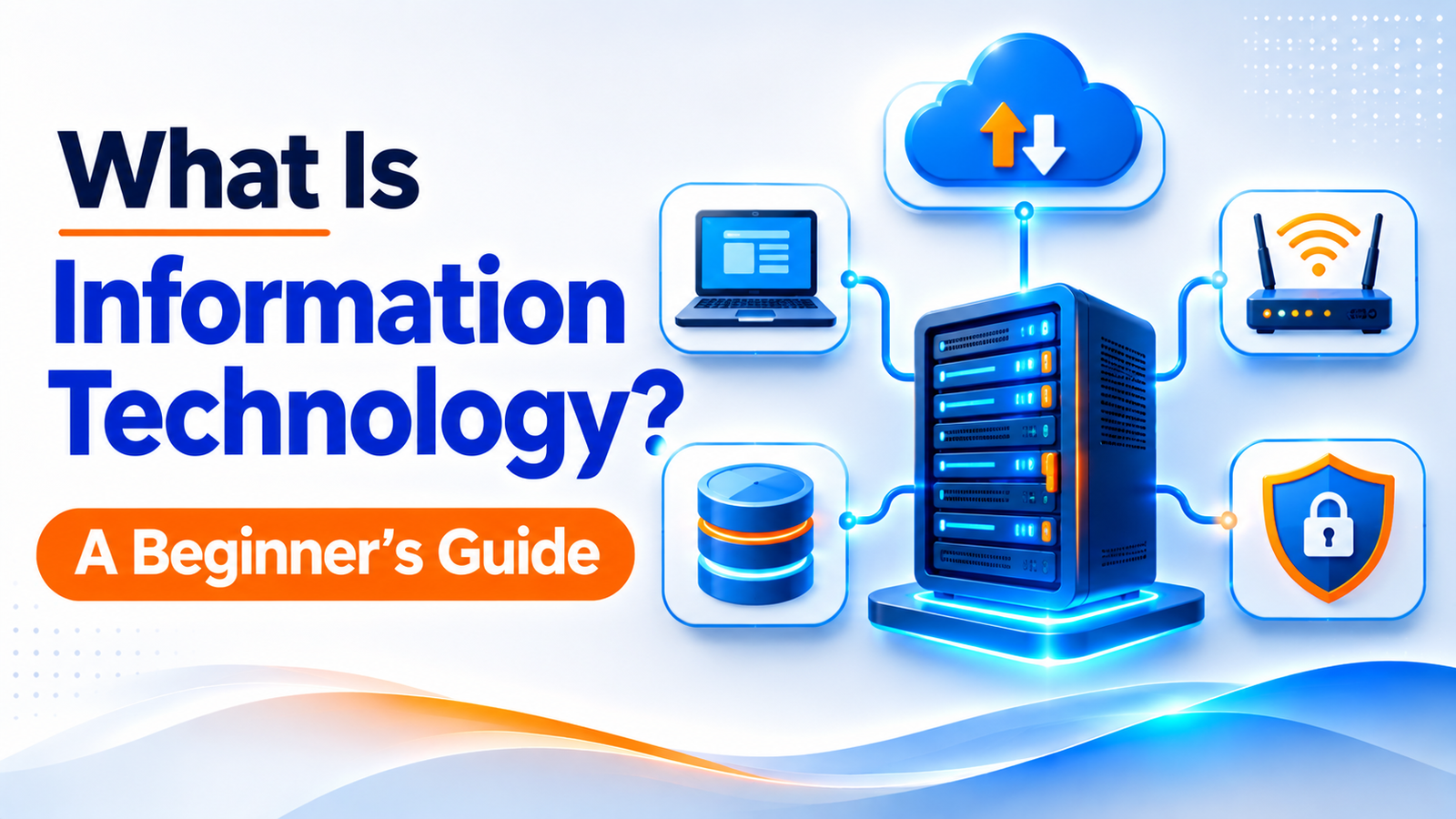
What Is Information Technology? A Beginner's Guide
Discover what Information Technology (IT) is, how it works, its main components, everyday applications, and how beginners can start learning IT.
Vyomanant Academy
Build these skills hands-on
Explore structured, practical technology programs from Vyomanant Academy.
Explore CoursesOn this page
Introduction
Imagine starting your day at work.
You:
- Turn on your computer to begin working.
- Connect to the internet to access websites and applications.
- Check your email to read important messages.
- Open a shared document to collaborate with colleagues.
- Join an online meeting to communicate with your team.
- Save your work so you can access it later.
All these activities depend on technology working together.
But have you ever wondered:
Who manages these systems, keeps them connected, protects information, and ensures everything works properly?
This is where Information Technology (IT) comes in.
Information Technology helps individuals and organizations use computers, software, networks, and digital systems to manage information and perform everyday tasks.
What Will You Learn?
In this beginner-friendly guide, you'll understand:
- What Information Technology is: The meaning of IT in simple words.
- Why IT is important: How technology supports everyday activities and businesses.
- Main components of IT: Hardware, software, networks, data, and security.
- How IT works: How different technologies work together.
- Common IT fields: Networking, cloud computing, cybersecurity, and more.
- IT career opportunities: Different roles available in the technology industry.
- Getting started: How beginners can begin learning IT.
You don't need previous technical knowledge to follow this guide.
1. What Is Information Technology (IT)?
Information Technology (IT) refers to the use and management of computers, software, networks, and digital systems to create, store, process, protect, and share information.
In simple words:
Information Technology is the technology that helps people and organizations manage information and use digital systems effectively.
IT includes much more than computers.
It also involves:
- Hardware: Physical devices such as computers, servers, and storage systems.
- Software: Programs and applications that perform tasks.
- Networks: Connections that allow devices to communicate.
- Data: Information stored and processed by digital systems.
- Security: Technologies and practices that protect systems and information.
- IT Services: Support, maintenance, and management of technology systems.
Simple Example: Sending an Email
Imagine sending an email to a colleague.
Several technologies work together:
- Your device: You write the message on a computer or smartphone.
- Email application: Software helps you compose and send the message.
- Network: The message travels through connected networks.
- Email servers: Systems process, route, and store the message.
- Recipient's device: Your colleague opens and reads the email.
IT professionals help organizations configure, manage, secure, and maintain the systems that support these activities.
Key Point: IT is not just about using computers. It is about making different technologies work together reliably and securely.
2. Why Is Information Technology Important?
Imagine a company with employees working from different locations around the world.
They need to:
- Communicate with colleagues.
- Access company applications.
- Share documents.
- Store business information.
- Attend virtual meetings.
- Protect confidential data.
Without reliable IT systems, these activities would become difficult.
How Does IT Help Organizations?
IT supports businesses in several ways.
- Communication: Enables email, messaging, and video meetings.
- Data Management: Helps store, organize, and retrieve information.
- Collaboration: Allows teams to work together from different locations.
- Automation: Reduces manual effort in repetitive processes.
- Security: Helps protect systems and sensitive information.
- Business Operations: Supports applications used for sales, finance, customer service, and other activities.
- Scalability: Helps organizations expand their technology resources as requirements grow.
Real-World Example: An Online Store
Imagine an online store receiving orders from customers around the world.
The business needs technology to:
- Display products on its website.
- Manage customer accounts.
- Process orders and payments.
- Track available inventory.
- Send order confirmations.
- Monitor application performance.
- Protect customer information.
IT systems support these activities behind the scenes.
Remember: Reliable IT helps organizations operate efficiently, communicate effectively, and provide digital services to customers.
3. What Are the Main Components of Information Technology?
Information Technology consists of several important components.
Let's understand each one using simple examples.
1. Hardware
Hardware refers to the physical devices used in computer systems.
Examples include:
- Computers: Desktops and laptops used for everyday work.
- Servers: Computers that provide applications, information, or services to other devices.
- Storage Devices: SSDs, hard drives, and other devices used to store data.
- Routers: Devices that connect different networks and direct network traffic.
- Switches: Devices that connect equipment within a local network.
- Printers and Scanners: Devices used to print and capture documents.
Example: When you use a laptop to open a website, your laptop is the hardware running the browser.
2. Software
Software refers to programs and instructions that tell computers what to do.
There are two common categories.
System Software
Helps operate and manage computer hardware.
Examples include:
- Windows.
- Linux.
- macOS.
Application Software
Helps users perform specific tasks.
Examples include:
- Web browsers.
- Email applications.
- Office applications.
- Video conferencing software.
Example: Your laptop is hardware, while the operating system and browser running on it are software.
3. Networking
Networking connects computers and other devices so they can communicate and share resources.
Common networking technologies include:
- LAN (Local Area Network): Connects devices within a limited area, such as an office.
- WAN (Wide Area Network): Connects networks across larger geographical areas.
- Wi-Fi: Allows compatible devices to connect wirelessly.
- Internet: A global network of interconnected networks.
Example: When multiple employees connect their computers to an office network, they can access shared systems and services.
4. Data and Storage
Data is information that computer systems store and process.
Examples include:
- Customer records.
- Business documents.
- Product information.
- Financial transactions.
- Application logs.
Organizations use different storage technologies to manage data.
Examples include:
- Local Storage: Information stored on a computer or directly connected device.
- Network Storage: Storage accessed through a network.
- Cloud Storage: Storage services accessed through network connections.
- Databases: Systems designed to organize and retrieve structured or other types of information.
Example: A business may store customer orders in a database so employees and applications can retrieve them when needed.
5. Cybersecurity
Cybersecurity focuses on protecting digital systems, networks, and information from threats.
Common security practices include:
- Authentication: Verifying a user's identity.
- Access Control: Limiting who can access information.
- Encryption: Protecting data by converting it into a form that requires a key to read.
- Software Updates: Fixing known vulnerabilities.
- Backups: Creating recoverable copies of important information.
- Monitoring: Identifying suspicious activity.
Example: Multi-factor authentication adds another verification step when someone signs in to an account.
6. IT Support and Services
IT support teams help users and organizations resolve technology problems.
Their responsibilities may include:
- Installing software.
- Configuring devices.
- Troubleshooting network connections.
- Managing user accounts.
- Resolving application issues.
- Maintaining computer systems.
Example: If an employee cannot connect to the company network, an IT support technician may investigate and resolve the problem.
Quick Comparison
| IT Component | Main Purpose | Example |
|---|---|---|
| Hardware | Provides physical computing equipment | Laptop, server |
| Software | Performs tasks and manages systems | Linux, web browser |
| Networking | Connects devices and systems | Router, Wi-Fi |
| Data and Storage | Stores and manages information | Database, SSD |
| Cybersecurity | Protects systems and information | Encryption, MFA |
| IT Support | Maintains systems and assists users | Help desk |
Key Point: These components work together to create and maintain useful IT services.
4. How Does Information Technology Work?
Let's understand how different IT components work together through a familiar activity.
Example: Opening a Website
Imagine you open a browser and visit an online learning website.
What happens behind the scenes?
Step 1: You Enter a Website Address
You type a website address into your browser.
For example:
https://example.com
The browser prepares to connect to the website.
Step 2: DNS Helps Find the Server
DNS (Domain Name System) helps translate a website's domain name into an IP address.
An IP address helps identify where network traffic should be sent.
Step 3: Your Device Connects to the Server
Your device sends a request through the network.
The request travels across network equipment and internet connections to reach the appropriate server.
Step 4: The Server Processes the Request
The server receives the request.
Depending on the website, it may:
- Retrieve website files.
- Run application code.
- Read information from a database.
- Prepare a response.
Step 5: The Website Appears
The server sends a response to your browser.
Your browser processes the received information and displays the webpage.
Simple Workflow
        Your Device
             |
             v
        Web Browser
             |
             v
       DNS Resolution
             |
             v
       Network / Internet
             |
             v
        Web Server
             |
             v
       Website Response
             |
             v
      Browser Displays Page
This is a simplified explanation. Real website communication may also involve caching, security checks, load balancers, and other systems.
Which IT Components Are Involved?
- Hardware: Your computer and the server.
- Software: Browser, operating system, and web application.
- Networking: The connections carrying requests and responses.
- Data: Information retrieved or processed by the application.
- Security: HTTPS and other protections that help secure communication.
Remember: IT systems work by combining multiple technologies rather than relying on a single device or application.
5. What Are the Different Fields of Information Technology?
IT is a broad industry with many specialized fields.
You do not need to learn every field at once.
1. IT Support
IT Support focuses on helping users and maintaining everyday technology.
Common responsibilities include:
- Troubleshooting computer problems.
- Installing and updating software.
- Managing user accounts.
- Supporting printers and other devices.
2. Networking
Networking focuses on connecting devices and ensuring reliable communication.
Common responsibilities include:
- Configuring routers and switches.
- Managing network connectivity.
- Troubleshooting communication problems.
- Monitoring network performance.
3. System Administration
System Administration focuses on managing computer systems and servers.
Common responsibilities include:
- Installing operating systems.
- Managing users and permissions.
- Maintaining servers.
- Monitoring system performance.
- Managing backups and updates.
4. Cloud Computing
Cloud Computing provides computing resources through services accessed over networks.
Cloud resources may include:
- Virtual servers.
- Storage.
- Databases.
- Networking.
- Application platforms.
Popular cloud providers include:
- Amazon Web Services (AWS).
- Microsoft Azure.
- Google Cloud.
5. Cybersecurity
Cybersecurity focuses on protecting digital systems and information.
Common responsibilities include:
- Monitoring security events.
- Managing access permissions.
- Identifying vulnerabilities.
- Investigating suspicious activity.
- Supporting security policies.
6. Software Development
Software Development involves creating and maintaining applications.
Developers may work on:
- Websites.
- Mobile applications.
- Business software.
- APIs.
- Backend services.
7. DevOps
DevOps combines development and operations practices to improve how software is built, tested, delivered, and maintained.
Common activities include:
- Automating software delivery.
- Managing infrastructure.
- Monitoring applications.
- Improving collaboration between teams.
8. Data and Database Management
This field focuses on organizing, storing, processing, and analyzing information.
Common responsibilities include:
- Managing databases.
- Maintaining data quality.
- Creating reports.
- Supporting data processing systems.
Quick Overview
| IT Field | Primary Focus |
|---|---|
| IT Support | Helping users solve technology problems |
| Networking | Connecting devices and systems |
| System Administration | Managing servers and operating systems |
| Cloud Computing | Managing cloud-based resources |
| Cybersecurity | Protecting digital systems |
| Software Development | Building applications |
| DevOps | Improving software delivery and operations |
| Data Management | Organizing and processing information |
6. How Is IT Used in Different Industries?
Information Technology is important in almost every modern industry.
Healthcare
IT helps healthcare organizations:
- Maintain electronic patient records.
- Manage appointment systems.
- Support communication between departments.
- Protect sensitive health information.
Example: A hospital uses an electronic records system to help authorized medical staff access patient information.
Education
IT supports schools, universities, and online learning platforms.
Examples include:
- Learning management systems.
- Virtual classrooms.
- Online examinations.
- Digital libraries.
- Student information systems.
Example: Students access course materials and submit assignments through an online learning platform.
Banking and Finance
IT supports financial services through:
- Online banking.
- Payment processing.
- Account management.
- Transaction records.
- Security monitoring.
Example: A banking application allows customers to view balances and transfer money securely.
Retail and E-Commerce
IT helps retailers manage:
- Online stores.
- Inventory.
- Customer accounts.
- Orders and payments.
- Delivery tracking.
Example: A retail company uses an inventory system to track available products across multiple warehouses.
Transportation and Logistics
IT supports:
- Shipment tracking.
- Route planning.
- Warehouse management.
- Scheduling.
- Fleet monitoring.
Example: A logistics company uses tracking systems to provide shipment updates to customers.
Key Point: Different industries use IT in different ways, but they all depend on reliable systems, secure information, and connected technologies.
7. What Is the Difference Between IT and Computer Science?
Information Technology and Computer Science are closely related, but they have different areas of emphasis.
Information Technology (IT)
IT focuses on using, managing, securing, and supporting technology systems.
Examples include:
- Managing servers.
- Configuring networks.
- Supporting employees.
- Maintaining cloud infrastructure.
- Securing organizational systems.
Computer Science (CS)
Computer Science focuses on the principles of computing and the design of computational systems.
Examples include:
- Algorithms.
- Data structures.
- Programming languages.
- Computing theory.
- Software and system design.
Quick Comparison
| Information Technology | Computer Science |
|---|---|
| Focuses heavily on applying and managing technology | Focuses heavily on computing principles and system design |
| Includes IT support, networking, and infrastructure | Includes algorithms, computation, and software design |
| Often emphasizes operating reliable systems | Often emphasizes understanding and creating computational solutions |
Important: These fields overlap. IT professionals may write code, and Computer Science graduates may work in infrastructure, cloud computing, or other IT roles.
8. What Are Some Common IT Career Roles?
The IT industry offers many career paths.
Here are several common roles.
IT Support Technician
Helps users resolve hardware, software, and connectivity problems.
Typical responsibilities include:
- Troubleshooting devices.
- Installing software.
- Managing user access.
- Resolving support requests.
Network Administrator
Helps manage an organization's network infrastructure.
Typical responsibilities include:
- Configuring network devices.
- Monitoring connectivity.
- Troubleshooting network problems.
- Supporting network security.
System Administrator
Manages servers, operating systems, and other infrastructure.
Typical responsibilities include:
- Maintaining Linux or Windows systems.
- Managing user permissions.
- Installing updates.
- Monitoring system health.
Cloud Engineer
Works with cloud-based infrastructure and services.
Typical responsibilities include:
- Configuring cloud resources.
- Managing virtual machines.
- Supporting cloud networking.
- Monitoring cloud environments.
Cybersecurity Analyst
Helps identify and respond to security risks.
Typical responsibilities include:
- Reviewing security alerts.
- Monitoring suspicious activity.
- Investigating incidents.
- Supporting security controls.
DevOps Engineer
Helps teams automate software delivery and infrastructure operations.
Typical responsibilities include:
- Building deployment pipelines.
- Managing automation tools.
- Supporting containers and cloud infrastructure.
- Monitoring applications.
Software Developer
Creates and maintains software applications.
Typical responsibilities include:
- Writing code.
- Testing applications.
- Fixing bugs.
- Building new features.
Beginner Tip: Job titles and responsibilities vary between organizations. Start by understanding the work involved rather than focusing only on job titles.
9. What Skills Are Important for an IT Career?
IT professionals use a combination of technical and non-technical skills.
Technical Skills
Some useful foundational skills include:
- Computer Fundamentals: Understanding hardware and operating systems.
- Networking Basics: Learning IP addresses, DNS, and connectivity.
- Operating Systems: Becoming familiar with Windows and Linux.
- Security Fundamentals: Understanding passwords, permissions, and safe computing.
- Troubleshooting: Identifying and resolving technical problems.
- Basic Scripting: Learning simple automation with Python, Bash, or PowerShell.
Non-Technical Skills
Important professional skills include:
- Problem-Solving: Investigating issues and identifying solutions.
- Communication: Explaining technical information clearly.
- Teamwork: Collaborating with colleagues.
- Documentation: Recording procedures and solutions.
- Continuous Learning: Keeping skills updated as technology changes.
Remember: A successful IT career requires both technical knowledge and the ability to solve real problems.
10. How Can Beginners Start Learning Information Technology?
You do not need an advanced technical background to begin learning IT.
Follow this practical learning path.
Step 1: Understand Computer Fundamentals
Start with:
- Computer hardware.
- Operating systems.
- Files and folders.
- Software installation.
- Basic troubleshooting.
Practice: Explore your computer's system settings and learn how to check available storage and memory.
Step 2: Learn Networking Basics
Understand:
- IP addresses.
- DNS.
- Routers and switches.
- LAN and WAN.
- Internet connectivity.
Practice: Learn how to check your device's IP address and test connectivity using basic networking commands.
Step 3: Explore Operating Systems
Become familiar with:
- Windows.
- Linux.
- File management.
- User accounts.
- Permissions.
- Basic command-line operations.
Practice: Try simple Linux commands in a safe learning environment.
Step 4: Learn Security Fundamentals
Explore:
- Strong passwords.
- Multi-factor authentication.
- Software updates.
- Data backups.
- Basic access controls.
Practice: Enable multi-factor authentication on a supported personal account.
Step 5: Understand Cloud Computing
Learn:
- What cloud computing means.
- What virtual machines are.
- How cloud storage works.
- Basic cloud networking concepts.
Practice: Explore beginner documentation and introductory cloud learning resources.
Step 6: Choose an IT Specialization
Once you understand the fundamentals, explore a field that interests you.
Possible paths include:
- IT Support.
- Networking.
- System Administration.
- Cloud Computing.
- Cybersecurity.
- Software Development.
- DevOps.
Step 7: Build Practical Experience
Try small projects such as:
- Installing Linux in a virtual machine.
- Creating a basic home network diagram.
- Hosting a simple website.
- Writing a basic automation script.
- Documenting a troubleshooting procedure.
Beginner Tip: Start with computer fundamentals and networking before moving into specialized infrastructure topics.
11. Common Misconceptions About Information Technology
Misconception 1: IT Is Only About Fixing Computers
IT includes much more than troubleshooting.
It also covers:
- Networking.
- Servers.
- Cloud infrastructure.
- Cybersecurity.
- Data management.
- Software and business systems.
Misconception 2: Every IT Job Requires Programming
Not every IT role requires advanced programming skills.
For example:
- Some IT support roles focus on troubleshooting.
- Network roles focus on connectivity and infrastructure.
- System administration roles focus on managing operating systems and servers.
However, basic scripting and automation skills can be valuable in many IT careers.
Misconception 3: You Must Learn Every Technology
IT is a broad industry.
You do not need to master every technology.
A better approach is to:
- Build strong fundamentals.
- Explore different fields.
- Choose a specialization.
- Develop practical skills.
Misconception 4: IT Professionals Only Work in Technology Companies
IT professionals work across many industries, including:
- Healthcare.
- Education.
- Banking.
- Retail.
- Manufacturing.
- Government.
- Transportation.
Key Point: IT skills are useful wherever organizations depend on digital systems.
12. Frequently Asked Questions (FAQs)
Q1. What is Information Technology in simple words?
Information Technology is the use and management of computers, software, networks, and digital systems to store, process, protect, and share information.
Q2. What are the main components of IT?
The main components include:
- Hardware.
- Software.
- Networking.
- Data and storage.
- Cybersecurity.
- IT services and support.
Q3. Is Information Technology a good field for beginners?
Yes. IT offers several entry points, including technical support, networking fundamentals, and junior infrastructure roles.
The best starting point depends on your interests and existing skills.
Q4. Do I need to learn coding to work in IT?
Not every IT role requires programming.
However, learning basic scripting can help with automation, troubleshooting, and career development.
Q5. What is the difference between IT and software development?
- IT: A broad field involving technology systems, infrastructure, support, security, and services.
- Software Development: Focuses on designing, building, testing, and maintaining applications.
Software development is closely related to IT and is often included within the broader technology industry.
Q6. Can I learn IT without a technical degree?
Yes. Many IT fundamentals can be learned through structured courses, documentation, hands-on labs, and practical projects.
Some employers and specialized roles may require particular qualifications, certifications, or experience.
13. Key Takeaways
Here are the most important points from this guide:
- Information Technology (IT) involves using and managing computers, software, networks, and digital systems.
- IT supports everyday activities such as email, websites, online meetings, and digital services.
- Hardware, software, networking, data, and security are important components of IT.
- IT professionals help organizations maintain reliable and secure technology systems.
- IT includes multiple career paths, such as networking, system administration, cloud computing, cybersecurity, and DevOps.
- Beginners can start with computer fundamentals, networking, operating systems, and basic security.
- Practical experience is an important part of developing IT skills.
14. What Should You Learn Next?
Now that you understand Information Technology, explore these foundational topics:
-
What Is Computer Hardware? A Beginner's Guide
- Learn about CPUs, memory, storage, and other physical computer components.
-
What Is an Operating System? Windows, Linux, and macOS Explained
- Understand how operating systems manage hardware and applications.
-
What Is Computer Networking? A Simple Beginner's Guide
- Learn how computers communicate through networks and the internet.
-
What Is Cloud Computing? A Beginner's Guide
- Discover how organizations use computing resources and services through the cloud.
These topics will help you build a stronger foundation before exploring advanced IT technologies.
Continue Learning with Vyomanant Academy
Information Technology is the foundation of many modern digital services and technical careers.
Vyomanant Academy helps learners develop practical knowledge in:
- IT Fundamentals.
- Computer Networking.
- Linux and System Administration.
- Cloud Computing.
- DevOps and Automation.
- Containers and Kubernetes.
- Artificial Intelligence and Machine Learning.
Whether you're starting your IT journey or exploring a new specialization, building strong fundamentals is an important first step.
Learn. Build. Grow.
CONTINUE EXPLORING
Recommended next
What Is Artificial Intelligence? A Simple Beginner's Guide
Learn what Artificial Intelligence (AI) means, how it works, and where we use it in everyday life, with simple examples that anyone can understand.
View resource
What Is Machine Learning? A Simple Beginner's Guide
Discover what Machine Learning is, how computers learn from data, and how predictions work. Explore key ML concepts, learning types, and real-world examples in this beginner-friendly guide.
View resource
What Is Cloud Computing? Explained with Examples
Learn what cloud computing is, how it works, and why businesses use it. Explore real-world examples, cloud service models, benefits, limitations, and beginner concepts.
View resource