
RESOURCES
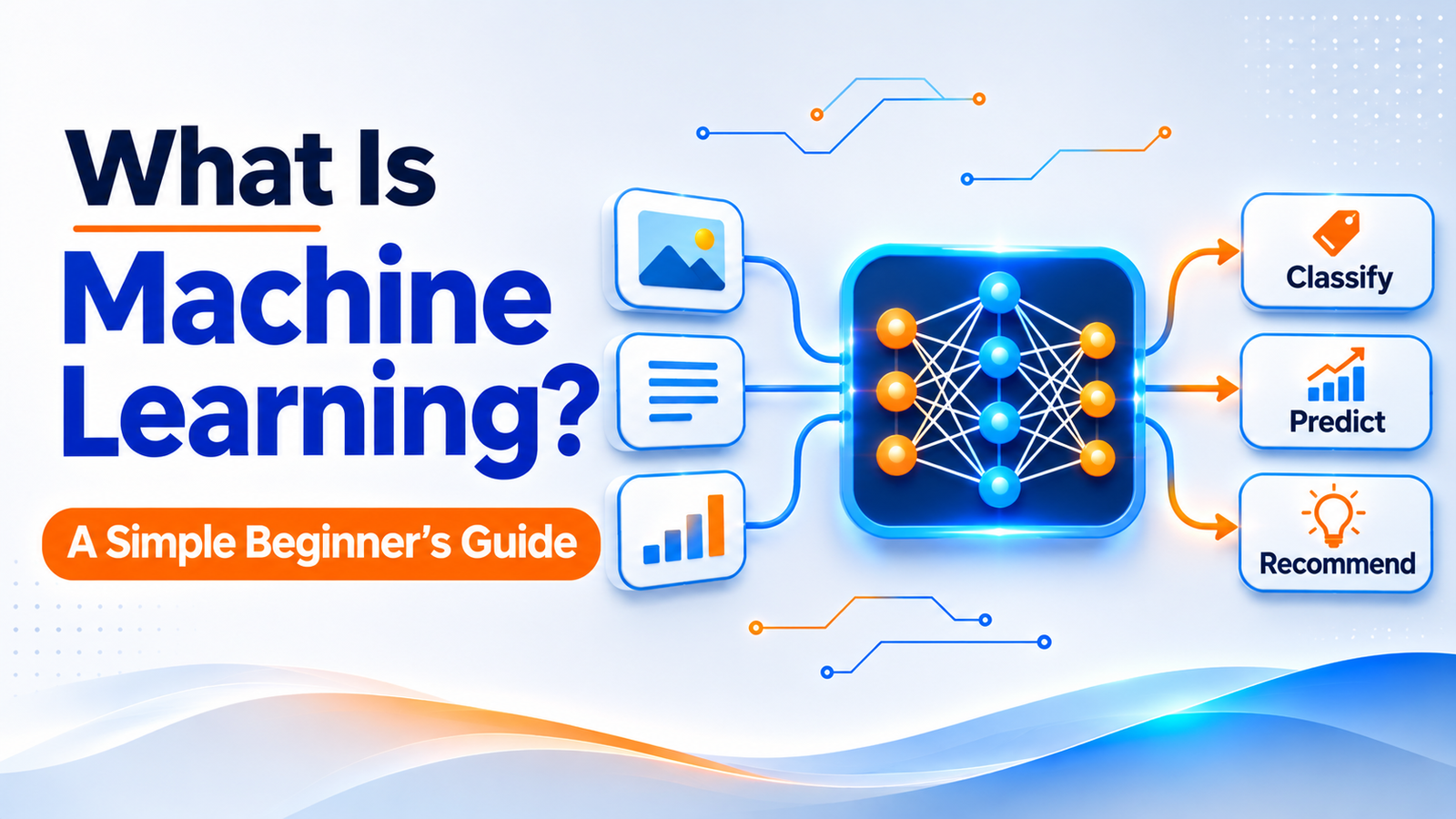
What Is Machine Learning? A Simple Beginner's Guide
Discover what Machine Learning is, how computers learn from data, and how predictions work. Explore key ML concepts, learning types, and real-world examples in this beginner-friendly guide.
Vyomanant Academy
Build these skills hands-on
Explore structured, practical technology programs from Vyomanant Academy.
Explore CoursesOn this page
Introduction
Imagine you want to buy a house.
You find a property with:
- Size: 1,500 square feet (about 139 square meters).
- Bedrooms: 3.
- Age: 5 years.
- Location: A residential neighborhood.
But you have an important question:
How much should this house cost?
You could compare the prices of similar houses manually.
But imagine having information about thousands of houses sold in the past.
A computer could analyze those records, identify patterns, and estimate the price of another house.
This is one example of Machine Learning (ML).
Machine Learning helps computers learn patterns from data and use those patterns to make predictions.
What Will You Learn?
In this guide, you'll understand:
- What Machine Learning is: How computers learn from data.
- How ML works: The process of training and testing a model.
- Important ML terms: Datasets, features, labels, and models.
- Types of Machine Learning: The three main learning approaches.
- Real-world applications: How different industries use ML.
- Getting started: How to begin your Machine Learning journey.
You don't need previous programming or Machine Learning experience to follow this guide.
1. What Is Machine Learning (ML)?
Machine Learning (ML) is a branch of Artificial Intelligence (AI) that enables computers to learn patterns from data and use those patterns to make predictions or decisions.
In simple words:
Machine Learning teaches computers to learn from examples instead of requiring programmers to write every rule manually.
Let's Understand with an Example
Imagine a company wants to predict how many products it might sell next month.
It has historical information about:
- Previous sales: How many products were sold.
- Product prices: How much customers paid.
- Seasonal demand: When sales increased or decreased.
- Promotions: Whether discounts influenced sales.
A Machine Learning model can analyze these records and estimate future demand.
The company can use these predictions to support inventory planning.
What Makes Machine Learning Different?
In traditional programming, developers explicitly write rules that tell computers what to do.
With Machine Learning, developers provide data and a learning method that allows the system to identify useful patterns.
For example:
- Traditional programming: A developer writes a fixed rule to calculate a discount.
- Machine Learning: A model learns from past sales data to estimate how demand may change.
Key Point: Machine Learning is useful when patterns are difficult to describe using simple, fixed rules.
2. Understanding Machine Learning Through House Price Prediction
Let's return to our house-buying example.
Imagine you have information about five houses that were recently sold.
| House Size | Bedrooms | House Age | Selling Price |
|---|---|---|---|
| 800 sq. ft. | 2 | 12 years | $160,000 |
| 1,000 sq. ft. | 2 | 8 years | $200,000 |
| 1,200 sq. ft. | 3 | 6 years | $245,000 |
| 1,500 sq. ft. | 3 | 5 years | $310,000 |
| 1,800 sq. ft. | 4 | 3 years | $380,000 |
Note: These are fictional prices used only for learning. Actual property prices vary significantly by location, market conditions, and other factors.
What Can We Learn from This Data?
Looking at the table, we might notice:
- House size: Larger houses often have higher prices.
- Bedrooms: The number of bedrooms may influence value.
- House age: Newer houses may sometimes sell for more.
- Location: Properties in different neighborhoods may have very different prices.
A Machine Learning model can analyze these relationships using many more examples.
Making a Prediction
Imagine a new house has:
- Size: 1,400 sq. ft.
- Bedrooms: 3.
- Age: 4 years.
- Location: The same general market as the training examples.
A trained model could estimate its selling price based on patterns in the historical data.
For illustration, it might predict $290,000.
This is only a hypothetical prediction, not a price calculated from the five records above.
What Is Happening Behind the Scenes?
The model:
- Examines historical house information.
- Learns relationships between property details and prices.
- Applies those learned relationships to a new house.
- Produces an estimated price.
Remember: A prediction is an estimate, not a guaranteed result. Real-world property valuation requires more representative data and careful testing.
3. Important Machine Learning Terms Every Beginner Should Know
Before learning how ML works, let's understand a few important terms.
1. Dataset
A dataset is a collection of information used for analysis or Machine Learning.
For example, a house price dataset may contain:
- House sizes.
- Number of bedrooms.
- Property locations.
- House ages.
- Selling prices.
Datasets are commonly stored in tables, spreadsheets, databases, or other file formats.
2. Features
Features are the pieces of information a model uses to make predictions.
In our house price example, features include:
- House size.
- Number of bedrooms.
- House age.
- Location.
These are the inputs provided to the model.
3. Label or Target
A label or target is the correct answer or value that a supervised learning model is trained to predict.
For our example:
- Features: House size, bedrooms, age, and location.
- Target: Selling price.
4. Model
A Machine Learning model is a system that uses learned patterns to produce predictions or other outputs.
After training, the model can process new information.
For example, it may estimate the selling price of a house that was not included in its training data.
5. Training
Training is the process of helping a model learn patterns from data.
During training:
- The model receives examples.
- It makes predictions.
- A learning algorithm measures prediction errors or another learning objective.
- The algorithm adjusts the model to improve its performance.
6. Prediction
A prediction is an output produced by a trained model.
Examples include:
- An estimated house price.
- Expected product demand.
- A predicted delivery time.
- The probability of equipment failure.
Quick Reference
| Term | Simple Meaning |
|---|---|
| Dataset | A collection of information |
| Feature | Information used as input |
| Label / Target | The answer or value to predict |
| Model | A system that uses learned patterns |
| Training | The process of learning from data |
| Prediction | An estimated result from the model |
Beginner Tip: Understanding these six terms will make future Machine Learning topics much easier.
4. How Does Machine Learning Work?
Now that you understand the basic terms, let's explore the process step by step.
We'll continue using house price prediction.
Step 1: Collect Data
First, collect historical house sale records.
Useful information might include:
- Property size.
- Number of bedrooms.
- Property age.
- Neighborhood.
- Actual selling price.
The goal is to collect enough relevant examples to identify meaningful patterns.
Step 2: Prepare the Data
Real-world data is rarely perfect.
Some records may contain:
- Missing values: A house has no recorded age.
- Incorrect information: A property size was entered incorrectly.
- Duplicate records: The same sale appears multiple times.
- Inconsistent units: Some properties use square feet while others use square meters.
Data preparation helps make the information more reliable.
Step 3: Split the Data
Before training, developers commonly divide the dataset into separate parts.
For example:
- Training data: Used to help the model learn.
- Testing data: Used to evaluate the model on unseen examples.
Some projects also use a separate validation dataset to help choose and improve the model before final testing.
Step 4: Train the Model
Next, a Machine Learning algorithm learns relationships between the features and selling prices.
For example, it may learn how property size, age, and location relate to price.
The model adjusts its parameters to reduce prediction errors.
Step 5: Evaluate the Model
After training, we test the model using examples it has not seen before.
We check:
- Prediction quality: How close estimates are to actual prices.
- Consistency: Whether predictions work across different types of houses.
- Errors: Whether the model makes unusually large mistakes.
Step 6: Make Predictions
Once the model performs well enough for its intended purpose, it can process new property information.
For example:
- Input: Size, bedrooms, age, and location.
- Output: Estimated selling price.
Simple Machine Learning Workflow
      Collect Data
           |
           v
      Prepare Data
           |
           v
       Split Data
           |
           v
      Train Model
           |
           v
     Evaluate Model
           |
           v
     Make Predictions
Key Point: Machine Learning involves more than training a model. Good data preparation and reliable evaluation are equally important.
5. What Are the Main Types of Machine Learning?
There are three major learning approaches that beginners should understand.
1. Supervised Learning
Supervised Learning uses examples that include the correct answers.
The model learns the relationship between inputs and their expected outputs.
Example: Predicting House Prices
The model receives:
- Input: House size, bedrooms, age, and location.
- Correct answer: Actual selling price.
After learning from historical examples, it can estimate prices for new houses.
Common Applications
- Price prediction: Estimating property or product prices.
- Demand forecasting: Predicting future sales.
- Quality inspection: Classifying products as defective or acceptable.
- Delivery estimation: Predicting delivery times.
2. Unsupervised Learning
Unsupervised Learning finds patterns or structures in data without predefined correct answers for those patterns.
Example: Grouping Customers
Imagine a retailer wants to understand its customers better.
It has information about:
- Purchase frequency.
- Average spending.
- Product categories purchased.
- Shopping behavior.
An unsupervised learning algorithm may identify groups of customers with similar behavior.
For example:
- Group A: Customers who shop frequently.
- Group B: Customers who mainly purchase during promotions.
- Group C: Customers who make occasional high-value purchases.
These groups are discovered from the data rather than supplied as predefined answers.
Common Applications
- Customer segmentation: Finding groups with similar behavior.
- Document grouping: Organizing similar documents.
- Pattern discovery: Identifying hidden relationships in data.
3. Reinforcement Learning
Reinforcement Learning involves learning through actions and rewards.
An agent interacts with an environment and learns which actions lead to better results.
Example: A Robot Learning to Navigate
Imagine a robot learning to move through a simple environment.
The robot:
- Observes its surroundings.
- Chooses a direction.
- Moves through the environment.
- Receives feedback based on its actions.
- Learns strategies that lead to better rewards.
Over many interactions, it may improve its navigation strategy.
Common Applications
- Robotics research: Learning movement and control strategies.
- Game-playing systems: Learning effective strategies.
- Optimization: Improving decisions in certain complex environments.
Quick Comparison
| Learning Type | How It Learns | Example |
|---|---|---|
| Supervised | From examples with correct answers | House price prediction |
| Unsupervised | By finding patterns without predefined labels | Customer grouping |
| Reinforcement | Through actions and rewards | Robot navigation |
Remember: These approaches solve different kinds of problems. The best approach depends on the available data and the task.
6. Two Common Machine Learning Tasks: Regression and Classification
In Supervised Learning, two important tasks are Regression and Classification.
Regression
Regression predicts a numerical value.
Examples include:
- House prices: Predicting the selling price of a property.
- Sales: Estimating next month's revenue.
- Energy consumption: Predicting electricity usage.
- Delivery times: Estimating how long a shipment may take.
For example:
Input:
House Size = 1,500 sq. ft.
Bedrooms   = 3
House Age  = 5 years

Output:
Estimated Price = $310,000
The output is illustrative, not a calculated prediction.
Classification
Classification predicts a category or class.
Examples include:
- Product inspection: Defective or acceptable.
- Customer feedback: Positive, neutral, or negative.
- Document processing: Invoice, receipt, or contract.
- Image analysis: Identifying an object category.
For example:
Input:
Product Image

Output:
Category = Defective
Regression vs Classification
| Regression | Classification |
|---|---|
| Predicts numerical values | Predicts categories |
| Example: House price | Example: Product quality |
| Output: $250,000 | Output: Defective |
Easy Way to Remember:
- Regression: How much or how many?
- Classification: Which category?
7. Where Is Machine Learning Used in the Real World?
Machine Learning supports many industries around the world.
Let's explore a few examples beyond the applications already introduced in our Artificial Intelligence guide.
1. Manufacturing
Manufacturers use ML to help improve production processes.
ML can assist with:
- Predictive maintenance: Estimating when equipment may need attention.
- Quality inspection: Identifying possible product defects.
- Production forecasting: Estimating future manufacturing demand.
Example: A factory analyzes machine temperature and vibration data to predict possible equipment failures.
2. Agriculture
ML can help farmers and agricultural researchers analyze information about crops and growing conditions.
Applications include:
- Crop monitoring: Identifying possible crop health problems.
- Yield prediction: Estimating future harvest quantities.
- Resource planning: Supporting decisions about water and other resources.
Example: An agricultural system analyzes weather and historical crop data to estimate expected harvest yields.
3. Logistics and Supply Chains
Logistics companies use ML to improve planning and forecasting.
Applications include:
- Delivery forecasting: Estimating arrival times.
- Demand prediction: Anticipating shipping requirements.
- Inventory planning: Estimating stock requirements.
Example: A warehouse uses historical order data to predict how much inventory it may need next month.
4. Education
Educational platforms can use ML to analyze learning patterns.
Applications include:
- Learning recommendations: Suggesting suitable practice material.
- Performance analysis: Identifying areas where students may need support.
- Personalized practice: Adjusting exercises based on learner progress.
Example: A learning platform recommends additional practice questions when a student struggles with a particular topic.
5. Energy and Utilities
ML can help organizations understand energy consumption patterns.
Applications include:
- Demand forecasting: Estimating future electricity usage.
- Equipment monitoring: Detecting unusual operating conditions.
- Resource planning: Supporting energy distribution decisions.
Example: An electricity provider analyzes historical consumption and weather information to forecast demand.
Key Point: Machine Learning is valuable wherever historical data can help organizations identify patterns and make better predictions.
8. How Is Machine Learning Used in IT Operations?
Machine Learning also plays an important role in modern IT environments.
Application Performance Monitoring
ML can help operations teams:
- Learn typical application performance patterns.
- Identify unusual response times.
- Detect unexpected changes in traffic.
- Support incident investigation.
Cloud Resource Planning
ML can help cloud teams:
- Analyze historical resource usage.
- Forecast computing demand.
- Identify unusual consumption patterns.
- Support capacity planning.
Software Quality
ML-based tools can assist software teams by:
- Analyzing patterns in test results.
- Identifying potentially risky changes.
- Prioritizing areas for additional testing.
Practical Example: Predicting Server Resource Demand
Imagine a website experiences different traffic levels throughout the week.
The operations team collects:
- Daily visitor counts.
- CPU utilization.
- Memory consumption.
- Request volumes.
- Historical peak traffic periods.
A Machine Learning model may learn patterns in this data and predict future resource requirements.
The team can use these predictions to plan infrastructure capacity.
Remember: ML predictions support operational planning, but monitoring and engineering judgment remain important.
9. What Are the Limitations of Machine Learning?
Machine Learning can be useful, but it is not perfect.
1. Poor Data Quality
Incorrect or incomplete data can lead to unreliable predictions.
Example: A house price model trained on incorrect selling prices may produce poor estimates.
2. Overfitting
Overfitting happens when a model learns its training examples too closely and struggles with new data.
For example:
- The model performs very well on training records.
- It performs poorly on houses it has never seen.
3. Underfitting
Underfitting happens when a model is too simple or insufficiently trained to learn important patterns.
For example:
- The model fails to capture useful relationships.
- It makes poor predictions even on training examples.
4. Changing Data
Real-world patterns can change.
For example:
- Property markets change.
- Customer preferences change.
- Product demand changes.
A model trained on older data may become less reliable over time.
5. Bias and Fairness
Training data may contain historical biases or fail to represent important groups and situations.
This can lead to unfair or unreliable outcomes.
How Can Developers Improve ML Models?
Common practices include:
- Improve data quality: Check for incorrect and missing values.
- Use representative examples: Ensure training data reflects relevant real-world conditions.
- Evaluate carefully: Test models on appropriate unseen data.
- Monitor performance: Check whether predictions remain reliable.
- Update when needed: Retrain or improve models as requirements change.
Key Point: Building a reliable Machine Learning system requires careful data preparation, testing, and ongoing monitoring.
10. How Can Beginners Start Learning Machine Learning?
A good learning path moves from basic concepts to small practical projects.
Step 1: Understand ML Fundamentals
Start with:
- Datasets.
- Features and labels.
- Training and testing.
- Regression and classification.
- Basic model evaluation.
Step 2: Learn Python Basics
Python is one of the most widely used programming languages for Machine Learning.
Focus on:
- Variables: Store information.
- Lists: Work with collections of values.
- Conditions: Make decisions in code.
- Loops: Repeat operations.
- Functions: Organize reusable code.
Step 3: Learn to Work with Data
Explore how to:
- Read CSV files.
- Understand rows and columns.
- Identify missing values.
- Calculate averages.
- Create simple charts.
Step 4: Explore ML Libraries
Common Python libraries include:
- NumPy: Numerical calculations.
- pandas: Working with structured data.
- Matplotlib: Creating charts.
- scikit-learn: Building and evaluating common ML models.
Step 5: Build Your First ML Project
A simple beginner project is House Price Prediction.
You can:
- Find a suitable sample housing dataset.
- Explore the available features.
- Prepare the data.
- Split it into training and testing sets.
- Train a simple regression model.
- Evaluate prediction errors.
- Try predictions on new examples.
Step 6: Explore More Advanced Topics
After completing a few beginner projects, continue with:
- Feature engineering.
- Model evaluation metrics.
- Decision trees.
- Neural networks.
- Deep Learning.
Beginner Tip: Focus on understanding how each part of a Machine Learning project works before moving to advanced algorithms.
11. Frequently Asked Questions (FAQs)
Q1. What is Machine Learning in simple words?
Machine Learning is a method of building computer systems that learn patterns from data and use those patterns to make predictions or decisions.
Q2. What is the difference between AI and Machine Learning?
- Artificial Intelligence: The broad field of building systems that perform intelligent tasks.
- Machine Learning: A branch of AI that learns patterns from data.
Machine Learning is one approach used to develop AI systems.
Q3. What is a Machine Learning model?
A Machine Learning model is a system that uses patterns learned during training to process new inputs and produce predictions or other outputs.
Q4. What is the difference between training and testing?
- Training: The model learns patterns from examples.
- Testing: The model is evaluated using separate examples it has not seen during training.
Q5. Is Python required to learn Machine Learning?
Python is not required to understand ML concepts, but it is a popular choice for building practical Machine Learning projects.
Q6. Can beginners learn Machine Learning without advanced mathematics?
Yes. Beginners can start with basic concepts and simple projects.
As you progress, knowledge of statistics, probability, linear algebra, and other mathematical topics becomes increasingly useful.
12. Key Takeaways
Here are the most important concepts from this guide:
- Machine Learning (ML) is a branch of AI that learns patterns from data.
- Datasets contain information used for training and evaluating models.
- Features are inputs, while labels or targets are the expected outputs in supervised learning.
- Training helps models learn, while testing measures performance on unseen examples.
- Supervised, Unsupervised, and Reinforcement Learning are three important ML approaches.
- Regression predicts numerical values, while Classification predicts categories.
- ML is used globally in manufacturing, agriculture, logistics, education, energy, and IT.
- Reliable ML requires good data, appropriate evaluation, and ongoing monitoring.
13. What Should You Learn Next?
Now that you understand Machine Learning fundamentals, continue with these topics:
-
What Is Deep Learning? Understanding Neural Networks
- Discover how neural networks learn complex patterns from data.
-
Supervised vs Unsupervised Learning: A Beginner's Guide
- Explore two important learning approaches with practical examples.
-
What Is a Machine Learning Model? Training, Testing, and Predictions Explained
- Understand the core building blocks of a practical ML system.
Continue Learning with Vyomanant Academy
Machine Learning is an important technology for understanding modern data-driven applications and intelligent systems.
Vyomanant Academy helps learners build practical knowledge in:
- Artificial Intelligence and Machine Learning.
- Cloud Computing.
- DevOps and Automation.
- Containers and Kubernetes.
- Modern IT Technologies.
Learn. Build. Grow.
CONTINUE EXPLORING
Recommended next
What Is Artificial Intelligence? A Simple Beginner's Guide
Learn what Artificial Intelligence (AI) means, how it works, and where we use it in everyday life, with simple examples that anyone can understand.
View resource
What Is Information Technology? A Beginner's Guide
Discover what Information Technology (IT) is, how it works, its main components, everyday applications, and how beginners can start learning IT.
View resource
What Is Cloud Computing? Explained with Examples
Learn what cloud computing is, how it works, and why businesses use it. Explore real-world examples, cloud service models, benefits, limitations, and beginner concepts.
View resource