
RESOURCES
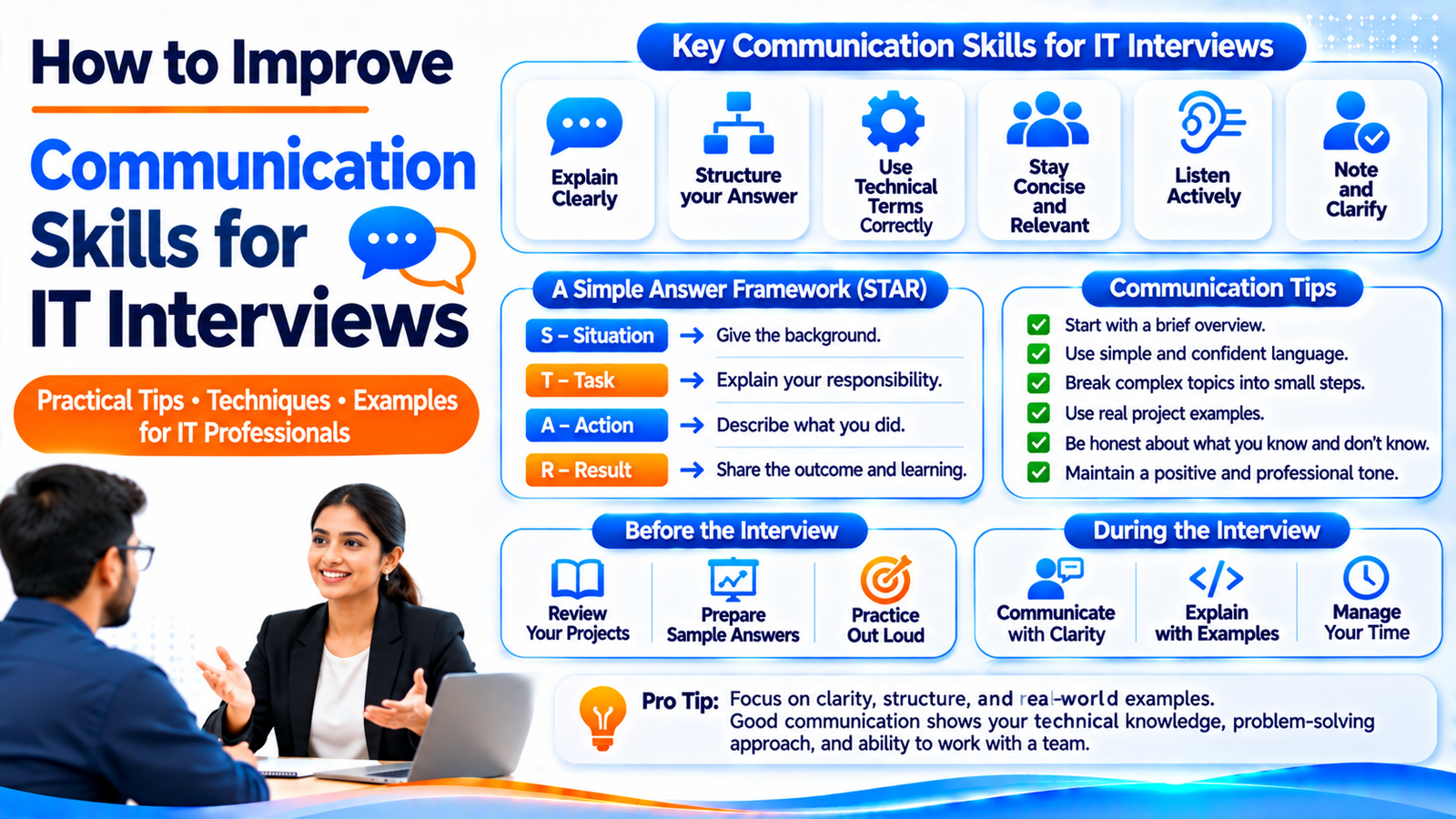
How to Improve Communication Skills for IT Interviews: Practical Tips, Examples & Interview Preparation Guide
Learn how to improve communication skills for IT interviews with practical speaking techniques, technical explanations, HR answers, mock interviews, and confidence-building exercises.
Vyomanant Academy
Build these skills hands-on
Explore structured, practical technology programs from Vyomanant Academy.
Explore CoursesOn this page
How to Improve Communication Skills for IT Interviews: A Practical Beginner's Guide
Introduction
Imagine preparing for a software developer, DevOps engineer, cloud engineer, technical support, or cybersecurity interview.
You understand the technical concepts. You have completed projects and practiced interview questions.
But when the interviewer asks you to explain something, you struggle to organize your thoughts.
You may speak too quickly, forget important points, use too many technical terms, or become nervous.
This is a common challenge for people preparing for IT interviews.
Technical knowledge helps you answer questions. Communication skills help you explain that knowledge clearly.
The good news is that effective interview communication can be developed through structured practice.
In this guide, you will learn:
- What communication skills mean in IT interviews.
- How to explain technical concepts clearly.
- How to introduce yourself professionally.
- How to describe IT projects with confidence.
- How to answer questions when you do not know something.
- How to improve speaking, listening, and body language.
- How to practice through mock interviews.
- How to build a practical 14-day improvement routine.
Whether you are a student, fresher, career changer, or experienced IT professional, these techniques can help you communicate more effectively.
1. Why Are Communication Skills Important in IT Interviews?
IT professionals do more than write code or manage systems.
They also communicate with:
- Team members.
- Project managers.
- Clients.
- Technical leads.
- Support teams.
- Security teams.
- Business stakeholders.
During interviews, employers may assess whether you can explain ideas, listen carefully, collaborate, and solve problems through discussion.
Technical Knowledge vs Communication Skills
| Technical Knowledge | Communication Skills |
|---|---|
| Understanding programming concepts | Explaining programming concepts |
| Knowing cloud architecture | Describing how cloud services work |
| Building a project | Presenting the project's purpose and design |
| Troubleshooting an error | Explaining the investigation and solution |
| Understanding tools | Discussing when and why to use them |
For example, a candidate may understand Docker but struggle to answer:
"What is Docker, and why did you use it in your project?"
A strong response should explain the concept, its purpose, and a relevant example without becoming unnecessarily complicated.
Important Point
You do not need a perfect accent or advanced vocabulary to communicate well.
Clarity, relevance, listening, and logical thinking matter more than sounding impressive.
2. What Communication Skills Do IT Interviewers Evaluate?
Communication involves several related abilities.
| Skill | What It Demonstrates |
|---|---|
| Verbal Communication | Explaining ideas clearly |
| Active Listening | Understanding the actual question |
| Structured Thinking | Organizing answers logically |
| Technical Explanation | Making complex topics understandable |
| Professional Language | Speaking respectfully and appropriately |
| Confidence | Communicating calmly and directly |
| Adaptability | Adjusting explanations to the audience |
| Nonverbal Communication | Showing attention through posture and expression |
Interviewers may also evaluate how you ask clarifying questions and respond to feedback.
Example
Interviewer: "How would you troubleshoot a website that is not loading?"
A weak response:
"I will check the server and fix the problem."
A stronger response:
"I would first confirm whether the issue affects one user or multiple users. Then I would check DNS resolution, network connectivity, the web server, application logs, and recent deployments. Once I identify the cause, I would apply a suitable fix and verify that the website works."
The second answer demonstrates a logical investigation process.
3. Use the PREP Method to Structure Technical Answers
One of the simplest ways to improve communication is to use a repeatable answer structure.
The PREP method stands for:
- P — Point: Give the direct answer.
- R — Reason: Explain why it matters.
- E — Example: Provide a relevant example.
- P — Point: Conclude with the main takeaway.
Example: What Is Cloud Computing?
Point:
"Cloud computing allows users to access computing resources such as servers, storage, and databases over a network, typically through a cloud provider."
Reason:
"It helps organizations provision resources without purchasing and maintaining all the physical infrastructure themselves."
Example:
"For example, a company can deploy a web application using AWS or Azure instead of buying its own servers."
Point:
"So cloud computing provides flexible access to computing resources, with costs and responsibilities depending on the service model."
When Should You Use PREP?
PREP works well for questions such as:
- What is Docker?
- What is Kubernetes?
- What is a CI/CD pipeline?
- Why is Linux used in DevOps?
- What is the difference between SQL and NoSQL?
- Why is monitoring important?
Communication Tip
Begin with a direct answer before adding details.
Avoid giving a long background explanation before addressing the question.
4. How to Introduce Yourself in an IT Interview
"Tell me about yourself" is one of the most common interview questions.
Your introduction should summarize your professional background and connect it to the role.
Recommended Structure
Professional Introduction
          |
          v
Education or Background
          |
          v
Relevant Technical Skills
          |
          v
Projects or Experience
          |
          v
Career Interest
Example for a Fresher
"Hello, I'm a recent computer science graduate with an interest in cloud computing and DevOps.
I have been learning Linux, Git, Docker, AWS, and CI/CD fundamentals.
As part of my learning, I built a project where I containerized a sample web application using Docker and automated its build process using GitHub Actions.
This helped me understand application packaging, version control, and deployment automation.
I'm looking for an entry-level opportunity where I can apply these skills, learn from experienced engineers, and contribute to real projects."
Example for an Experienced Professional
"I'm a software engineer with experience developing backend applications and supporting their deployment.
My work has involved Java, REST APIs, SQL databases, Git, and CI/CD workflows.
In one project, I helped improve the release process by automating build and test steps, reducing repetitive manual work.
I'm now interested in a role where I can contribute to application development while expanding my cloud and automation skills."
Common Mistakes
- Reciting your entire resume.
- Sharing unrelated personal information.
- Listing tools without context.
- Memorizing a script so rigidly that it sounds unnatural.
- Making claims you cannot explain.
Recommended Duration
Aim for approximately 60–90 seconds for a standard self-introduction, adjusting to the interviewer's expectations.
5. How to Explain Technical Concepts in Simple Language
Technical interviews often require you to explain complicated topics clearly.
The goal is not to use the maximum number of technical terms.
The goal is to demonstrate understanding.
Use the Three-Level Explanation Method
Explain a concept at three levels:
- Simple definition: What is it?
- Technical explanation: How does it work?
- Practical example: Where is it used?
Example: Explain Docker
Level 1 — Simple Definition
"Docker is a platform used to build, package, and run applications in containers."
Level 2 — Technical Explanation
"A Docker image packages the application and its required runtime components. A container runs that image using operating-system-level isolation."
Level 3 — Practical Example
"In a project, I can package a Python application into a Docker image and run it consistently across development and testing environments, provided the target environment supports the image."
Another Example: Explain a CI/CD Pipeline
"CI/CD is a set of practices that helps teams integrate code changes, test them automatically, and prepare or deliver software releases.
For example, when a developer pushes code to GitHub, a pipeline can build the application, run tests, scan the code, and deploy an approved version."
Avoid Unnecessary Jargon
Instead of:
"We leveraged orchestration capabilities to operationalize deployment workflows."
Say:
"We used Kubernetes to manage application containers and automate deployment and recovery tasks."
Clear language demonstrates understanding. Complicated language does not automatically demonstrate expertise.
6. How to Explain an IT Project Confidently
Project explanation is one of the most important communication skills for technical interviews.
You should explain not only what tools you used but also why you used them.
Use the PROJECT Framework
| Step | Question to Answer |
|---|---|
| P — Purpose | What problem did the project solve? |
| R — Requirements | What did the system need to do? |
| O — Overview | What was the architecture? |
| J — Job | What was your responsibility? |
| E — Execution | How did you implement it? |
| C — Challenges | What problems did you face? |
| T — Takeaways | What were the results and lessons? |
Example: DevOps CI/CD Project
Purpose:
"The project aimed to automate the build and deployment process for a web application."
Requirements:
"We needed automated testing, container packaging, and a repeatable deployment workflow."
Overview:
"The architecture used GitHub for source control, Jenkins for CI/CD, Docker for containerization, and a Linux server for deployment."
Job:
"My responsibility was to configure the Jenkins pipeline and Docker build process."
Execution:
"I created a Jenkinsfile that checked out the code, ran tests, built the Docker image, and deployed it to the target server."
Challenges:
"During testing, the deployment failed because the application port was configured incorrectly. I reviewed the container logs, corrected the configuration, and tested the deployment again."
Takeaways:
"The project helped me understand pipeline automation, container troubleshooting, and deployment verification."
This is an illustrative answer. Adapt it to work you actually performed.
Interview Tip
Prepare two versions of each project explanation:
- Short version: Approximately 60–90 seconds.
- Detailed version: Approximately 3–5 minutes, depending on the question.
Start with the short version and expand when the interviewer asks for details.
7. Use the STAR Method for Behavioral Interview Questions
Technical interviews may include questions about teamwork, challenges, deadlines, and problem-solving.
The STAR method helps organize these answers.
STAR Framework
- S — Situation: Describe the context.
- T — Task: Explain your responsibility.
- A — Action: Describe what you did.
- R — Result: Explain the outcome.
Example: Tell Me About a Challenge You Faced
Situation:
"During a team project, our application failed during a scheduled demonstration."
Task:
"I was responsible for investigating the deployment issue."
Action:
"I reviewed the application logs, checked the environment variables, and discovered that a required database configuration was missing. I corrected the configuration and verified connectivity."
Result:
"The application started successfully, and we completed the demonstration after resolving the issue."
Why Does STAR Work?
It helps you avoid vague answers.
Instead of saying, "I'm good at solving problems," you demonstrate how you approached one.
Questions Where STAR Is Useful
- Tell me about a difficult problem you solved.
- Describe a time you worked in a team.
- How did you handle a disagreement?
- Tell me about a mistake you made.
- How do you manage competing priorities?
Use real examples wherever possible.
8. What to Say When You Don't Know an Answer
Many candidates become nervous when they encounter unfamiliar technical questions.
But interviews do not require you to know everything.
A good response should be honest and constructive.
Example 1: You Know Part of the Answer
Interviewer: "How does Kubernetes scheduling work?"
Response:
"I understand that the Kubernetes scheduler assigns unscheduled Pods to suitable nodes based on factors such as resource requirements and scheduling constraints. I haven't explored the full scheduling process in depth yet."
Example 2: You Have Not Used a Tool
Interviewer: "Have you worked with Terraform Cloud?"
Response:
"I haven't used Terraform Cloud directly. My Terraform experience has focused on local workflows and remote state with S3. I understand the general purpose of centralized Terraform workflows, and I'd be interested in learning the platform."
Example 3: You Need Clarification
Interviewer: "How would you improve application performance?"
Response:
"Could you clarify whether the main concern is response time, throughput, or resource usage? My investigation would depend on the performance problem."
What Should You Avoid?
- Inventing technical details.
- Claiming experience you do not have.
- Giving an unrelated answer.
- Repeatedly apologizing.
- Giving up immediately when you know part of the topic.
Honesty combined with structured reasoning is more valuable than confident misinformation.
9. Improve Active Listening During Interviews
Good communication starts with understanding the question.
Practical Listening Techniques
Listen to the complete question.
Avoid interrupting the interviewer before they finish.
Identify the key requirement.
Is the interviewer asking for a definition, comparison, project example, or troubleshooting approach?
Clarify ambiguity.
Ask a brief question when multiple interpretations are possible.
Pause before answering.
A short pause can help you organize your thoughts.
Confirm complex scenarios.
For example:
"So the application is running, but users are receiving intermittent errors after deployment. Is that correct?"
Example
Interviewer: "How would you troubleshoot a slow application running in Kubernetes?"
A candidate who listens carefully should recognize that the question involves troubleshooting, not merely defining Kubernetes.
A useful answer could cover:
- Confirming the symptoms and scope.
- Reviewing application latency and error metrics.
- Checking Pod status and resource usage.
- Examining application logs.
- Reviewing recent deployments and dependencies.
- Applying a fix and verifying recovery.
Key Point
Answer the question being asked, not just the topic you prepared.
10. Improve Speaking Fluency and Clarity
Speaking clearly is a skill that improves through practice.
Technique 1: Speak at a Comfortable Pace
Avoid rushing through answers.
Use short sentences and natural pauses.
Technique 2: Practice Out Loud
Reading technical content silently is different from explaining it verbally.
Choose one topic and explain it without reading.
Technique 3: Record Your Answers
Use a phone or computer to record a practice answer.
Listen for:
- Unclear explanations.
- Excessive filler words.
- Long pauses.
- Repeated sentences.
- Unnecessary jargon.
- Missing conclusions.
Technique 4: Practice Technical Vocabulary
Learn to pronounce common terms such as:
- Kubernetes.
- Infrastructure.
- Repository.
- Authentication.
- Virtualization.
- Deployment.
- Orchestration.
- Scalability.
Pronunciation should support understanding, not become a source of unnecessary pressure.
Technique 5: Use Simple Professional English
Instead of:
"Actually, basically, I was like doing Docker and all those things."
Say:
"I used Docker to package the application and run it in a container."
Important Reminder
You do not need to imitate a particular accent.
Focus on being understandable, accurate, and comfortable with your own speaking style.
11. Body Language and Video Interview Communication
Nonverbal communication can influence how your message is received.
However, interviewers should evaluate job-relevant communication rather than superficial mannerisms.
In-Person Interviews
- Sit comfortably with an attentive posture.
- Maintain natural, culturally appropriate eye contact.
- Avoid constantly checking your phone.
- Listen without interrupting.
- Use natural hand gestures when helpful.
Online Interviews
- Test your microphone and camera.
- Use a stable internet connection.
- Choose a reasonably quiet environment.
- Keep relevant notes nearby without reading entire answers.
- Look toward the camera occasionally when speaking.
- Allow for small delays before responding.
What If Your Internet Connection Fails?
You can say:
"I'm sorry, the audio was interrupted. Could you please repeat the last part of the question?"
Technical difficulties happen. Communicate the problem briefly and continue.
12. How to Communicate During Coding Interviews
Coding interviews evaluate more than the final code.
Interviewers may also observe how you reason about requirements and explain your approach.
Recommended Approach
Understand the Problem
         |
         v
Clarify Requirements
         |
         v
Explain Initial Approach
         |
         v
Discuss Complexity
         |
         v
Implement Solution
         |
         v
Test Edge Cases
         |
         v
Summarize Trade-offs
Example: Find Duplicates in an Array
You might say:
"First, I'll clarify whether the input can contain negative numbers and whether we need all duplicate values or just one.
A straightforward approach is to compare each element with the others, but that can take quadratic time.
A more efficient approach is to use a hash set to track values already seen.
That usually gives linear expected time complexity, with additional space proportional to the number of distinct values."
Why Explain Your Thinking?
It helps the interviewer understand your reasoning and gives them opportunities to clarify requirements.
Avoid Talking Continuously
You do not need to narrate every keystroke.
Explain important decisions, assumptions, and trade-offs, then focus on implementation.
13. How to Handle HR Interview Questions
HR and behavioral questions often evaluate motivation, self-awareness, and professional judgment.
Question 1: Why Should We Hire You?
Example Answer:
"I have a foundation in the technical skills required for this role and have applied them in practical projects. I approach problems systematically, communicate clearly with teammates, and am willing to learn unfamiliar technologies. I believe I can contribute while continuing to develop my skills."
Question 2: What Are Your Strengths?
Example Answer:
"One of my strengths is structured problem-solving. When something fails, I try to understand the symptoms, investigate possible causes, and verify the solution rather than making random changes."
Question 3: What Is Your Weakness?
Example Answer:
"Earlier, I sometimes gave overly detailed explanations when answering technical questions. I've been practicing concise summaries followed by examples, which has helped me communicate more clearly."
Choose an authentic weakness and explain how you are improving it.
Question 4: Why Do You Want This Role?
Example Answer:
"I'm interested in this role because it involves technologies and responsibilities that match my current skills and career goals. I'm particularly interested in contributing to practical projects while developing deeper expertise."
Question 5: Where Do You See Yourself in Five Years?
Example Answer:
"I hope to become a dependable engineer with strong technical and problem-solving skills, take ownership of more complex work, and contribute to the development of other team members."
Avoid memorizing answers word for word. Adapt them to your actual experience and the employer.
14. Common Communication Mistakes in IT Interviews
| Mistake | Better Approach |
|---|---|
| Speaking too quickly | Use a comfortable pace |
| Giving very long answers | Start with the main point |
| Using unnecessary jargon | Explain concepts simply |
| Interrupting the interviewer | Listen before responding |
| Memorizing entire answers | Remember structures and key ideas |
| Guessing unfamiliar facts | State what you know honestly |
| Describing only tools | Explain purpose and implementation |
| Ignoring the question | Identify what is actually being asked |
| Speaking negatively about others | Focus on facts and lessons |
| Ending without a conclusion | Summarize the key takeaway |
Example: Weak vs Strong Project Explanation
Weak Answer:
"I used AWS, Docker, Jenkins, GitHub, Linux, Kubernetes, and Terraform."
Stronger Answer:
"I built a CI/CD workflow for a containerized web application. GitHub stored the source code, Jenkins automated the build and test process, and Docker packaged the application. I deployed it to a Linux-based environment and verified the release using application logs and health checks."
The stronger answer connects tools to responsibilities and outcomes.
15. Practice Common IT Interview Questions
Use these questions for daily speaking practice.
Technical Communication
- Explain cloud computing to a beginner.
- What is the difference between Docker and Kubernetes?
- How does a CI/CD pipeline work?
- What happens when you enter a website URL in a browser?
- What is the difference between HTTP and HTTPS?
Project Communication
- Explain your most recent technical project.
- Why did you choose your technology stack?
- What was your responsibility?
- What was the most difficult issue you faced?
- How did you test and verify your project?
Behavioral Communication
- Tell me about yourself.
- Describe a challenge you solved.
- How do you handle feedback?
- What would you do if you disagreed with a teammate?
- How do you learn a new technology?
Troubleshooting Communication
- How would you investigate a website outage?
- How would you troubleshoot a failed CI/CD pipeline?
- What would you check if a Docker container kept restarting?
- How would you investigate high CPU usage?
- What would you do if a production deployment introduced errors?
For each answer, practice being clear, structured, and relevant.
16. A 14-Day Communication Improvement Plan
You can use this beginner-friendly schedule to develop better interview communication.
| Day | Practice Activity | Suggested Duration |
|---|---|---|
| 1 | Record your self-introduction | 20 minutes |
| 2 | Practice five basic technical definitions | 20 minutes |
| 3 | Explain one project using PROJECT | 25 minutes |
| 4 | Practice PREP with three technical questions | 20 minutes |
| 5 | Answer three behavioral questions using STAR | 25 minutes |
| 6 | Practice listening and clarifying questions | 20 minutes |
| 7 | Complete a short mock interview | 30 minutes |
| 8 | Review recordings and identify improvements | 20 minutes |
| 9 | Explain a technical topic to a nontechnical person | 20 minutes |
| 10 | Practice two troubleshooting scenarios | 25 minutes |
| 11 | Explain a coding solution aloud | 25 minutes |
| 12 | Practice unfamiliar questions honestly | 20 minutes |
| 13 | Complete a full mock interview | 40 minutes |
| 14 | Review progress and repeat weak areas | 30 minutes |
How to Measure Progress
Compare recordings from Day 1 and Day 14.
Look for improvement in:
- Answer structure.
- Clarity.
- Speaking pace.
- Technical accuracy.
- Relevance.
- Confidence.
- Ability to handle follow-up questions.
Improvement does not require eliminating every pause or filler word.
The goal is to make your explanations easier to understand.
17. Practical Exercise: Explain One IT Concept in 60 Seconds
Choose a concept such as Docker, Linux, Git, or AWS.
Step 1: Write a Simple Definition
Example:
"Git is a version control system used to track changes in files."
Step 2: Explain Why It Matters
"It helps developers manage changes, collaborate, and review project history."
Step 3: Give an Example
"In a team project, developers can work on separate branches and combine approved changes."
Step 4: Summarize
"So Git helps teams organize and track software development work."
Step 5: Record Yourself
Speak naturally without reading the full answer.
Step 6: Review
Ask yourself:
- Did I answer directly?
- Was my explanation accurate?
- Did I include a relevant example?
- Did I avoid unnecessary detail?
- Could a beginner understand me?
Repeat the exercise with another topic.
18. Mock Interview Evaluation Checklist
After each mock interview, rate your performance.
| Skill | Score |
|---|---|
| Self-introduction | 1–5 |
| Listening and understanding | 1–5 |
| Technical explanation | 1–5 |
| Project explanation | 1–5 |
| Answer structure | 1–5 |
| Speaking clarity | 1–5 |
| Handling unknown questions | 1–5 |
| Professional communication | 1–5 |
Scoring Guide:
- 1: Needs substantial practice.
- 2: Developing.
- 3: Generally understandable.
- 4: Clear and well structured.
- 5: Consistently effective.
Use the scores to identify practice priorities, not to judge your personal worth.
Example Improvement Goal
If your project explanation scores 2 out of 5, focus on preparing a clear architecture overview, identifying your responsibilities, and describing one challenge.
Practice the same project explanation again after making improvements.
19. Frequently Asked Questions
Do I need fluent English to clear an IT interview?
You need to communicate effectively in the language required for the role. Perfect grammar or a particular accent is not necessarily required. Clear explanations, listening, and technical understanding are important.
How can I improve communication skills if I am shy?
Start with short recorded answers, then practice with one trusted person before moving to longer mock interviews.
How long should a technical interview answer be?
It depends on the question. Start with a concise answer and expand when more detail is useful or requested.
Is it acceptable to pause before answering?
Yes. A short pause to organize your thoughts is generally better than rushing into an unclear response.
What if I forget a technical term?
Explain the concept in simple words. You can clarify the exact terminology if it comes back to you.
Should I memorize interview answers?
Memorize useful structures and key ideas rather than complete scripts. This helps you adapt to different questions.
How do I explain a project without professional experience?
Describe a genuine academic, personal, or lab project. Explain its objective, architecture, your contribution, testing, and lessons learned.
Can mock interviews improve communication?
Yes. Mock interviews provide opportunities to practice, receive feedback, and improve your responses.
20. Key Takeaways
- Communication skills are essential for explaining technical knowledge during IT interviews.
- Clarity matters more than complicated vocabulary.
- PREP helps structure technical explanations.
- PROJECT helps organize technical project discussions.
- STAR helps answer behavioral questions.
- Active listening prevents misunderstandings.
- Honest answers are better than invented experience.
- Mock interviews help improve confidence and fluency.
- Recording yourself makes communication habits easier to identify.
- Regular practice helps you communicate more clearly over time.
21. What Should You Learn Next?
Continue with these related resources:
- How to Introduce Yourself in an IT Interview
- How to Explain Technical Projects in Interviews
- Common HR Interview Questions for IT Freshers
- How to Prepare for a DevOps Engineer Interview
- How to Answer Scenario-Based IT Interview Questions
Continue Learning with Vyomanant Academy
Technical skills and communication skills work together to support career development.
At Vyomanant Academy, learners can develop practical knowledge in software development, cloud computing, DevOps, cybersecurity, and IT fundamentals.
Combine technical learning with project explanations, mock interviews, and regular speaking practice to prepare more effectively for career opportunities.
Learn. Build. Grow.
CONTINUE EXPLORING
Recommended next

What Is Artificial Intelligence? A Simple Beginner's Guide
Learn what Artificial Intelligence (AI) means, how it works, and where we use it in everyday life, with simple examples that anyone can understand.
View resource
What Is Machine Learning? A Simple Beginner's Guide
Discover what Machine Learning is, how computers learn from data, and how predictions work. Explore key ML concepts, learning types, and real-world examples in this beginner-friendly guide.
View resource
What Is Information Technology? A Beginner's Guide
Discover what Information Technology (IT) is, how it works, its main components, everyday applications, and how beginners can start learning IT.
View resource