
RESOURCES
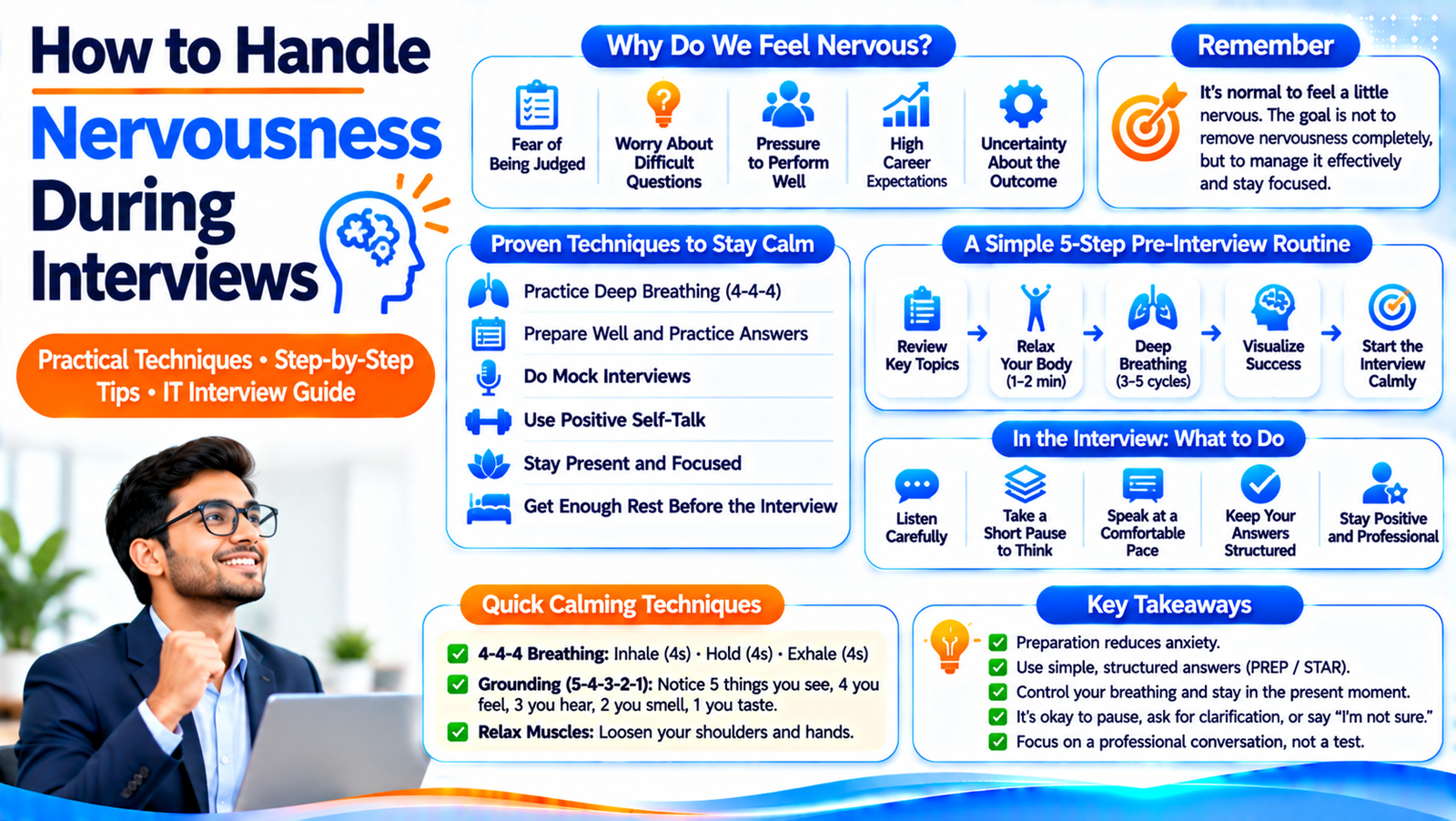
How to Handle Nervousness During Interviews: Practical Tips, Calming Techniques & IT Interview Preparation
Learn how to manage interview nervousness with practical calming techniques, preparation strategies, confidence-building exercises, and real IT interview examples.
Vyomanant Academy
Build these skills hands-on
Explore structured, practical technology programs from Vyomanant Academy.
Explore CoursesOn this page
How to Handle Nervousness During Interviews: A Practical Guide for IT Job Seekers
Introduction
Imagine you are attending an interview for a software developer, DevOps engineer, cloud engineer, cybersecurity analyst, or IT support position.
You have prepared for several days. You understand the technical concepts, practiced common questions, and reviewed your projects.
But when the interview begins, your heart starts beating faster.
Your hands feel uncomfortable. Your thoughts become difficult to organize. You may forget something you studied the previous day.
You start thinking:
- "What if I forget the answer?"
- "What if my English is not good enough?"
- "What if the interviewer asks something difficult?"
- "What if I make a mistake?"
These reactions are common in situations where people feel evaluated.
The goal is not to eliminate every feeling of nervousness. It is to learn how to manage nervousness so you can communicate your knowledge more effectively.
This guide explains why interviews can feel stressful, what to do before and during an interview, how to recover from difficult moments, and how to build confidence through practical exercises.
1. Why Do We Feel Nervous During Interviews?
Interviews combine several sources of pressure.
You may be meeting unfamiliar people, discussing your abilities, answering unexpected questions, and thinking about an important career opportunity.
Your body can respond to this pressure with a stress reaction.
Common Signs of Interview Nervousness
| Physical Signs | Mental or Communication Signs |
|---|---|
| Faster heartbeat | Difficulty concentrating |
| Sweaty hands | Forgetting prepared points |
| Dry mouth | Overthinking answers |
| Muscle tension | Fear of making mistakes |
| Faster breathing | Speaking too quickly |
| Restlessness | Negative self-talk |
These experiences vary from person to person.
Some people feel nervous before the interview but become comfortable once the conversation begins.
Others may feel nervous throughout the interview.
Why Does This Happen?
When you perceive a situation as threatening or highly important, your body's stress response may become more active.
This response can affect attention, memory retrieval, breathing, and speaking pace.
It does not necessarily mean you lack knowledge or preparation.
Important Reminder
Feeling nervous and performing well are not mutually exclusive.
You can feel nervous and still provide accurate, thoughtful answers.
2. Understand the Difference Between Nervousness and Poor Preparation
Nervousness and lack of preparation can sometimes look similar, but they are not the same.
Example
Two candidates are asked:
"What is the difference between Docker and Kubernetes?"
Candidate A understands both technologies but speaks too quickly because of nervousness.
Candidate B is calm but has not studied the concepts.
Candidate A may benefit from practicing answer delivery.
Candidate B needs additional technical preparation.
What Should You Focus On?
| Challenge | Helpful Response |
|---|---|
| You know the answer but rush | Practice speaking pace and pauses |
| You forget the order of your points | Use a simple answer structure |
| You do not understand the concept | Study and practice the topic |
| You fear unexpected questions | Practice unfamiliar scenarios |
| You struggle to explain projects | Prepare a project overview |
| You worry about making mistakes | Practice correcting answers calmly |
Key Principle
Preparation builds knowledge. Interview practice helps you communicate that knowledge under pressure.
Both matter.
3. Change the Way You Think About Interviews
Your expectations can influence how stressful an interview feels.
If you believe that one wrong answer means automatic failure, every question may feel threatening.
A more useful approach is to treat the interview as a professional discussion.
Replace Unhelpful Thoughts
| Unhelpful Thought | More Balanced Thought |
|---|---|
| "I must answer everything perfectly." | "I will explain what I know accurately." |
| "One mistake will ruin the interview." | "I can correct mistakes and continue." |
| "Everyone else is more confident." | "I can focus on my own preparation." |
| "I must use advanced English." | "I can use clear, professional language." |
| "I cannot ask questions." | "Clarifying questions can show careful thinking." |
| "I should never say I don't know." | "Honesty is better than guessing." |
Example
Instead of thinking:
"I have to impress the interviewer with every answer."
Try:
"I want to help the interviewer understand my skills, experience, and approach to solving problems."
This shift may make the conversation feel more manageable.
4. Prepare the Right Things Before the Interview
One of the most practical ways to reduce uncertainty is to prepare for the specific role.
You do not need to study every technology in IT.
Focus on what is relevant.
Step 1: Review the Job Description
Identify the main responsibilities and technologies.
For example, a junior DevOps role might mention:
- Linux.
- Git.
- CI/CD.
- Docker.
- Cloud fundamentals.
- Monitoring.
- Basic scripting.
Prioritize these areas rather than studying unrelated topics.
Step 2: Review Your Resume
Be ready to explain every major skill, project, and responsibility you have listed.
Step 3: Prepare Your Self-Introduction
Create a short introduction covering:
- Your background.
- Relevant skills.
- One project or experience.
- Your interest in the role.
Step 4: Prepare Two Project Examples
Choose projects you understand well.
For each project, remember:
- What problem it addressed.
- Which technologies you used.
- What you personally implemented.
- One challenge you faced.
- What you learned.
Step 5: Practice Common Questions
Practice technical, behavioral, and troubleshooting questions aloud.
Important Tip
Preparation should make you more flexible, not dependent on memorized scripts.
Remember key points rather than every sentence.
5. Use a Simple Routine Before the Interview
A short preparation routine can help you focus on what you can control.
A 10-Minute Pre-Interview Routine
| Time | Activity |
|---|---|
| Minutes 1–2 | Check your interview location, meeting link, or equipment |
| Minutes 3–4 | Review your self-introduction's main points |
| Minutes 5–6 | Recall one project and one troubleshooting example |
| Minutes 7–8 | Sit comfortably and use a calm breathing rhythm |
| Minutes 9–10 | Put away unnecessary notes and prepare to listen |
For Online Interviews
Check:
- Internet connection.
- Microphone.
- Camera, if required.
- Meeting link.
- Battery or power supply.
- Background noise.
For In-Person Interviews
Confirm:
- Interview location.
- Travel arrangements.
- Required documents.
- Expected arrival time.
- Contact details for unexpected delays.
Why Does This Help?
A routine reduces last-minute decisions and gives you a clear sequence to follow.
It cannot guarantee that you will feel calm, but it can help you arrive better prepared.
6. Use Comfortable Breathing to Manage Immediate Nervousness
When nervous, some people breathe more quickly or shallowly.
Gentle, comfortable breathing can help you settle your attention before speaking.
A Simple Breathing Exercise
- Sit or stand comfortably.
- Relax your shoulders if possible.
- Breathe in gently through your nose or mouth.
- Breathe out slowly and comfortably.
- Repeat for a few breaths without forcing the rhythm.
You can try this before joining an interview or while waiting for your turn to speak.
Important Safety Note
Avoid forcing deep breaths or holding your breath for long periods.
If breathing exercises make you dizzy or uncomfortable, stop and return to your normal breathing.
When Can This Be Useful?
- Before the interview starts.
- After a difficult question.
- During a short break.
- When you notice yourself rushing.
Remember
Breathing exercises are optional tools for managing ordinary nervousness, not a requirement for good interview performance or a treatment for anxiety disorders.
7. Use the Pause–Organize–Answer Technique
Nervous candidates sometimes begin answering immediately because they fear silence.
But a short pause can help you understand the question and organize your thoughts.
Three-Step Method
Interview Question
        |
        v
      PAUSE
Understand the question
        |
        v
     ORGANIZE
Choose 2–3 key points
        |
        v
      ANSWER
Speak clearly and directly
Example
Interviewer: "How would you troubleshoot a Docker container that keeps restarting?"
Instead of rushing into a list of random commands, organize your answer.
Example Response:
"First, I would check the container status and logs to understand why it is restarting.
Next, I would review the application's startup configuration, environment variables, and resource usage.
If I identified a configuration problem, I would correct it and restart the container.
Finally, I would verify that the container remains healthy and the application works."
Why This Works
It gives your answer a logical sequence.
It also helps you focus on the problem instead of worrying about how nervous you feel.
8. What to Do When Your Mind Goes Blank
One of the most uncomfortable interview experiences is temporarily forgetting an answer.
You may know the topic but struggle to remember the information at that moment.
Step 1: Do Not Rush
Give yourself a brief moment to think.
Step 2: Start with What You Know
Recall the basic definition or first step.
Step 3: Ask for Clarification
If the question is broad, ask which aspect the interviewer wants you to focus on.
Step 4: Explain Your Reasoning
For scenario-based questions, describe how you would investigate.
Step 5: Be Honest About Missing Details
Do not invent commands, configurations, or experience.
Example
Interviewer: "What is the exact Linux command to display a specific network configuration?"
Response:
"I don't recall the exact command option at the moment. I would first identify which network information is needed, such as IP addresses or routing details, and then use the appropriate system command or check its documentation."
Useful Phrases
- "Let me think about that for a moment."
- "I'll start with the part I know."
- "Could you clarify which aspect you mean?"
- "I don't remember the exact syntax, but I understand the approach."
- "Let me correct my previous statement."
A temporary memory lapse does not need to define the rest of the interview.
9. How to Handle Difficult Technical Questions
Some questions are intentionally open-ended.
The interviewer may want to observe how you reason through uncertainty.
Example Scenario
"A website becomes very slow after deployment. What would you do?"
You do not need to identify the root cause immediately.
Instead, use a troubleshooting structure.
Recommended Approach
Understand Symptoms
        |
        v
Check Monitoring Data
        |
        v
Review Logs and Changes
        |
        v
Identify Possible Causes
        |
        v
Test and Apply a Fix
        |
        v
Verify Recovery
Example Answer
"I would first confirm when the slowdown started and whether it affects all users.
Then I would review application response times, error rates, server resource usage, and relevant logs.
I would also check whether the slowdown started after a recent deployment.
Based on the evidence, I would investigate possible causes such as inefficient database queries, resource limits, or application errors.
After applying a suitable fix, I would verify the results using monitoring data and application tests."
Why This Helps With Nervousness
A familiar problem-solving structure gives you a starting point even when the exact answer is unknown.
10. Stop Trying to Speak Perfect English
Some candidates become nervous because they focus too much on grammar, pronunciation, or accent.
Clear communication is more important than using complicated language.
Example
Overcomplicated:
"I possess substantial expertise in the operationalization of containerized application environments."
Clearer:
"I have experience deploying and managing containerized applications."
Use Simple Sentence Patterns
- "The main purpose is..."
- "I used this tool because..."
- "First, I would check..."
- "One problem I faced was..."
- "I solved it by..."
- "The result was..."
- "I learned that..."
What If You Make a Grammar Mistake?
If the meaning remains clear, continue.
If the mistake changes the meaning, correct it briefly.
What About Your Accent?
You do not need a particular accent to be an effective communicator.
Focus on understandable pronunciation, relevant content, and a comfortable speaking pace.
11. Manage Nervousness During Self-Introduction
The first question often feels especially stressful.
A prepared introduction can make the beginning of the interview more predictable.
Simple Self-Introduction Structure
Background
    |
    v
Technical Skills
    |
    v
Project or Experience
    |
    v
Career Interest
Example for an IT Fresher
"Hello, I recently completed my degree in computer science.
I am interested in cloud computing and DevOps.
I have been learning Linux, Git, Docker, and AWS fundamentals.
I also completed a practice project where I containerized a web application and created a basic CI/CD workflow.
This helped me understand application packaging and deployment automation.
I am looking for an opportunity to apply these skills and continue learning."
Practice Advice
Prepare a 45–60-second version.
Practice speaking it naturally rather than memorizing it word for word.
If you forget a sentence, continue with the next main point.
12. How to Recover After Giving a Wrong Answer
A mistake during an interview can feel disappointing.
However, trying to hide the mistake may create more confusion.
Example
Interviewer: "Does Kubernetes build Docker images?"
Candidate: "Yes, Kubernetes builds Docker images."
The candidate then realizes the answer is incorrect.
Better Recovery
"Let me correct that. Kubernetes does not normally build container images itself. Image-building tools create the images, and Kubernetes runs and manages workloads using those images."
Why This Is Better
It shows:
- Willingness to correct errors.
- Technical awareness.
- Professional communication.
- Ability to continue after a mistake.
What Not to Do
- Argue when the evidence clearly shows an error.
- Invent additional details.
- Apologize repeatedly.
- Assume the interview is already lost.
Correct the answer when possible and move forward.
13. Use Body Language That Helps You Stay Comfortable
Body language can influence your comfort and how others understand your attention.
There is no single correct way to look confident.
In-Person Interviews
- Sit in a comfortable position.
- Keep your posture reasonably relaxed.
- Use natural facial expressions.
- Maintain eye contact when comfortable and culturally appropriate.
- Avoid repeatedly checking unrelated devices.
- Listen before responding.
Online Interviews
- Test your microphone and camera.
- Use a reasonably quiet environment.
- Keep water nearby if permitted.
- Position your screen comfortably.
- Avoid reading full scripted answers.
- Allow for minor audio delays.
Important Reminder
You do not need to force constant eye contact, suppress every movement, or imitate someone else's speaking style.
Focus on communicating effectively in a way that works for you.
14. How to Handle an Interviewer Who Asks Rapid Questions
Some interviews move quickly.
The interviewer may ask follow-up questions before you finish your explanation.
This can feel stressful, but it does not necessarily mean you are performing badly.
Example
Interviewer: "What is Docker?"
Candidate: "Docker is a platform for packaging and running applications in containers."
Interviewer: "Why use containers?"
Candidate: "Containers help package an application with its required runtime components, which can make deployments more consistent."
Interviewer: "What is the difference between an image and a container?"
Candidate: "An image is a packaged template. A container is a running or stopped instance created from an image."
How to Respond
- Listen to the latest question.
- Give the direct answer.
- Avoid repeating earlier explanations.
- Ask for clarification when necessary.
- Treat follow-ups as part of the technical discussion.
Helpful Phrase
"I'll answer that part first."
This can help you stay focused when several questions are asked together.
15. How to Handle Nervousness in HR Interviews
HR and behavioral interviews can feel personal because they involve your experience, decisions, and career goals.
Prepare honest examples instead of trying to predict a perfect answer.
Question: What Is Your Biggest Weakness?
Example Response:
"Earlier, I sometimes became nervous while presenting technical work to others.
I started practicing short explanations and asking for feedback.
I have become more comfortable explaining my work, and I continue to improve."
Question: How Do You Handle Pressure?
Example Response:
"I try to understand the priority, divide the work into manageable steps, and communicate early if I need support or more time."
Question: Tell Me About a Failure
Use the STAR method:
- Situation: What happened?
- Task: What was your responsibility?
- Action: What did you do afterward?
- Result: What changed or what did you learn?
Key Advice
Use genuine experiences.
You do not need to present yourself as someone who has never made a mistake.
16. Practice With Gradual Mock Interviews
Mock interviews can make the interview format more familiar.
Instead of starting with a long, high-pressure simulation, gradually increase the difficulty.
Level 1: Practice Alone
Record yourself answering three familiar questions.
Level 2: Practice With a Trusted Person
Ask a friend or mentor to listen and provide feedback.
Level 3: Practice Unexpected Questions
Ask someone to choose questions without telling you in advance.
Level 4: Simulate a Full Interview
Practice introductions, technical questions, project discussions, and behavioral questions in one session.
Example Progression
Speak Alone
     |
     v
Record Answers
     |
     v
Practice with One Person
     |
     v
Answer Unexpected Questions
     |
     v
Complete Mock Interview
     |
     v
Review and Improve
What Should You Evaluate?
- Did you understand the question?
- Did you answer directly?
- Was your explanation accurate?
- Did you speak at a comfortable pace?
- Did you recover from mistakes?
- Did you ask for clarification when needed?
Avoid judging the entire practice session based only on how nervous you felt.
17. A Seven-Day Interview Nervousness Management Plan
Use this schedule to practice both preparation and communication.
| Day | Focus | Suggested Duration |
|---|---|---|
| 1 | Identify nervousness triggers | 20 minutes |
| 2 | Practice self-introduction | 20 minutes |
| 3 | Explain technical concepts aloud | 25 minutes |
| 4 | Practice difficult questions | 25 minutes |
| 5 | Practice pauses and recovery phrases | 20 minutes |
| 6 | Complete a mock interview | 30 minutes |
| 7 | Review progress and create a personal routine | 30 minutes |
Day 1: Identify Your Triggers
Write down the situations that make you most nervous.
For example:
- Speaking English.
- Technical follow-up questions.
- Forgetting commands.
- Explaining projects.
- Talking to unfamiliar people.
Choose one or two areas to focus on first.
Day 2: Prepare Your Introduction
Practice your introduction using key points rather than a full script.
Day 3: Practice Technical Explanations
Explain five familiar concepts using:
Definition → Purpose → Example
Day 4: Practice Unfamiliar Questions
Answer questions you have not prepared for.
Focus on clarifying, reasoning, and acknowledging uncertainty.
Day 5: Practice Recovery
Intentionally pause during practice.
Try phrases such as:
"Let me think about that."
"I'd like to correct one point."
"Could you clarify the requirement?"
Day 6: Complete a Mock Interview
Ask a friend or mentor to conduct a short interview.
Request feedback on clarity, relevance, and technical accuracy.
Day 7: Review Your Progress
Compare your recent recordings with your earlier attempts.
Notice improvements in structure, pace, and your ability to continue after difficult moments.
18. Practical Exercise: Create Your Interview Recovery Plan
Prepare a short plan for situations that make you nervous.
Scenario 1: You Forget an Answer
Your Plan:
Pause, recall the basic concept, explain what you know, and acknowledge any missing details.
Scenario 2: You Speak Too Fast
Your Plan:
Finish the current sentence, pause briefly, and continue at a comfortable pace.
Scenario 3: You Don't Understand the Question
Your Plan:
Ask the interviewer to repeat or clarify the question.
Scenario 4: You Give an Incorrect Answer
Your Plan:
Correct the information calmly and continue.
Scenario 5: You Feel Nervous Before Joining
Your Plan:
Check your setup, review key points, use a comfortable breathing rhythm if helpful, and focus on listening to the first question.
Create Your Own Checklist
- I reviewed the job requirements.
- I can explain my resume.
- I practiced my introduction.
- I prepared one or two projects.
- I practiced unfamiliar questions.
- I know how to ask for clarification.
- I have a plan for correcting mistakes.
- I checked the interview arrangements.
- I will focus on clear communication rather than perfection.
19. Common Mistakes That Can Increase Interview Nervousness
| Mistake | Better Approach |
|---|---|
| Studying everything at the last minute | Prioritize relevant topics |
| Memorizing complete scripts | Remember key points |
| Trying to eliminate all nervousness | Focus on functioning despite nervousness |
| Speaking immediately | Pause and organize |
| Comparing yourself with other candidates | Focus on your own preparation |
| Treating one wrong answer as failure | Correct and continue |
| Pretending to know unfamiliar tools | Answer honestly |
| Ignoring sleep and basic needs | Plan a reasonable routine |
| Practicing only silently | Speak aloud regularly |
| Avoiding all mock interviews | Start small and increase gradually |
Important Principle
Confidence grows through preparation, practice, and experience—not through a requirement to feel perfectly calm.
20. Frequently Asked Questions
Is it normal to feel nervous during interviews?
Yes. Interviews involve evaluation and uncertainty, so nervousness is a common experience.
Can I perform well even if I feel nervous?
Yes. Nervousness does not automatically prevent clear thinking or effective communication.
How can I calm myself before an interview?
Prepare relevant material, check logistics, use a familiar routine, and try gentle breathing if it feels comfortable.
What if my voice shakes?
Continue at a comfortable pace. You do not need to have a perfectly steady voice to give a useful answer.
What should I do if I forget a technical answer?
Pause, explain what you remember, and acknowledge missing details rather than guessing.
Can mock interviews reduce nervousness?
They may help by making the interview format more familiar and giving you opportunities to practice difficult situations.
Should I tell the interviewer that I am nervous?
You can acknowledge it briefly if doing so helps you communicate, but you are not required to disclose your feelings.
What if nervousness is severe or affects everyday life?
If anxiety is persistent, overwhelming, or significantly affects your daily functioning, consider speaking with a qualified mental health professional for individualized support.
21. Key Takeaways
- Interview nervousness is common and does not automatically indicate poor preparation.
- The goal is to manage nervousness, not eliminate every uncomfortable feeling.
- Role-specific preparation reduces uncertainty.
- Simple routines help you focus before interviews.
- Comfortable breathing may help with immediate nervousness.
- Pause–Organize–Answer supports clearer responses.
- Structured troubleshooting helps with difficult technical questions.
- Honest communication is better than guessing.
- Correcting mistakes is part of professional communication.
- Gradual mock interviews build familiarity and adaptability.
- Consistent practice helps you communicate effectively under pressure.
22. What Should You Learn Next?
Continue with these related resources:
- How to Speak Confidently During an Interview
- How to Structure Clear and Concise Interview Answers
- How to Answer Interview Questions in Simple English
- How to Improve Communication Skills for IT Interviews
- How to Introduce Yourself in an IT Interview
Continue Learning with Vyomanant Academy
Technical knowledge and communication skills work together during interviews.
At Vyomanant Academy, learners can build practical skills in software development, DevOps, cloud computing, cybersecurity, and IT fundamentals.
Combine hands-on technical projects with structured speaking practice and mock interviews to prepare for career opportunities.
Learn. Build. Grow.
CONTINUE EXPLORING
Recommended next

What Is Artificial Intelligence? A Simple Beginner's Guide
Learn what Artificial Intelligence (AI) means, how it works, and where we use it in everyday life, with simple examples that anyone can understand.
View resource
What Is Machine Learning? A Simple Beginner's Guide
Discover what Machine Learning is, how computers learn from data, and how predictions work. Explore key ML concepts, learning types, and real-world examples in this beginner-friendly guide.
View resource
What Is Information Technology? A Beginner's Guide
Discover what Information Technology (IT) is, how it works, its main components, everyday applications, and how beginners can start learning IT.
View resource