
RESOURCES
How to Answer Interview Questions in Simple English: Practical Tips, Examples & IT Interview Guide
Learn to answer IT interview questions in simple English with easy sentence structures, technical and HR answer examples, practical exercises, and speaking tips.
Vyomanant Academy
Build these skills hands-on
Explore structured, practical technology programs from Vyomanant Academy.
Explore CoursesOn this page
How to Answer Interview Questions in Simple English: A Beginner's Guide
Introduction
Imagine attending an interview for a software developer, cloud engineer, DevOps engineer, IT support specialist, or cybersecurity role.
The interviewer asks:
"Can you explain your project?"
You understand your project. You know which technologies you used and what problems you solved.
But when you try to explain it in English, you struggle to find the right words.
You may think:
- "My English is not advanced enough."
- "What if I make a grammar mistake?"
- "How can I explain technical concepts in simple words?"
- "What if the interviewer asks an unexpected question?"
Here is something important to remember:
You do not need complicated English to give a strong interview answer. You need clear ideas, relevant examples, and understandable sentences.
Simple English can help you explain technical knowledge without unnecessary vocabulary.
In this guide, you will learn how to answer common interview questions using simple English, organize technical explanations, discuss projects, handle difficult questions, and improve through daily speaking practice.
1. What Does Simple English Mean in an Interview?
Simple English means using familiar words, short sentences, and a clear structure to communicate your ideas.
It does not mean giving incomplete answers or avoiding important technical terminology.
For example, terms such as Docker, Kubernetes, CI/CD, API, and database may be necessary in an IT interview.
You can use these terms while explaining their meaning in straightforward language.
Complicated English vs Simple English
| Complicated English | Simple English |
|---|---|
| "I possess comprehensive knowledge of cloud infrastructure." | "I understand cloud infrastructure and have practiced using cloud services." |
| "I was responsible for facilitating application deployment." | "I helped deploy the application." |
| "We encountered an unexpected technical complication." | "We faced a technical problem." |
| "I utilized Docker for application containerization." | "I used Docker to package the application into a container." |
| "I collaborated with multiple stakeholders." | "I worked with different team members." |
Simple English is not less professional.
It often makes technical communication more effective.
Three Rules for Simple English
- Use familiar words where possible.
- Keep sentences focused on one main idea.
- Explain technical terms when the listener may not know them.
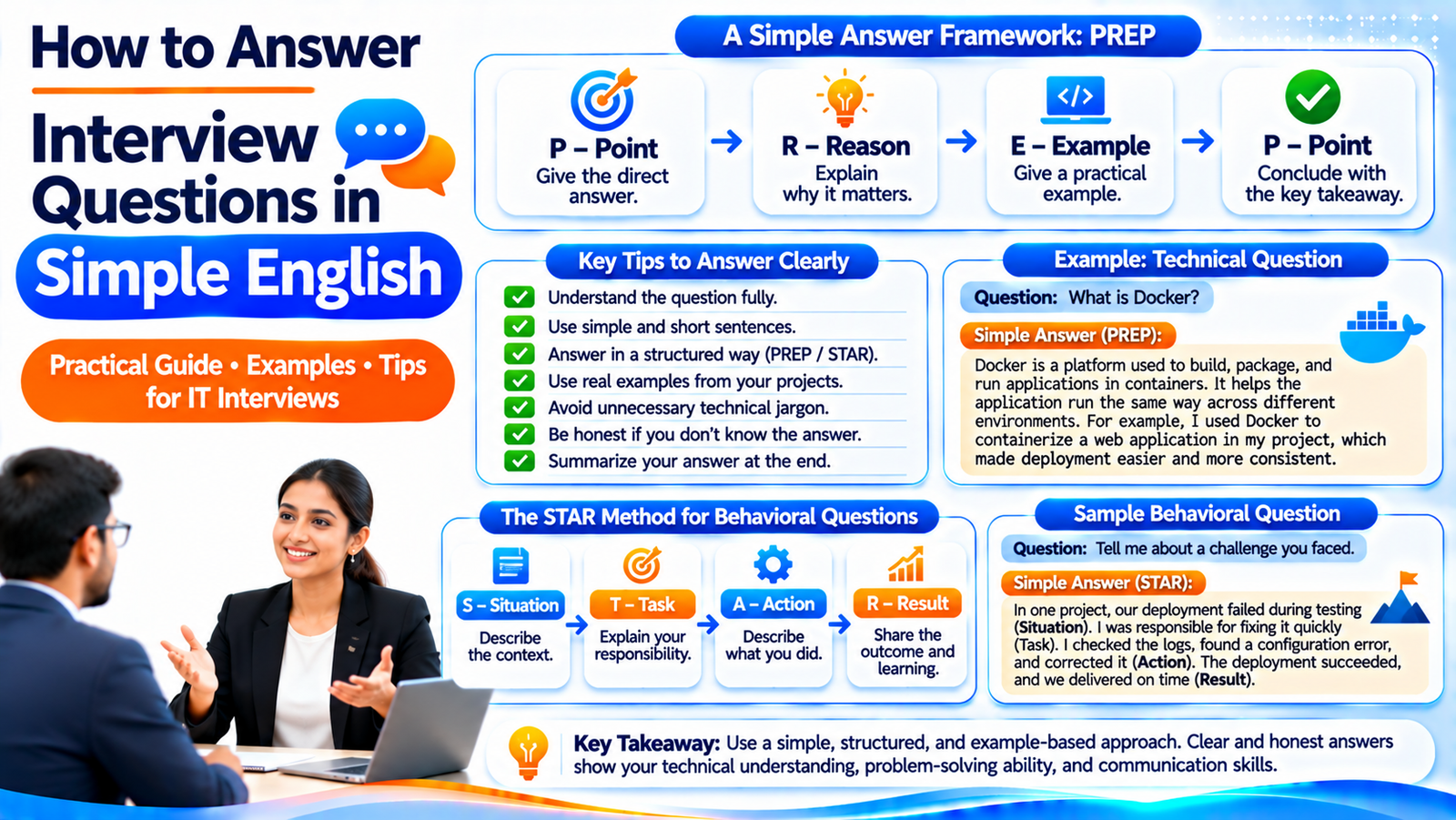
2. Use the Answer–Explain–Example Method
One of the easiest ways to answer interview questions is to follow three steps.
Answer → Explain → Example
Step 1: Answer
Give the main answer immediately.
Step 2: Explain
Add one or two sentences explaining how or why.
Step 3: Example
Provide a practical example when useful.
Example: What Is Docker?
Answer:
"Docker is a tool used to package and run applications in containers."
Explain:
"A container includes the application and the runtime components it needs. This helps the application run more consistently across compatible environments."
Example:
"In my practice project, I used Docker to package a Python web application and run it on a Linux server."
Another Example: What Is Git?
Answer:
"Git is a version control system."
Explain:
"It helps developers track file changes and work together on projects."
Example:
"I used Git to save changes to my project and manage different versions of the code."
Why This Method Works
You do not have to remember a long paragraph.
You only need to remember:
       Interview Question
               |
               v
         Direct Answer
               |
               v
       Short Explanation
               |
               v
       Practical Example
This structure works for technical definitions, tool explanations, and many general interview questions.
3. Learn Useful Sentence Starters
Sometimes the hardest part of speaking English is starting the sentence.
Preparing a few natural sentence patterns can help.
| Situation | Useful Sentence Starter |
|---|---|
| Explaining a concept | "It is a tool used to..." |
| Describing a purpose | "The main purpose is to..." |
| Giving an example | "For example..." |
| Explaining a process | "First..., then..., finally..." |
| Comparing technologies | "The main difference is..." |
| Explaining a project | "The goal of my project was..." |
| Describing responsibility | "My role was to..." |
| Explaining a problem | "We faced an issue with..." |
| Describing a solution | "I checked... and found..." |
| Explaining a result | "After the change, we..." |
| Asking for clarification | "Could you please explain what you mean by...?" |
| Admitting limited knowledge | "I haven't worked with that yet, but..." |
Example: Explaining Jenkins
"The main purpose of Jenkins is to automate tasks in software development.
It is commonly used to build, test, and deploy applications.
For example, we can create a Jenkins pipeline that runs automatically when developers push code."
Practice Tip
Choose five sentence starters and use them to explain different technical topics.
The goal is to make them feel natural rather than repeating the same phrase in every answer.
4. How to Answer "Tell Me About Yourself" in Simple English
This is one of the most common interview questions.
Your introduction should be short, relevant, and easy to follow.
Simple Structure
Your Background
      |
      v
Your Skills
      |
      v
Your Project or Experience
      |
      v
Your Career Goal
Example for an IT Fresher
"Hello, I recently completed my degree in computer science.
I am interested in cloud computing and DevOps.
I have learned Linux, Git, Docker, and basic AWS services.
I also completed a practice project where I deployed a web application using Docker.
I am looking for an entry-level opportunity where I can use my skills and continue learning."
Example for a Software Developer
"I am a software developer with experience in Java, SQL, and REST APIs.
I have worked on backend features, database queries, and application testing.
In my recent project, I helped develop APIs for a task management application.
I enjoy solving technical problems and improving my development skills."
Example for a Career Changer
"My background is in customer support, where I developed problem-solving and communication skills.
I became interested in IT and started learning Linux, networking, and cloud fundamentals.
I have completed hands-on labs and practiced basic system administration tasks.
I am now looking for an opportunity to start my career in IT support."
Important Tips
- Keep the introduction relevant to the job.
- Use short, connected sentences.
- Mention skills you can explain.
- Include one genuine project or experience.
- Avoid repeating your entire resume.
For many interviews, a 45–90-second introduction is a useful starting point.
5. How to Answer Basic Technical Questions in Simple English
You can explain technical concepts without using long definitions.
Question 1: What Is Cloud Computing?
"Cloud computing means using computing services such as servers, storage, and databases over the internet.
Companies can use these services without managing all the physical hardware themselves.
For example, AWS and Azure provide cloud services."
Question 2: What Is Linux?
"Linux is an operating system used on servers, computers, and many other devices.
It is widely used in IT because it is flexible and supports many development and administration tools."
Question 3: What Is an API?
"An API allows different software applications to communicate.
For example, a mobile application can use an API to request information from a server."
Question 4: What Is a Database?
"A database is used to store and organize information.
For example, an online shopping application may use a database to store product and order details."
Question 5: What Is CI/CD?
"CI/CD helps teams automate software integration and delivery.
A CI/CD pipeline can build code, run tests, and prepare or deploy an application.
For example, Jenkins or GitHub Actions can automate these steps."
Question 6: What Is Kubernetes?
"Kubernetes is a platform used to manage containerized applications.
It helps teams deploy applications, scale workloads, and replace failed containers according to their configuration."
Question 7: What Is Monitoring?
"Monitoring means checking the health and performance of systems.
For example, Prometheus can collect server metrics, and Grafana can display them in dashboards."
Question 8: What Is DevSecOps?
"DevSecOps means including security practices in software development and operations.
For example, a CI/CD pipeline can check code, dependencies, and container images for security risks before deployment."
Important Reminder
These are starting answers.
If the interviewer asks for more detail, explain the architecture, workflow, or practical example.
6. How to Explain Your IT Project in Simple English
Project questions are often more challenging than basic definitions.
You need to explain several things in a logical order.
Use this five-part structure:
- Project goal.
- Tools used.
- Your responsibility.
- Problem and solution.
- Result or learning.
Example: CI/CD Pipeline Project
"The goal of my project was to automate the build and deployment of a web application.
I used GitHub for source code, Jenkins for automation, and Docker for containerization.
My responsibility was to create the Jenkins pipeline and Dockerfile.
During testing, the pipeline failed because a required build configuration was missing.
I checked the Jenkins logs, corrected the configuration, and ran the pipeline again.
After the fix, the application built and deployed successfully in my test environment.
This project helped me understand CI/CD automation and troubleshooting."
Example: AWS Cloud Project
"I created a small cloud infrastructure project using AWS.
The goal was to host a web application on a cloud server.
I launched an EC2 instance, configured the required security group rules, and deployed the application.
I tested the application through its public endpoint.
This project helped me understand virtual servers, network access, and basic cloud deployment."
Example: Monitoring Project
"I created a monitoring project for a Linux server.
I used Prometheus to collect metrics and Grafana to create dashboards.
The dashboards showed CPU usage, memory usage, and server availability.
I also practiced identifying unusual resource usage.
This project helped me understand infrastructure monitoring."
These examples are fictional templates. Change the details to match what you actually did.
Simple Project Formula
My project was about...
The main goal was...
I used...
My responsibility was...
One problem I faced was...
I solved it by...
The result was...
I learned...
You do not need to use every sentence in every interview.
Choose the details that best answer the question.
7. How to Answer HR Interview Questions in Simple English
HR questions often focus on motivation, teamwork, strengths, and professional behavior.
Q1. Why Should We Hire You?
"I have the basic technical skills required for this role, and I have practiced them through projects.
I am willing to learn, I work carefully, and I try to solve problems step by step.
I believe I can contribute to the team while improving my skills."
Q2. What Are Your Strengths?
"One of my strengths is problem-solving.
When I face a technical issue, I try to understand the problem, check possible causes, and test the solution.
I also enjoy learning new tools."
Q3. What Is Your Weakness?
"Sometimes I spend too much time explaining technical details.
I am improving this by practicing shorter answers and focusing on the main point first."
Choose a real weakness and explain how you are working on it.
Q4. Why Do You Want This Job?
"This role matches my interests and the skills I have been developing.
I want to work on practical projects, learn from experienced team members, and contribute to the company."
Q5. How Do You Handle Pressure?
"I first identify the most important task.
Then I divide the work into smaller steps and focus on completing them.
If I need help or more time, I communicate that early."
Q6. How Do You Handle Feedback?
"I listen carefully and try to understand the feedback.
If something is unclear, I ask questions.
Then I use the feedback to improve my work."
Q7. Where Do You See Yourself in Five Years?
"I want to become a skilled and reliable IT professional.
I hope to handle more complex responsibilities and help my team solve technical problems."
Key Advice
Do not memorize these examples as fixed scripts.
Adjust them to your background, experience, and the specific job.
8. How to Answer "Why Did You Use This Tool?"
Interviewers often ask why you selected a technology.
They want to understand your decisions, not just your ability to name tools.
Example: Why Did You Use Docker?
"I used Docker because I wanted to package the application and its dependencies into one image.
This made it easier to run the same application build in compatible environments."
Example: Why Did You Use Jenkins?
"I used Jenkins to automate the build and test process.
It helped me create a repeatable pipeline instead of running every step manually."
Example: Why Did You Use Terraform?
"I used Terraform to define cloud infrastructure in configuration files.
This helped me create and update infrastructure in a repeatable way."
Example: Why Did You Use Grafana?
"I used Grafana to create dashboards.
It helped me understand server performance by showing metrics in charts."
Better Answer Structure
Tool → Reason → Benefit
For example:
"I used Prometheus to collect server metrics. This helped me monitor CPU, memory, and availability over time."
9. How to Explain a Technical Problem You Solved
Interviewers may ask:
"Tell me about a technical challenge you faced."
Use simple past-tense sentences to explain what happened.
Example: Docker Container Not Starting
"In my Docker project, the container stopped soon after starting.
I checked the container logs to understand the problem.
I found that the application was missing a required environment variable.
I added the correct configuration and started the container again.
After that, the application worked in my test environment."
Example: Jenkins Pipeline Failure
"My Jenkins pipeline failed during the build stage.
I checked the console output and found a dependency-related error.
I reviewed the project configuration and corrected the dependency version.
Then I ran the pipeline again and confirmed that the build passed."
Simple Problem-Solving Structure
Problem
   |
   v
What I Checked
   |
   v
What I Found
   |
   v
What I Changed
   |
   v
How I Verified It
Useful Sentence Patterns
- "The problem was..."
- "I checked..."
- "I found that..."
- "I changed..."
- "After the fix..."
- "I verified the result by..."
These phrases are especially useful for DevOps, cloud, networking, and IT support interviews.
10. What to Say When You Don't Know the Answer
You do not need to invent an answer.
It is better to be honest and explain what you know.
Situation 1: You Have Not Used the Tool
Interviewer: "Have you worked with Ansible?"
Answer:
"I have learned the basic purpose of Ansible, but I have not used it in a complete project yet.
I understand that it is used to automate configuration and system administration tasks."
Situation 2: You Know Part of the Concept
Interviewer: "How does Kubernetes networking work?"
Answer:
"I know that Kubernetes provides networking between Pods and uses Services to provide stable access to selected workloads.
I have not studied every networking component in detail yet."
Situation 3: You Need Time to Think
You can say:
"Could I take a moment to think about that?"
Then organize your answer.
Situation 4: You Did Not Understand the Question
You can say:
"Could you please repeat the question?"
Or:
"Could you explain what you mean by that?"
Situation 5: You Cannot Remember a Command
You can say:
"I don't remember the exact command at the moment, but I know the steps I would follow. I would confirm the syntax in the documentation before running it."
Remember
Simple English and honest communication are better than complicated but incorrect answers.
11. How to Ask Questions Politely in an Interview
Communication is not only about answering questions.
It also involves asking appropriate questions.
When You Need Clarification
- "Could you please repeat the question?"
- "Could you explain that in another way?"
- "Do you mean the development environment or production environment?"
- "Should I explain the concept or give a practical example?"
When You Need a Moment
- "Let me think about that for a moment."
- "I would like to organize my answer."
- "There are a few things I would check first."
When You Want to Confirm
- "Just to confirm, the application is running but not responding. Is that correct?"
- "Are you asking about the deployment process?"
Questions You Can Ask the Interviewer
At the end of the interview, you might ask:
- "What would my main responsibilities be in this role?"
- "What technologies does the team use most often?"
- "How does the team support learning and development?"
- "What would success look like in the first few months?"
Ask questions that genuinely help you understand the opportunity.
12. How to Improve English Speaking for Technical Interviews
You can improve your interview English without studying every grammar rule first.
Focus on the language you need for real interview situations.
Technique 1: Practice One Question Every Day
Choose a common question and answer it aloud.
Example:
"What is a REST API?"
Speak for 30–60 seconds.
Technique 2: Record Your Voice
Listen to your answer and identify unclear sentences.
Repeat the answer using simpler words.
Technique 3: Learn Phrases, Not Only Individual Words
Instead of learning only the word "deploy," practice:
- "I deployed the application."
- "The deployment failed."
- "I checked the deployment logs."
- "I verified the deployment."
This helps you use vocabulary naturally.
Technique 4: Explain Your Daily Technical Work
After completing a lab or exercise, say:
"Today I created a Docker image.
I ran the container and tested the application.
I faced one configuration problem and fixed it."
Technique 5: Practice With Another Person
Ask a friend, mentor, or study partner to conduct a short interview.
Request feedback on clarity and relevance.
Technique 6: Practice Follow-Up Questions
After explaining a concept, ask yourself:
- Why is it used?
- How does it work?
- What is an alternative?
- What problem can happen?
- How would I troubleshoot it?
This helps you move beyond memorized answers.
13. Basic Grammar Patterns Useful for IT Interviews
You do not need to speak with perfect grammar, but a few common sentence patterns can make answers easier.
Present Simple: Facts and Regular Activities
"I use Git to track code changes."
"Docker helps package applications."
Past Simple: Completed Projects
"I created a Jenkins pipeline."
"I deployed the application on a Linux server."
Present Perfect: Experience
"I have worked with Java and SQL."
"I have completed several cloud labs."
Future or Intended Actions
"I would check the logs first."
"I would test the application after the deployment."
Compare These Examples
| Less Clear | Clearer |
|---|---|
| "I am did project." | "I completed a project." |
| "I am knowing Docker." | "I understand Docker basics." |
| "I was use Jenkins." | "I used Jenkins." |
| "I will checked logs." | "I would check the logs." |
| "I have create pipeline." | "I have created a pipeline." |
Practical Tip
When describing a completed project, past-tense sentences are often useful.
When explaining what a tool does, present-tense sentences are usually appropriate.
When describing a possible troubleshooting approach, "I would..." is natural.
14. Common Mistakes to Avoid
| Mistake | Better Approach |
|---|---|
| Trying to use difficult words | Use familiar, accurate words |
| Giving one-word answers | Add a short explanation |
| Speaking too quickly | Pause between ideas |
| Memorizing full paragraphs | Remember key points |
| Using incorrect technical terms | Explain what you know accurately |
| Answering without listening | Understand the question first |
| Saying "yes" to unfamiliar tools | Describe your real experience |
| Giving very long introductions | Focus on relevant background |
| Ignoring project details | Explain your contribution |
| Worrying about every grammar mistake | Focus on understandable communication |
Important Difference
Simple answers should still contain useful information.
For example:
Too Short:
"Jenkins is an automation tool."
Better:
"Jenkins is an automation server. It can run tasks such as building code, testing applications, and preparing deployments. I used it to create a basic CI/CD pipeline."
The second answer is still simple, but it demonstrates more understanding.
15. Seven-Day Simple English Interview Practice Plan
| Day | Practice Topic | Suggested Time |
|---|---|---|
| 1 | Self-introduction and background | 20 minutes |
| 2 | Five technical definitions | 25 minutes |
| 3 | Project explanation | 25 minutes |
| 4 | Common HR questions | 25 minutes |
| 5 | Troubleshooting questions | 25 minutes |
| 6 | Unknown questions and clarification | 20 minutes |
| 7 | Complete mock interview | 30 minutes |
Day 1: Introduce Yourself
Prepare a short introduction using four points: background, skills, project, and goal.
Day 2: Explain Technical Concepts
Choose five technologies you know.
Explain each using Answer–Explain–Example.
Day 3: Explain Your Project
Use simple sentences to describe your objective, tools, responsibility, challenge, and result.
Day 4: Practice HR Questions
Prepare answers about strengths, weaknesses, teamwork, and career goals.
Day 5: Practice Troubleshooting
Explain what you would check first, how you would investigate, and how you would verify a solution.
Day 6: Practice Difficult Situations
Practice asking for clarification and acknowledging unfamiliar topics.
Day 7: Complete a Mock Interview
Record a 20–30-minute practice interview.
Review whether your answers were clear, accurate, and relevant.
16. Practical Exercise: Rewrite Difficult Answers in Simple English
Try changing these sentences into simpler language.
Exercise 1
Difficult:
"I was instrumental in implementing an automated deployment mechanism."
Simple:
"I helped create an automated deployment process."
Exercise 2
Difficult:
"We experienced an unexpected disruption in service availability."
Simple:
"Our application stopped working for a short time."
Exercise 3
Difficult:
"I leveraged infrastructure automation to provision cloud resources."
Simple:
"I used automation tools to create cloud resources."
Exercise 4
Difficult:
"I possess foundational expertise in container orchestration."
Simple:
"I understand the basics of managing containers with Kubernetes."
Exercise 5
Difficult:
"I conducted an investigation into performance degradation."
Simple:
"I investigated why the application became slow."
Your Turn
Write a short answer to this question:
"Explain one IT project you completed."
Use these prompts:
My project was about...

The goal was...

I used...

My role was...

One problem was...

I solved it by...

The result was...

I learned...
Speak the answer aloud and make it sound natural.
17. Frequently Asked Questions
Can I clear an IT interview using simple English?
Yes. Simple English can be effective when your answers are accurate, relevant, and understandable. Hiring decisions also depend on technical ability and other role requirements.
Do interviewers expect perfect grammar?
Expectations vary by role. In many technical interviews, clear communication matters more than flawless grammar or sophisticated vocabulary.
What if I forget an English word?
Use another familiar word or explain the idea in a short sentence.
How can I answer technical questions without advanced English?
Use a direct definition, a short explanation, and one practical example.
Is it acceptable to pause before answering?
Yes. A short pause can help you organize your thoughts.
Should I memorize common interview answers?
Prepare key points and practice speaking naturally. Avoid depending on word-for-word scripts.
How do I improve my English if I do not have a speaking partner?
Record yourself, practice mock interview questions aloud, and compare your answers over time.
What if my accent is different from the interviewer's?
A particular accent is not required for effective communication. Focus on understandable speech and ask for clarification when needed.
18. Key Takeaways
- Simple English can be professional and effective.
- Clear ideas are more important than complicated vocabulary.
- Answer–Explain–Example is a useful structure for technical questions.
- Short sentences help listeners follow your explanation.
- Prepared sentence starters make it easier to begin speaking.
- Project explanations should describe your goal, contribution, challenges, and results.
- Honest answers are better than invented experience.
- Basic grammar patterns can support clearer communication.
- Speaking aloud regularly is more useful than practicing only silently.
- Mock interviews help develop flexibility and confidence.
19. What Should You Learn Next?
Continue with these related resources:
- How to Improve Communication Skills for IT Interviews
- How to Speak Confidently During an Interview
- How to Introduce Yourself in an IT Interview
- How to Answer HR Interview Questions Confidently
- How to Explain Technical Projects in Interviews
Continue Learning with Vyomanant Academy
Strong technical knowledge becomes more valuable when you can explain it clearly.
At Vyomanant Academy, learners can develop practical skills in software development, cloud computing, DevOps, cybersecurity, and IT fundamentals.
Practice technical concepts, complete hands-on projects, and explain your work using simple, clear English.
Learn. Build. Grow.
CONTINUE EXPLORING
Recommended next

What Is Artificial Intelligence? A Simple Beginner's Guide
Learn what Artificial Intelligence (AI) means, how it works, and where we use it in everyday life, with simple examples that anyone can understand.
View resource
What Is Machine Learning? A Simple Beginner's Guide
Discover what Machine Learning is, how computers learn from data, and how predictions work. Explore key ML concepts, learning types, and real-world examples in this beginner-friendly guide.
View resource
What Is Information Technology? A Beginner's Guide
Discover what Information Technology (IT) is, how it works, its main components, everyday applications, and how beginners can start learning IT.
View resource