
RESOURCES
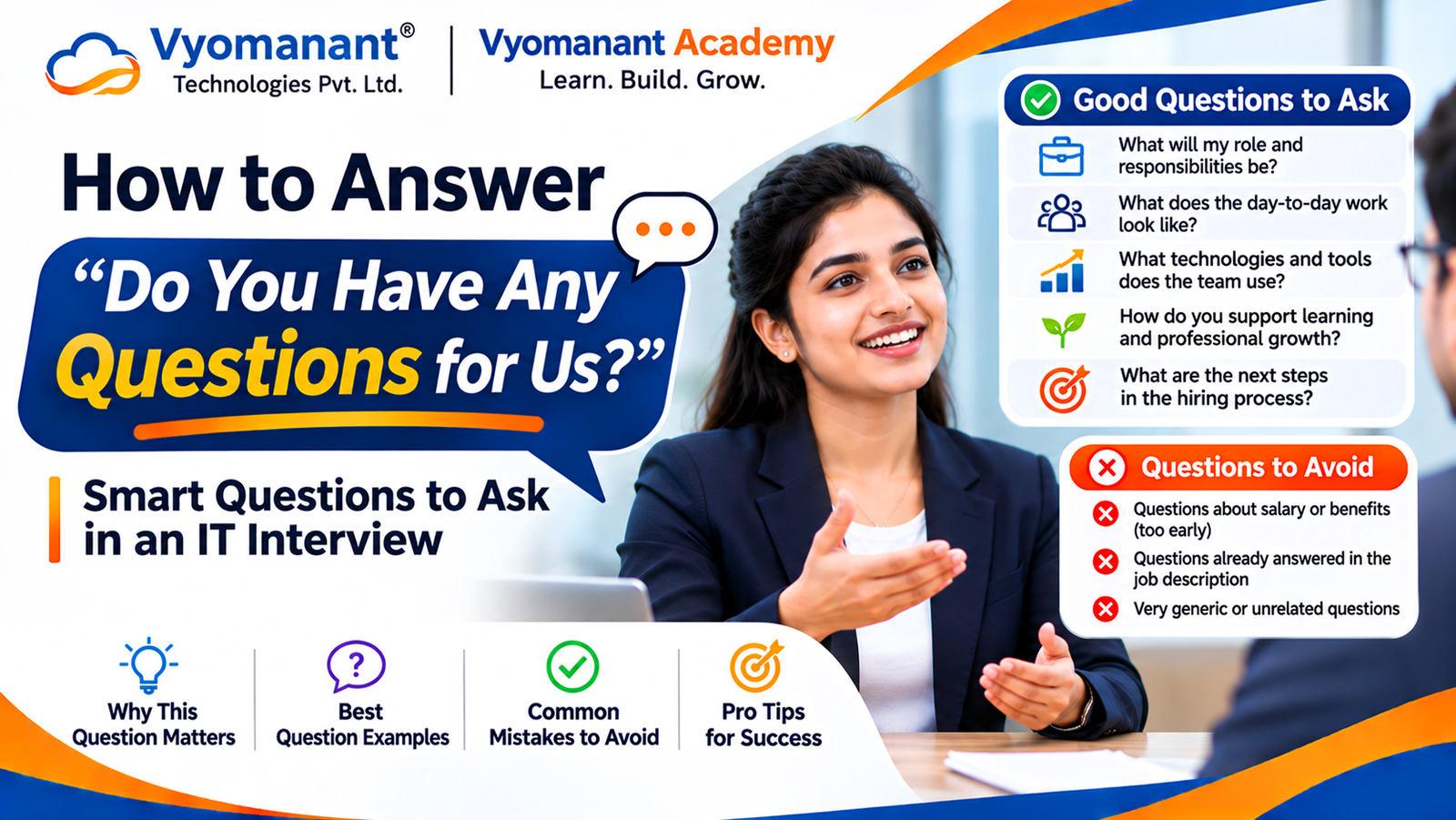
How to Answer "Do You Have Any Questions for Us?" in IT Interviews
Learn how to answer "Do you have any questions for us?" in IT interviews with smart questions for HR, technical interviewers, and hiring managers, plus practical examples and mistakes to avoid.
Vyomanant Academy
Build these skills hands-on
Explore structured, practical technology programs from Vyomanant Academy.
Explore CoursesOn this page
Introduction
At the end of an interview, the interviewer often asks:
"Do you have any questions for us?"
Many candidates respond with:
"No, I don't have any questions. Thank you."
Although this is polite, it misses an opportunity to learn about the role and demonstrate genuine interest.
This question is not simply a formality. It gives you a chance to understand the team's expectations, technical environment, daily responsibilities, and opportunities for professional growth.
Whether you are an IT fresher, DevOps Engineer, Cloud Engineer, Software Developer, or experienced professional, asking thoughtful questions can help you finish your interview on a positive note.
In this guide, you will learn what to ask, how to ask it professionally, and which questions to avoid.
Why Do Interviewers Ask "Do You Have Any Questions for Us?"
Interviewers usually ask this question to give candidates an opportunity to clarify important details about the position.
Your questions may also demonstrate:
- Interest in the Role: You want to understand the responsibilities.
- Preparation: You have reviewed the job requirements.
- Technical Curiosity: You are interested in the team's tools and workflows.
- Professional Thinking: You want to understand expectations and challenges.
- Career Awareness: You are evaluating whether the opportunity matches your goals.
What Is the Interviewer Really Looking For?
Imagine you are interviewing for a DevOps Engineer position.
The interviewer has already discussed Jenkins, Docker, Kubernetes, and AWS.
Instead of asking an unrelated question, you could say:
"Could you share how your team currently manages CI/CD pipelines and application deployments, and what the main challenges are?"
This question demonstrates that you are interested in how the team actually works, not just the technologies listed in the job description.
Key Point: Ask questions that help you understand the opportunity while demonstrating thoughtful interest in the work.
The Best Framework for Asking Questions
Use this simple approach:
Role → Technology → Expectations → Growth
You do not need to ask about all four areas. Select two or three relevant questions based on the interview discussion.
1. Role — Understand Your Responsibilities
Ask what you would be expected to do.
Example:
"Could you explain the main responsibilities of this position during a typical working week?"
This helps you understand the actual work beyond the job description.
2. Technology — Understand the Technical Environment
Ask about the tools, architecture, and engineering practices used by the team.
Example:
"What technologies and tools does the team currently use for CI/CD automation, infrastructure management, and monitoring?"
This is especially useful when the interviewer has not already covered the technical environment.
3. Expectations — Understand What Success Looks Like
Ask how performance and contributions are evaluated.
Example:
"What would you expect someone in this position to accomplish during the first three months?"
This demonstrates that you are thinking about contributing to the team.
4. Growth — Understand Learning Opportunities
Ask how the organization supports technical development.
Example:
"Are there opportunities for engineers to learn new technologies, contribute to different projects, or develop deeper technical expertise?"
This helps you understand the organization's approach to professional development.
Remember: The best questions are relevant to the conversation, not simply memorized from an interview preparation guide.
Understand It Through a Simple Real-Life Analogy
An Interview Is Like a Two-Way Technical Discussion
Imagine you are choosing a new laptop.
The salesperson explains its processor, memory, storage, and features.
Would you purchase it without asking whether it meets your actual requirements?
Probably not.
You might ask:
- Does it support the applications I need?
- Can I upgrade the memory?
- What warranty and support are available?
These questions help you make an informed decision.
An interview works similarly.
The company evaluates whether you are suitable for the role, and you evaluate whether the role is suitable for your career.
The Lesson: Asking thoughtful questions is not about impressing the interviewer with complicated language. It is about understanding the opportunity and making an informed career decision.
Best Questions to Ask at the End of an IT Interview
The following questions are useful for different interview situations.
Question 1: What Are the Main Responsibilities of This Role?
Ask:
"Could you explain the key responsibilities of this position and what a typical working day looks like?"
Why It Is Useful:
Job descriptions sometimes provide broad responsibilities. This question helps clarify what you would actually do.
Best For: HR interviews, hiring managers, and initial technical discussions.
Question 2: What Technologies Does the Team Use?
Ask:
"What are the main technologies and tools your team uses for development, deployment, and infrastructure management?"
Why It Is Useful:
This helps you understand the technical environment and whether your skills align with the team's requirements.
Best For: Technical interviewers and engineering managers.
Tip: If the interviewer has already explained the tools, ask about a specific challenge instead of repeating the same question.
Question 3: What Are the Biggest Challenges Facing the Team?
Ask:
"What are some of the main technical or operational challenges the team is currently working to solve?"
Why It Is Useful:
This question helps you understand real problems you might contribute to solving.
For a DevOps team, challenges might involve:
- Deployment automation.
- Infrastructure reliability.
- Application monitoring.
- Cloud cost management.
- Security and access controls.
Best For: Technical leads, engineering managers, and experienced candidates.
Question 4: What Would Success Look Like in the First 90 Days?
Ask:
"What would successful performance look like for someone joining this role during the first 90 days?"
Why It Is Useful:
It helps clarify priorities, expectations, and how you can prepare to contribute.
Best For: Hiring managers and team leads.
Pro Tip: This is one of the most versatile questions because it focuses on responsibility, contribution, and performance expectations.
Question 5: How Does the Team Handle Production Issues?
Ask:
"How does the team typically handle production incidents, troubleshooting, and escalation?"
Why It Is Useful:
This provides insight into operational processes, collaboration, and incident management.
Best For: DevOps Engineers, Cloud Engineers, Site Reliability Engineers, and Linux Administrators.
You can also ask about on-call responsibilities and incident response expectations when relevant.
Question 6: How Does the Team Support Learning and Growth?
Ask:
"How does the organization support engineers in learning new technologies and developing their technical skills?"
Why It Is Useful:
This helps you understand opportunities for training, mentorship, and career development.
Best For: Freshers, junior engineers, and professionals transitioning into new technologies.
Question 7: What Are the Next Steps in the Interview Process?
Ask:
"Could you please share the next steps in the interview process and the expected timeline?"
Why It Is Useful:
This is a professional way to understand what happens after the interview.
Best For: HR interviews and recruitment discussions.
Key Point: Asking about next steps is appropriate, but it is usually better to combine it with a question about the role or team.
Best Questions to Ask in a DevOps Engineer Interview
For DevOps roles, focus on automation, deployment workflows, infrastructure, reliability, and collaboration.
| Area | Smart Question |
|---|---|
| CI/CD | How does the team manage CI/CD pipelines and release automation? |
| Containers | Are applications primarily deployed using Docker and Kubernetes? |
| Cloud | Which cloud services are most important to the current infrastructure? |
| Infrastructure as Code | Does the team use Terraform or other IaC tools? |
| Monitoring | How are application health and infrastructure metrics monitored? |
| Reliability | What are the most common production challenges? |
| Collaboration | How do development and operations teams coordinate releases? |
Best Sample Conversation — DevOps Engineer
Interviewer:
"Do you have any questions for us?"
Candidate:
"Yes, thank you. I have two questions.
First, I would like to understand how your DevOps team currently manages CI/CD pipelines and application deployments.
Second, what are the main technical challenges or improvement priorities the team is focusing on?
I am asking because I would like to understand where my experience with Jenkins, Docker, AWS, and deployment automation could be most relevant."
Why This Answer Works:
- Demonstrates interest in the team's actual work.
- Connects questions to relevant technical skills.
- Focuses on potential contributions.
- Remains professional and concise.
Important: Mention only technologies you genuinely know or have worked with.
Best Questions to Ask in an AWS Cloud Engineer Interview
For cloud engineering positions, focus on cloud architecture, infrastructure management, security, and operational practices.
Recommended Questions
- Cloud Architecture: "What types of applications and workloads does the team currently host on AWS?"
- Infrastructure Automation: "How does the team provision and manage cloud infrastructure?"
- Security: "How are IAM permissions, infrastructure access, and cloud security responsibilities managed?"
- Monitoring: "Which monitoring and alerting tools are used for cloud infrastructure?"
- Cost Optimization: "Does the team have ongoing initiatives to improve cloud resource utilization and cost efficiency?"
Best Sample Answer
"Yes, I have a couple of questions.
Could you share how the team manages AWS infrastructure provisioning and monitoring?
Also, what are the main cloud reliability or security priorities for this role?
I would like to understand the technical environment and how I could contribute effectively."
Why This Answer Works: It demonstrates interest in practical cloud responsibilities rather than simply asking which AWS services are used.
Best Questions for IT Freshers
Freshers should focus on role expectations, initial responsibilities, mentorship, and learning opportunities.
Question 1: What Will My Initial Responsibilities Be?
"What types of tasks or projects would a fresher typically work on during the first few months?"
Question 2: Is There a Training or Onboarding Process?
"Does the team provide structured onboarding or guidance to help new engineers understand the technical environment?"
Question 3: How Can I Prepare Before Joining?
"Are there any specific technologies or technical fundamentals you would recommend I strengthen before joining the team?"
Best Sample Answer for Freshers
Interviewer:
"Do you have any questions for us?"
Candidate:
"Yes, thank you.
I would like to know what the initial responsibilities are for someone joining this role as a fresher.
Also, are there any specific technologies or skills I should focus on to prepare myself for the team's projects?
I am interested in understanding how I can become productive and contribute effectively."
Why This Answer Works:
- Demonstrates willingness to learn.
- Shows interest in practical responsibilities.
- Focuses on preparing for the role.
- Avoids unrealistic claims.
Pro Tip for Freshers: Asking about onboarding and learning expectations is often more useful than asking highly advanced architectural questions you do not yet understand.
Best Questions for Experienced IT Professionals
Experienced professionals can ask more detailed questions about technical ownership, architecture, team collaboration, and engineering priorities.
Recommended Questions
1. Technical Ownership
"What level of ownership would this role have over infrastructure, deployment automation, and operational decisions?"
2. Architecture
"Are there any major infrastructure modernization or architectural improvement initiatives planned?"
3. Engineering Challenges
"Which technical problems would you expect the person in this role to help solve first?"
4. Team Collaboration
"How do engineering teams coordinate changes, production deployments, and incident resolution?"
5. Performance Expectations
"How is success measured for this position during the first six months?"
Best Sample Answer
"Yes, I have two questions.
First, what are the most important technical challenges the team expects this position to address?
Second, how much ownership would the role have over CI/CD improvements, infrastructure automation, and deployment reliability?
I would like to understand the expectations and where I could make the strongest contribution."
Why This Answer Works: It demonstrates professional maturity and interest in responsibilities rather than focusing only on job titles.
What to Ask HR vs a Technical Interviewer
Different interviewers can answer different types of questions.
| HR Interviewer | Technical Interviewer |
|---|---|
| What are the next steps in the hiring process? | What technologies does the team use? |
| How is onboarding structured? | How are CI/CD pipelines managed? |
| What is the work arrangement? | What are the main technical challenges? |
| How are performance reviews conducted? | How are production incidents handled? |
| What learning opportunities are available? | What engineering improvements are planned? |
Simple Rule
Ask HR about employment processes and organizational policies.
Ask technical interviewers about engineering work, architecture, responsibilities, and technical challenges.
Ask hiring managers about team priorities, ownership, performance expectations, and growth.
This helps you direct each question to the person most likely to provide a useful answer.
Questions About Salary, Work Hours, and Benefits
Candidates sometimes worry that asking about salary or working conditions will create a negative impression.
These are legitimate topics, but timing and phrasing matter.
Salary Expectations
If compensation has not been discussed, you can ask HR:
"Could you share the compensation range budgeted for this position?"
Working Hours
For roles involving production support:
"Could you explain the typical working hours and whether this position includes on-call or weekend support responsibilities?"
Work Arrangement
"Is this position office-based, hybrid, or remote, and are there any specific location requirements?"
Benefits
"Could you share an overview of the benefits and leave policies associated with this position?"
Key Point: You are entitled to understand compensation and working conditions. These questions are often best addressed with HR or the recruiter, while technical discussions focus on the engineering role.
Questions You Should Avoid Asking
Some questions may be unnecessary, poorly timed, or already answered during the interview.
| Avoid | Better Alternative |
|---|---|
| "Did I get selected?" | "What are the next steps in the hiring process?" |
| "Is the work very easy?" | "What are the main responsibilities and challenges?" |
| "How quickly can I get promoted?" | "How is professional growth supported?" |
| "Will I have to work hard?" | "What are the typical workload and support expectations?" |
| Questions already clearly answered | Ask a thoughtful follow-up |
| Several unrelated questions | Select two or three relevant questions |
What If the Interviewer Already Answered Everything?
You do not need to invent another question.
Professional Response:
"Thank you. You have already explained the role, team structure, and technical responsibilities very clearly.
I don't have any additional questions at the moment, but I appreciate the opportunity to learn more about the position."
Remember: A genuine response is better than asking an unnecessary question only because you feel obligated.
How Many Questions Should You Ask?
For most interviews, two or three thoughtful questions are sufficient.
If the interviewer has limited time, ask your most important question first.
Recommended Priority
First Question — Role or Team
"What are the main priorities for someone joining this position?"
Second Question — Technical Environment
"What are the key technologies or engineering challenges the team is currently working with?"
Third Question — Next Steps
"Could you share the next steps in the interview process?"
You can adjust the number of questions based on the time available and what has already been discussed.
Pro Tip: Quality matters more than quantity. One relevant question is better than five generic questions.
A Complete Interview-Ready Answer
Here is a versatile answer suitable for many IT roles.
Interviewer:
"Do you have any questions for us?"
Candidate:
"Yes, thank you for the opportunity.
I have two questions.
First, could you explain what the main priorities would be for someone joining this role during the first three months?
Second, what are the biggest technical challenges the team is currently working on?
I would like to understand how I can prepare myself and contribute effectively to the team's goals."
Why This Answer Works
- Professional: Uses polite and confident language.
- Relevant: Focuses on the actual role.
- Thoughtful: Asks about expectations and challenges.
- Concise: Avoids unnecessary explanations.
- Adaptable: Works for DevOps, Cloud, Linux, and other IT positions.
How to Respond After the Interviewer Answers
Asking a good question is only the first step.
You should also listen carefully and respond naturally.
Example Conversation
Candidate:
"What are the biggest technical challenges the team is currently facing?"
Interviewer:
"We are currently working on improving our deployment automation and reducing manual release activities."
Candidate:
"Thank you for explaining. That sounds closely related to my experience with Jenkins and CI/CD automation. It is helpful to understand the team's current priorities."
Why This Works: The candidate listens to the answer and connects it naturally to relevant experience.
Important: Avoid turning every interviewer response into another lengthy explanation of your own skills.
Common Mistakes to Avoid
- Asking Nothing Automatically: Prepare questions, even if you do not use all of them.
- Asking Only About Salary: Balance employment-related questions with interest in the role.
- Repeating Answered Questions: Listen throughout the interview.
- Asking Too Many Questions: Respect the interviewer's available time.
- Using Overly Complicated Language: Keep your questions natural.
- Asking Questions You Do Not Understand: Focus on genuine curiosity.
- Interrupting the Interviewer: Allow them to complete their explanation.
Key Point: Your questions should help create a meaningful professional discussion, not become another memorized performance.
How to Prepare Your Questions Before an Interview
Follow these five simple steps.
Step 1: Review the Job Description
Identify the main responsibilities and required technologies.
Step 2: Research the Organization
Review its official website, products, services, and publicly available technical information.
Step 3: Prepare Three Relevant Questions
Choose questions about responsibilities, technical challenges, and expectations.
Step 4: Listen During the Interview
Remove questions that have already been answered.
Step 5: Ask Naturally
Use a polite opening:
"Yes, thank you. I have a couple of questions about the role and the team."
Then ask your most relevant questions.
Interview Preparation Tip: Prepare a few questions in advance, but adapt them to the actual conversation.
Frequently Asked Questions
1. Is It Bad to Say "I Don't Have Any Questions"?
Not necessarily. However, asking a relevant question can help you understand the role and demonstrate interest. If everything has already been covered, acknowledge that politely.
2. Can Freshers Ask Technical Questions?
Yes. Freshers can ask about technologies, onboarding, initial responsibilities, and learning expectations.
3. Should I Ask About Salary at the End of a Technical Interview?
Salary discussions are generally better directed to HR or the recruiter, although you can clarify compensation when appropriate.
4. Can I Ask About Work-Life Balance?
Yes. Ask professionally about working hours, on-call schedules, weekend support, and workload expectations.
5. What Is the Best Single Question to Ask?
A strong, broadly useful question is:
"What would success look like for someone in this role during the first three months?"
It helps you understand expectations and demonstrates interest in contributing effectively.
Key Takeaways
- Treat "Do you have any questions for us?" as an opportunity for a two-way discussion.
- Use the Role → Technology → Expectations → Growth framework.
- Prepare two or three relevant questions before the interview.
- Ask HR about employment processes and technical interviewers about engineering responsibilities.
- Focus on team challenges, technical workflows, and success expectations.
- Listen carefully and avoid repeating questions already answered.
- Ask about compensation, work arrangements, and on-call responsibilities when appropriate.
Final Reminder: The best questions are not necessarily the most complicated. They are the ones that help you understand the role, evaluate the opportunity, and demonstrate genuine professional interest.
What Should You Learn Next?
Continue strengthening your IT interview preparation:
- How to Answer "Why Do You Want to Join Our Company?"
- How to Answer "Where Do You See Yourself in Five Years?"
- How to End an Interview Professionally and Confidently
Continue Learning with Vyomanant Academy
Strong technical knowledge helps you answer interview questions. Effective communication also helps you ask thoughtful questions and understand professional opportunities.
Vyomanant Academy provides practical, industry-focused learning in Cloud Computing, DevOps, Linux, Docker, Kubernetes, Infrastructure Automation, and AI technologies.
Develop hands-on skills, improve your interview confidence, and prepare for real-world IT engineering careers.
Learn. Build. Grow.
Explore Programs: https://academy.vyomanant.com/
CONTINUE EXPLORING
Recommended next

What Is Artificial Intelligence? A Simple Beginner's Guide
Learn what Artificial Intelligence (AI) means, how it works, and where we use it in everyday life, with simple examples that anyone can understand.
View resource
What Is Machine Learning? A Simple Beginner's Guide
Discover what Machine Learning is, how computers learn from data, and how predictions work. Explore key ML concepts, learning types, and real-world examples in this beginner-friendly guide.
View resource
What Is Information Technology? A Beginner's Guide
Discover what Information Technology (IT) is, how it works, its main components, everyday applications, and how beginners can start learning IT.
View resource