
RESOURCES
DevOps vs Platform Engineering vs SRE: Key Differences Explained with Real-World Examples
Understand the differences between DevOps, Platform Engineering, and Site Reliability Engineering (SRE) with beginner-friendly explanations, practical examples, responsibilities, tools, and career guidance. Learn how these three approaches work together to deliver reliable software.
Vyomanant Academy
Build these skills hands-on
Explore structured, practical technology programs from Vyomanant Academy.
Explore CoursesOn this page
Imagine a company developing an online shopping application.
The developers write code, but several important questions remain:
- How can new features be delivered quickly?
- How can developers deploy applications without managing complex infrastructure?
- How can the application remain available during high traffic?
These challenges are closely related to DevOps, Platform Engineering, and Site Reliability Engineering (SRE).
Although they share common tools and practices, each has a different primary focus.
In Simple Terms:
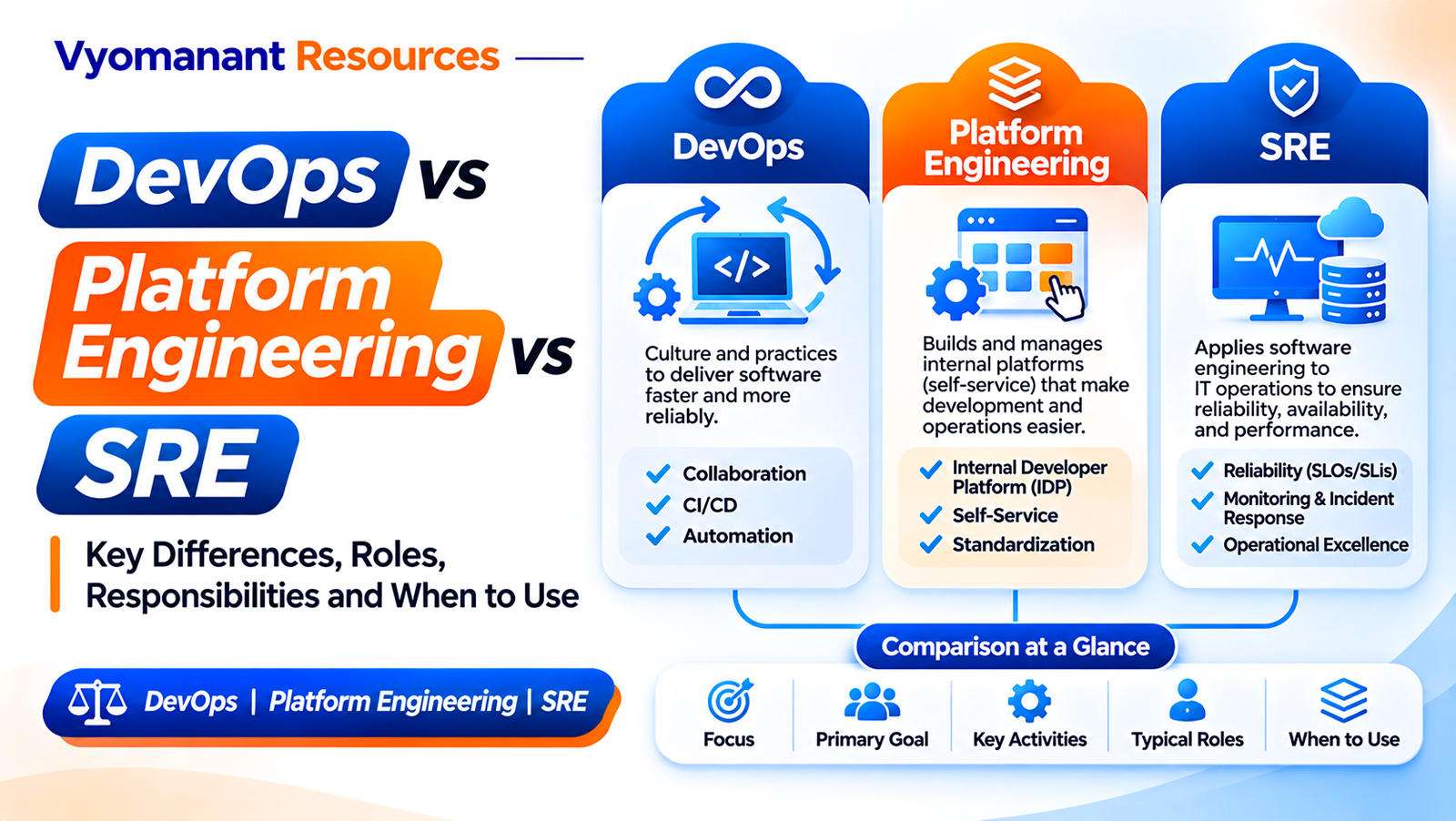
- DevOps: Improves how development and operations teams collaborate and deliver software.
- Platform Engineering: Builds reusable platforms that make development and deployment easier.
- SRE: Applies engineering practices to improve system reliability and availability.
Let's understand each concept with practical examples.
1. What Is DevOps?
DevOps is a culture and set of engineering practices that bring development and operations closer together to deliver software faster and more reliably.
Traditionally, developers focused on building applications, while operations teams managed deployment and production infrastructure.
This separation could lead to communication gaps, delays, and operational problems.
DevOps encourages collaboration, automation, shared responsibility, and continuous improvement.
Real-World Example
A developer adds a new payment feature to an e-commerce application.
Instead of manually building, testing, and deploying the application, the team uses a CI/CD pipeline.
Developer Pushes Code
          |
          v
     Git Repository
          |
          v
    Automated Build
          |
          v
    Automated Tests
          |
          v
   Security Checks
          |
          v
       Deployment
          |
          v
      Monitoring
Result: Software changes move through a repeatable delivery process with faster feedback.
Common DevOps Practices
- Continuous Integration and Continuous Delivery (CI/CD).
- Infrastructure as Code (IaC).
- Automated testing and deployment.
- Monitoring and feedback.
- Collaboration and shared ownership.
Key Point: DevOps is not simply a tool or a job title. It is an approach to building and operating software.
2. What Is Platform Engineering?
Platform Engineering is the practice of building and maintaining internal platforms that provide developers with reusable tools, automation, and self-service capabilities.
Imagine a company with 30 development teams.
Each team needs to configure:
- CI/CD pipelines.
- Cloud infrastructure.
- Kubernetes deployments.
- Monitoring.
- Security policies.
If every team creates these systems independently, the organization may face duplicated work and inconsistent configurations.
Platform Engineering helps solve this problem.
Real-World Example
A platform team creates an Internal Developer Platform (IDP).
A developer opens a self-service portal and selects:
"Create a New Java Application."
The platform can automatically:
- Generate a project from an approved template.
- Create a Git repository.
- Configure a CI/CD pipeline.
- Provision approved infrastructure.
- Set up deployment and monitoring.
Result: Developers can focus on application features instead of repeatedly configuring infrastructure.
Common Platform Engineering Practices
- Internal Developer Platforms (IDPs).
- Self-service infrastructure.
- Reusable deployment templates.
- Standardized developer workflows.
- Infrastructure automation.
- Developer experience improvements.
Key Point: Platform Engineering reduces the complexity developers face by providing reusable, reliable services.
3. What Is Site Reliability Engineering (SRE)?
Site Reliability Engineering (SRE) applies software engineering principles to operations, with a strong focus on system reliability, availability, and performance.
SRE teams use automation, monitoring, and measurable reliability objectives to keep applications running effectively.
Real-World Example
An online shopping application experiences slow response times during a major sale.
An SRE team investigates:
- Application response times.
- CPU and memory usage.
- Database performance.
- Error rates.
- Infrastructure capacity.
The team identifies a database bottleneck and works on improving system performance.
Result: Better application stability and reduced risk of recurring incidents.
Important SRE Concepts
Service Level Indicator (SLI):
A measurement of service performance, such as availability or request latency.
Service Level Objective (SLO):
A target for a service's reliability.
Example: 99.9% successful requests over 30 days.
Service Level Agreement (SLA):
A formal agreement describing service commitments and potentially the consequences of not meeting them.
Error Budget:
The amount of unreliability permitted by an SLO.
For example, a 99.9% availability SLO allows approximately 43.2 minutes of unavailability over a 30-day period, assuming availability is measured by time.
Key Point: SRE focuses on measuring and improving reliability rather than simply reacting to incidents.
4. DevOps vs Platform Engineering vs SRE
| Aspect | DevOps | Platform Engineering | SRE |
|---|---|---|---|
| Primary Focus | Collaboration and delivery | Developer experience and self-service | Reliability and availability |
| Main Goal | Improve software delivery | Reduce developer complexity | Keep services reliable |
| Core Approach | Culture and automation | Internal platforms | Engineering-driven operations |
| Key Activities | CI/CD, IaC, monitoring | IDPs, templates, automation | SLOs, incident response, capacity planning |
| Main Users | Development and operations teams | Internal development teams | Service owners and users |
| Success Measures | Delivery speed and quality | Developer productivity and adoption | Reliability and service performance |
Remember: DevOps improves delivery practices, Platform Engineering simplifies developer workflows, and SRE focuses on service reliability.
5. Simple Analogy: Running a Restaurant
Imagine a busy restaurant.
DevOps — Team Collaboration
The chefs, servers, and kitchen staff work together to prepare and deliver meals efficiently.
Focus: Better teamwork and faster delivery.
Platform Engineering — Shared Kitchen Infrastructure
The restaurant provides standardized equipment, ingredient preparation systems, and automated ordering tools.
Staff can work efficiently without setting up everything themselves.
Focus: Reusable tools and simplified workflows.
SRE — Quality and Reliability
A team ensures that kitchen equipment works, orders are delivered consistently, and service remains reliable during busy hours.
Focus: Consistent service quality and operational reliability.
The Lesson: All three approaches support the same business, but they improve different aspects of how it operates.
6. How DevOps, Platform Engineering, and SRE Work Together
Let's consider a company deploying a microservices application to Kubernetes.
Step 1: DevOps Improves the Delivery Process
Development and operations teams collaborate to establish automated builds, testing, security checks, and deployments.
Step 2: Platform Engineering Provides Reusable Infrastructure
The platform team creates standardized deployment templates, CI/CD integrations, and self-service Kubernetes environments.
Step 3: SRE Improves Production Reliability
SRE practices help the organization define reliability targets, monitor production systems, respond to incidents, and improve service resilience.
Combined Workflow
          DEVELOPMENT TEAM
                 |
                 v
       DEVOPS PRACTICES
       Collaboration
       CI/CD Automation
       Continuous Delivery
                 |
                 v
       PLATFORM ENGINEERING
       Self-Service Platform
       Reusable Templates
       Cloud / Kubernetes
                 |
                 v
        RUNNING APPLICATION
                 |
                 v
          SRE PRACTICES
          Monitoring
          SLOs & Alerts
          Incident Response
          Reliability
Important: This is a simplified illustration. In real organizations, these responsibilities often overlap and operate together rather than as separate sequential stages.
7. Common Tools Used
Many tools are shared across these disciplines.
| Tool | DevOps | Platform Engineering | SRE |
|---|---|---|---|
| GitHub / GitLab | Version control and collaboration | Repository templates | Operational code and runbooks |
| Jenkins / GitHub Actions | CI/CD pipelines | Reusable pipeline services | Reliability checks |
| Docker | Containerization | Standardized application packaging | Container troubleshooting |
| Kubernetes | Deployment automation | Shared application platform | Workload reliability |
| Terraform | Infrastructure as Code | Self-service infrastructure | Reliable infrastructure management |
| Backstage | Developer collaboration integrations | Developer portal and service catalog | Service ownership information |
| Prometheus / Grafana | Monitoring and feedback | Platform observability | SLIs, alerts, and reliability monitoring |
| Argo CD | GitOps delivery | Standardized deployment workflows | Deployment visibility and recovery |
Key Point: Tools do not define the discipline. The purpose and engineering practices behind their use matter more.
8. Real-World Scenario: Production Deployment Failure
Scenario: A new application version is deployed, but users begin experiencing errors.
How might each discipline contribute?
DevOps Perspective
The team investigates the delivery process.
- Did automated tests pass?
- Were deployment checks sufficient?
- Can the release be rolled back safely?
- How can the pipeline prevent similar failures?
Focus: Improve the software delivery process.
Platform Engineering Perspective
The platform team examines the shared deployment capabilities.
- Did the deployment template work correctly?
- Were health checks configured?
- Did the platform provide a safe rollback mechanism?
- Can safeguards be improved for all development teams?
Focus: Improve reusable deployment systems.
SRE Perspective
The SRE team focuses on service impact and recovery.
- How many users are affected?
- Are reliability objectives being violated?
- Should traffic be shifted or the deployment rolled back?
- What changes will prevent the incident from recurring?
Focus: Restore and protect service reliability.
Result: These approaches complement each other to improve delivery, developer productivity, and production stability.
9. Career Roles and Responsibilities
DevOps Engineer
Common responsibilities:
- Build and maintain CI/CD pipelines.
- Automate infrastructure provisioning.
- Manage cloud environments.
- Support application deployments.
- Improve development workflows.
Platform Engineer
Common responsibilities:
- Build Internal Developer Platforms.
- Create reusable infrastructure templates.
- Develop self-service automation.
- Maintain shared cloud and Kubernetes services.
- Improve developer experience.
Site Reliability Engineer
Common responsibilities:
- Define and monitor SLIs and SLOs.
- Improve service availability and performance.
- Automate operational tasks.
- Respond to incidents.
- Conduct post-incident reviews.
- Support capacity planning.
Important: Actual responsibilities vary between organizations. Some companies combine these roles into a single engineering team.
10. Which Career Path Should You Choose?
All three paths share foundational technical skills.
Choose DevOps If You Enjoy:
- CI/CD and automation.
- Cloud infrastructure.
- Application delivery.
- Infrastructure as Code.
- Working across development and operations.
Choose Platform Engineering If You Enjoy:
- Building tools for developers.
- Creating reusable infrastructure.
- Kubernetes and cloud platforms.
- Designing internal developer platforms.
- Improving engineering productivity.
Choose SRE If You Enjoy:
- Troubleshooting production incidents.
- Monitoring and observability.
- System reliability and performance.
- Automation and software engineering.
- Solving complex infrastructure problems.
Common Skills to Learn First
Regardless of your chosen path, start with:
- Linux and networking.
- Git and scripting.
- Cloud fundamentals.
- Docker and Kubernetes.
- CI/CD and Terraform.
- Monitoring and troubleshooting.
- Security and automation.
Career Tip: Build a strong foundation in DevOps and cloud engineering, then specialize based on your interests and the roles available to you.
11. Can One Organization Use All Three?
Yes. In fact, these approaches often work best when combined appropriately.
For example:
- DevOps practices encourage teams to collaborate and automate delivery.
- Platform Engineering provides reusable tools and infrastructure.
- SRE practices establish measurable reliability goals and operational improvements.
However, smaller organizations may not need separate teams for every discipline.
The goal is not to create more job titles. It is to solve delivery, productivity, and reliability problems effectively.
12. Final Thoughts
DevOps, Platform Engineering, and SRE are closely connected approaches that address different engineering challenges.
DevOps emphasizes collaboration and continuous delivery.
Platform Engineering provides reusable, self-service systems that reduce developer complexity.
SRE applies engineering principles to keep applications reliable and performant.
Key Takeaway: DevOps helps teams deliver software efficiently, Platform Engineering makes delivery easier for developers, and SRE helps ensure the software remains reliable in production.
CONTINUE EXPLORING
Recommended next

What Is Artificial Intelligence? A Simple Beginner's Guide
Learn what Artificial Intelligence (AI) means, how it works, and where we use it in everyday life, with simple examples that anyone can understand.
View resource
What Is Machine Learning? A Simple Beginner's Guide
Discover what Machine Learning is, how computers learn from data, and how predictions work. Explore key ML concepts, learning types, and real-world examples in this beginner-friendly guide.
View resource
What Is Information Technology? A Beginner's Guide
Discover what Information Technology (IT) is, how it works, its main components, everyday applications, and how beginners can start learning IT.
View resource