
RESOURCES
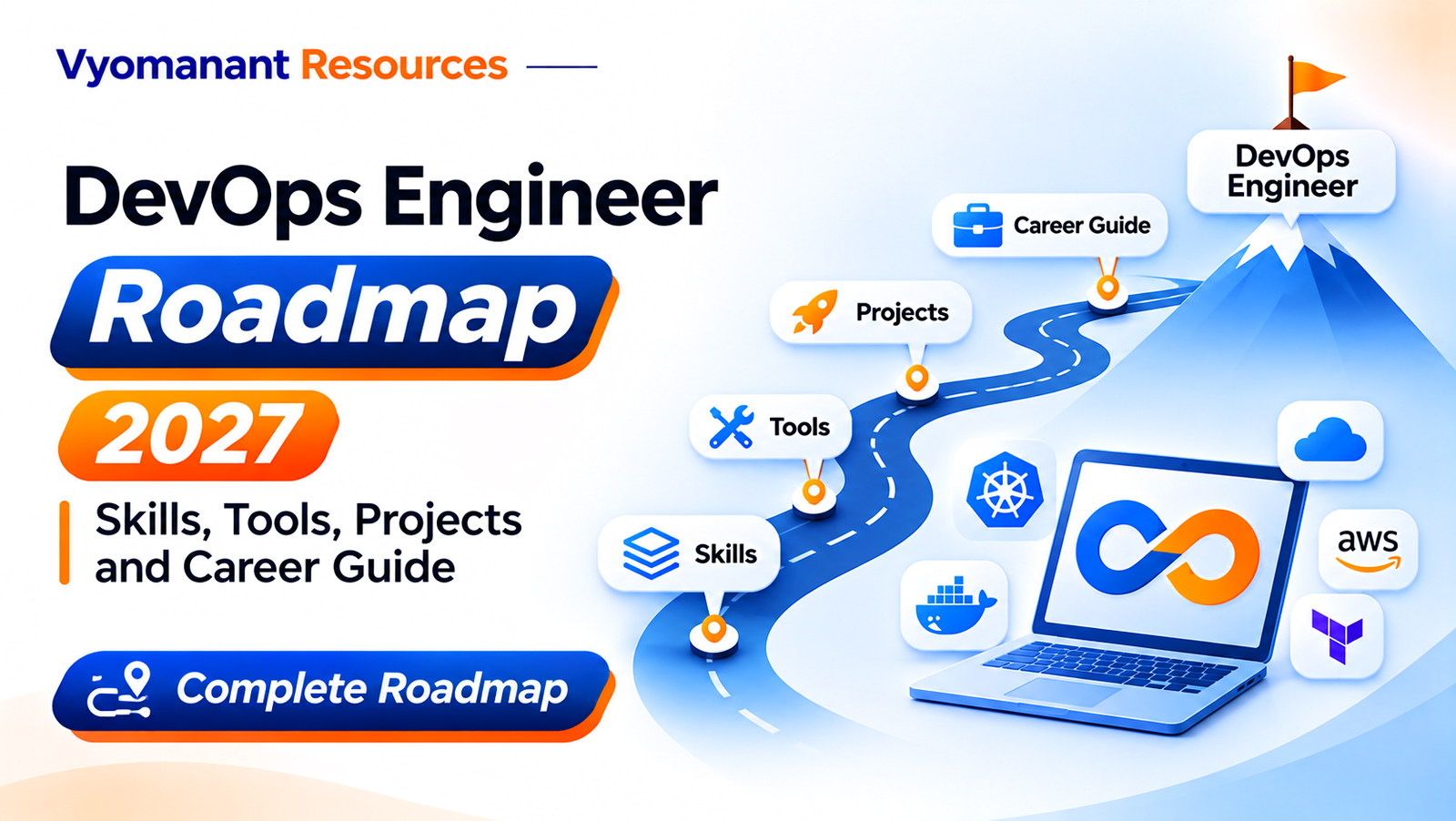
DevOps Engineer Roadmap 2027: Skills, Tools, Projects and Career Guide
Discover the complete DevOps Engineer Roadmap for 2027. Learn essential skills, tools, cloud technologies, CI/CD, Docker, Kubernetes, Terraform, monitoring, and AI-powered DevOps with a step-by-step learning path, hands-on projects, and career guidance.
Vyomanant Academy
Build these skills hands-on
Explore structured, practical technology programs from Vyomanant Academy.
Explore CoursesOn this page
Want to become a DevOps Engineer but confused about where to start, which tools to learn, and how to gain practical experience?
DevOps combines software development, IT operations, automation, cloud computing, and continuous delivery to help organizations release applications faster and more reliably.
The good news? You don't need to learn every DevOps tool to start your career.
You need a clear learning path, strong fundamentals, and hands-on project experience.
This guide explains the essential DevOps skills, tools, projects, and career opportunities to help you prepare for 2027.
1. What Does a DevOps Engineer Do?
A DevOps Engineer helps automate and improve how software is built, tested, deployed, monitored, and maintained.
Imagine a developer creates an application.
Before users can access it, the application needs to be:
- Stored in a version control system.
- Built and tested.
- Packaged for deployment.
- Deployed to a server or cloud platform.
- Monitored for errors and performance.
A DevOps Engineer helps automate and manage these processes.
Simple Example:
Instead of manually copying application files to a server every time developers release a new version, a DevOps Engineer creates a CI/CD pipeline that builds, tests, and deploys the application through a repeatable workflow.
Key Point: DevOps is not just about tools. It is about collaboration, automation, reliability, and continuous improvement.
2. DevOps Engineer Roadmap — Learning Path
Follow this recommended order:
           Linux Fundamentals
                    |
                    v
            Networking Basics
                    |
                    v
              Git & GitHub
                    |
                    v
           Scripting & Python
                    |
                    v
             CI/CD Pipelines
                    |
                    v
             Docker & Containers
                    |
                    v
            Cloud Computing
              (AWS / Azure)
                    |
                    v
                Terraform
                    |
                    v
               Kubernetes
                    |
                    v
            Monitoring & Logging
                    |
                    v
           DevSecOps & Security
                    |
                    v
           GitOps & Automation
                    |
                    v
          AI-Assisted DevOps & SRE
                    |
                    v
            Real-World Projects
Important: This is a suggested learning sequence, not a strict requirement. Many skills can be learned together through projects.
3. Step 1: Learn Linux Fundamentals
Linux is one of the most important foundations for DevOps.
Many application servers, cloud environments, containers, and automation tools run on Linux.
What to Learn
- Linux file system and directory structure.
- File and directory permissions.
- User and group management.
- Process and service management.
- Package installation.
- Log analysis.
- Basic shell commands.
Essential Commands
pwd                 # Current directory
ls -la              # List files
cd /var/log         # Change directory
cat app.log         # Read a file
grep "ERROR" app.log # Search logs
ps aux              # View processes
df -h               # Check disk usage
free -h             # Check memory
systemctl status ssh # Check a service
Practice Task: Launch a Linux virtual machine, install Nginx, configure it, and troubleshoot a service failure.
Goal: Become comfortable working with Linux without depending entirely on a graphical interface.
4. Step 2: Understand Networking Basics
DevOps Engineers regularly troubleshoot application connectivity and infrastructure communication.
What to Learn
- IP addresses and subnetting.
- DNS and domain names.
- HTTP and HTTPS.
- TCP and UDP.
- Ports and firewalls.
- Load balancers.
- SSH and network connectivity.
Practical Example
Your application is running on a server but is not accessible through the browser.
You should know how to check:
- Whether the application process is running.
- Whether the expected port is listening.
- Whether the firewall allows traffic.
- Whether DNS resolves correctly.
- Whether the load balancer routes traffic properly.
Useful Commands:
ping example.com
curl -I https://example.com
nslookup example.com
ss -tuln
Goal: Understand how applications communicate across networks.
5. Step 3: Learn Git and GitHub
Git is a version control system that tracks changes to source code.
GitHub provides repository hosting and collaboration features.
What to Learn
- Repositories and commits.
- Branching and merging.
- Pull requests.
- Merge conflicts.
- Git workflows.
Essential Commands
git init
git clone <repository-url>
git status
git add .
git commit -m "Initial commit"
git branch
git switch -c feature-login
git push origin feature-login
Practice Task: Create a GitHub repository, make changes in a feature branch, and merge them through a pull request.
Goal: Understand how development teams collaborate and manage code.
6. Step 4: Learn Scripting and Automation
DevOps Engineers use scripting to automate repetitive tasks.
Recommended Languages
- Bash: Linux and shell automation.
- Python: APIs, automation scripts, and operational tooling.
Practical Example
Instead of manually checking disk usage every day, write a Bash script.
#!/bin/bash

usage=$(df / --output=pcent | tail -1 | tr -d ' %')

if [ "$usage" -gt 80 ]; then
  echo "Warning: Disk usage is above 80%"
else
  echo "Disk usage is normal"
fi
Practice Task: Create scripts for checking system health, backing up files, and analyzing logs.
Goal: Learn to automate common operational activities.
7. Step 5: Understand CI/CD Pipelines
CI/CD helps automate application integration, testing, and delivery.
- Continuous Integration (CI): Automatically builds and tests code changes.
- Continuous Delivery: Prepares tested changes for release.
- Continuous Deployment: Automatically releases changes that pass required checks.
Popular Tools
- Jenkins
- GitHub Actions
- GitLab CI/CD
- Azure Pipelines
Simple CI/CD Workflow
Developer Pushes Code
          |
          v
    Git Repository
          |
          v
    Build Application
          |
          v
    Run Automated Tests
          |
          v
    Security Scanning
          |
          v
    Build Docker Image
          |
          v
    Deploy Application
          |
          v
    Verify Deployment
Real-World Example: When a developer pushes code to GitHub, a pipeline automatically builds the application, runs tests, and prepares it for deployment.
Practice Task: Build a GitHub Actions or Jenkins pipeline for a simple application.
Goal: Understand how software moves from source code to deployment.
8. Step 6: Learn Docker and Containers
Docker helps package applications and their dependencies into portable containers.
A container provides a consistent application environment across development, testing, and production.
What to Learn
- Images and containers.
- Dockerfiles.
- Container networking.
- Volumes.
- Docker Compose.
- Image registries.
Essential Commands
docker build -t myapp:v1 .
docker images
docker run -d -p 8080:80 nginx
docker ps
docker logs <container-id>
docker exec -it <container-id> sh
docker stop <container-id>
Real-World Example: Package a Python application into a Docker image and run it on different environments without manually installing its dependencies.
Practice Task: Containerize a web application and run it with Docker Compose alongside a database.
Goal: Learn how applications are packaged and deployed consistently.
9. Step 7: Learn Cloud Computing
Cloud platforms provide infrastructure and managed services for running applications.
Choose One Cloud Provider First
AWS:
- EC2
- VPC
- IAM
- S3
- RDS
- CloudWatch
Microsoft Azure:
- Virtual Machines
- Virtual Networks
- Entra ID
- Blob Storage
- Azure SQL
- Azure Monitor
You do not need to master multiple cloud platforms at the beginning.
Practical Example
Deploy a web application using:
- A cloud virtual machine.
- A secure network configuration.
- A database service.
- Monitoring and logging.
- Appropriate identity and access permissions.
Goal: Understand how to deploy and manage applications in the cloud.
Tip: Use free-tier or low-cost resources where eligible, configure budget alerts, and delete unused infrastructure.
10. Step 8: Learn Terraform and Infrastructure as Code
Infrastructure as Code (IaC) means defining and managing infrastructure using configuration files instead of creating everything manually.
Terraform is a widely used IaC tool.
What to Learn
- Providers.
- Resources.
- Variables and outputs.
- State files.
- Modules.
- Remote state.
- Infrastructure planning.
Essential Commands
terraform init
terraform fmt
terraform validate
terraform plan
terraform apply
terraform destroy
Practical Example
Instead of manually creating a cloud virtual machine through a console, define it using Terraform configuration.
Practice Task: Provision a cloud virtual machine and network resources using Terraform.
Goal: Learn how to create repeatable, version-controlled infrastructure.
11. Step 9: Learn Kubernetes
Kubernetes is a container orchestration platform used to deploy, scale, and manage containerized applications.
It becomes especially useful when applications run across multiple containers and servers.
What to Learn
- Pods and Nodes.
- Deployments.
- Services.
- ConfigMaps and Secrets.
- Namespaces.
- Ingress and Gateway API basics.
- Persistent storage.
- Resource requests and limits.
- Health probes.
- Autoscaling.
Essential Commands
kubectl get nodes
kubectl get pods
kubectl get deployments
kubectl get services
kubectl describe pod <pod-name>
kubectl logs <pod-name>
kubectl apply -f deployment.yaml
kubectl rollout status deployment/<name>
Real-World Example: Deploy a containerized application with three replicas and expose it through a Kubernetes Service.
Practice Task: Use Minikube or kind to deploy, scale, update, and troubleshoot an application.
Goal: Understand container orchestration and application reliability.
12. Step 10: Learn Monitoring and Observability
Deploying an application is only part of the job.
You must also understand whether it is healthy and performing correctly.
Important Concepts
- Metrics: Numerical measurements such as CPU usage and request latency.
- Logs: Records of application and system events.
- Traces: Information showing how requests move through services.
Popular Tools
- Prometheus
- Grafana
- OpenTelemetry
- Loki
- CloudWatch
- Azure Monitor
Practical Example
An application suddenly becomes slow.
Monitoring and observability tools help you investigate CPU usage, memory consumption, response times, errors, and request traces.
Practice Task: Monitor a containerized application using Prometheus and Grafana.
Goal: Learn how to identify and investigate production issues.
13. Step 11: Understand DevSecOps
DevSecOps integrates security practices into development and delivery workflows.
Security should not be treated as a final step before deployment.
What to Learn
- Secrets management.
- Vulnerability scanning.
- Container image security.
- Dependency scanning.
- IAM and least privilege.
- Kubernetes RBAC.
- Software supply chain security.
Useful Tools
- Trivy
- SonarQube
- OWASP Dependency-Check
- HashiCorp Vault
- Checkov
Practical Example: Add container image scanning to a CI/CD pipeline and prevent images with critical vulnerabilities from being released until reviewed.
Goal: Understand how to build secure delivery pipelines.
14. Step 12: Explore GitOps, SRE, and AI-Assisted DevOps
Once your fundamentals are strong, explore modern engineering practices.
GitOps
GitOps uses Git repositories as a source of desired configuration for automated delivery and reconciliation.
Tools: Argo CD and Flux.
Example: A configuration change merged into Git is detected by Argo CD and synchronized to Kubernetes according to policy.
Site Reliability Engineering (SRE)
SRE applies software engineering approaches to operational reliability.
Important Concepts:
- Service Level Indicators (SLIs).
- Service Level Objectives (SLOs).
- Error budgets.
- Incident management.
AI-Assisted DevOps
AI tools can help engineers:
- Explain pipeline failures.
- Analyze logs.
- Generate automation scripts.
- Review infrastructure configurations.
- Investigate incidents.
Important: Always review AI-generated commands and infrastructure changes before executing them.
Goal: Understand modern practices that improve delivery, reliability, and engineering productivity.
15. Build Real-World DevOps Projects
Hands-on projects are one of the best ways to demonstrate your DevOps skills.
Start with small projects and gradually combine multiple technologies.
| Level | Project | Technologies |
|---|---|---|
| Beginner | Linux Server Setup | Linux, Nginx, SSH |
| Beginner | Automated CI Pipeline | GitHub, GitHub Actions |
| Beginner | Dockerized Web Application | Docker, Docker Compose |
| Intermediate | Cloud Infrastructure Automation | AWS/Azure, Terraform |
| Intermediate | Kubernetes Application Deployment | Docker, Kubernetes, Helm |
| Intermediate | Monitoring Dashboard | Prometheus, Grafana |
| Advanced | End-to-End DevOps Pipeline | Git, CI/CD, Docker, Cloud, Kubernetes |
| Advanced | GitOps Deployment | Kubernetes, Argo CD |
| Advanced | Secure CI/CD Pipeline | Trivy, Terraform, CI/CD |
Recommended Portfolio Project
Build an End-to-End DevOps Pipeline
      Developer
          |
          v
        GitHub
          |
          v
    GitHub Actions
          |
          v
     Build & Test
          |
          v
    Security Scan
          |
          v
    Docker Image
          |
          v
   Container Registry
          |
          v
    Kubernetes
          |
          v
  Running Application
          |
          v
 Prometheus + Grafana
Use Terraform to provision suitable infrastructure and Argo CD to manage Kubernetes application deployments as you advance.
What to Include in Your Portfolio:
- Source code and configuration files.
- Architecture diagram.
- README documentation.
- Deployment instructions.
- Pipeline screenshots.
- Troubleshooting notes.
- Security and monitoring details.
Key Point: One well-documented, working project can demonstrate more practical knowledge than several incomplete projects.
16. Suggested 6-Month DevOps Learning Plan
This is an example schedule for consistent learners. Your timeline may vary based on experience and available study time.
| Month | Learning Focus |
|---|---|
| Month 1 | Linux, Networking, Git |
| Month 2 | Bash, Python Basics, CI/CD |
| Month 3 | Docker, Cloud Fundamentals |
| Month 4 | Terraform, Kubernetes |
| Month 5 | Monitoring, Security, GitOps |
| Month 6 | End-to-End Project, Resume, Interviews |
Recommended Approach: Spend time practicing commands, building small projects, and troubleshooting errors rather than only watching tutorials.
17. How to Prepare for a DevOps Job
Build Strong Fundamentals
Understand why a tool is used, not just how to execute commands.
Create a GitHub Portfolio
Publish projects with clear documentation and architecture diagrams.
Practice Real-World Scenarios
Prepare to answer questions such as:
- Why is a Kubernetes Pod in CrashLoopBackOff?
- How do you troubleshoot a failed CI/CD pipeline?
- What happens when Terraform state becomes inconsistent?
- How do you secure secrets in a deployment pipeline?
- How do you investigate high CPU usage on a Linux server?
Learn to Explain Your Projects
Practice describing:
Problem → Architecture → Tools → Implementation → Challenges → Results
Consider Certifications
Depending on your chosen career path, relevant certifications may include:
- AWS Certified Cloud Practitioner or Solutions Architect – Associate.
- Microsoft Azure Administrator Associate.
- Certified Kubernetes Administrator (CKA).
- HashiCorp Terraform Associate.
Remember: Certifications can support learning and credibility, but practical skills and project experience remain essential.
18. Common Mistakes Beginners Should Avoid
- Learning too many tools at once: Focus on one tool per category initially.
- Ignoring Linux and networking: These are essential troubleshooting foundations.
- Only watching tutorials: Practice independently.
- Memorizing commands: Understand what each command does.
- Skipping security: Include basic security from the beginning.
- Avoiding documentation: Document your projects and troubleshooting steps.
- Expecting instant results: DevOps requires consistent learning and practice.
19. Final Thoughts
Becoming a DevOps Engineer is a journey of learning, automation, troubleshooting, and continuous improvement.
Start with Linux, networking, and Git. Then progress through CI/CD, Docker, cloud computing, Terraform, Kubernetes, monitoring, and security.
As you gain experience, explore GitOps, SRE, and AI-assisted DevOps workflows.
Most importantly, build real-world projects and learn how to explain the problems you solved.
Key Takeaway: You don't need to know every DevOps tool. You need strong fundamentals, practical experience, and the ability to solve real engineering problems.
CONTINUE EXPLORING
Recommended next
What Is Artificial Intelligence? A Simple Beginner's Guide
Learn what Artificial Intelligence (AI) means, how it works, and where we use it in everyday life, with simple examples that anyone can understand.
View resource
What Is Machine Learning? A Simple Beginner's Guide
Discover what Machine Learning is, how computers learn from data, and how predictions work. Explore key ML concepts, learning types, and real-world examples in this beginner-friendly guide.
View resource
What Is Information Technology? A Beginner's Guide
Discover what Information Technology (IT) is, how it works, its main components, everyday applications, and how beginners can start learning IT.
View resource