
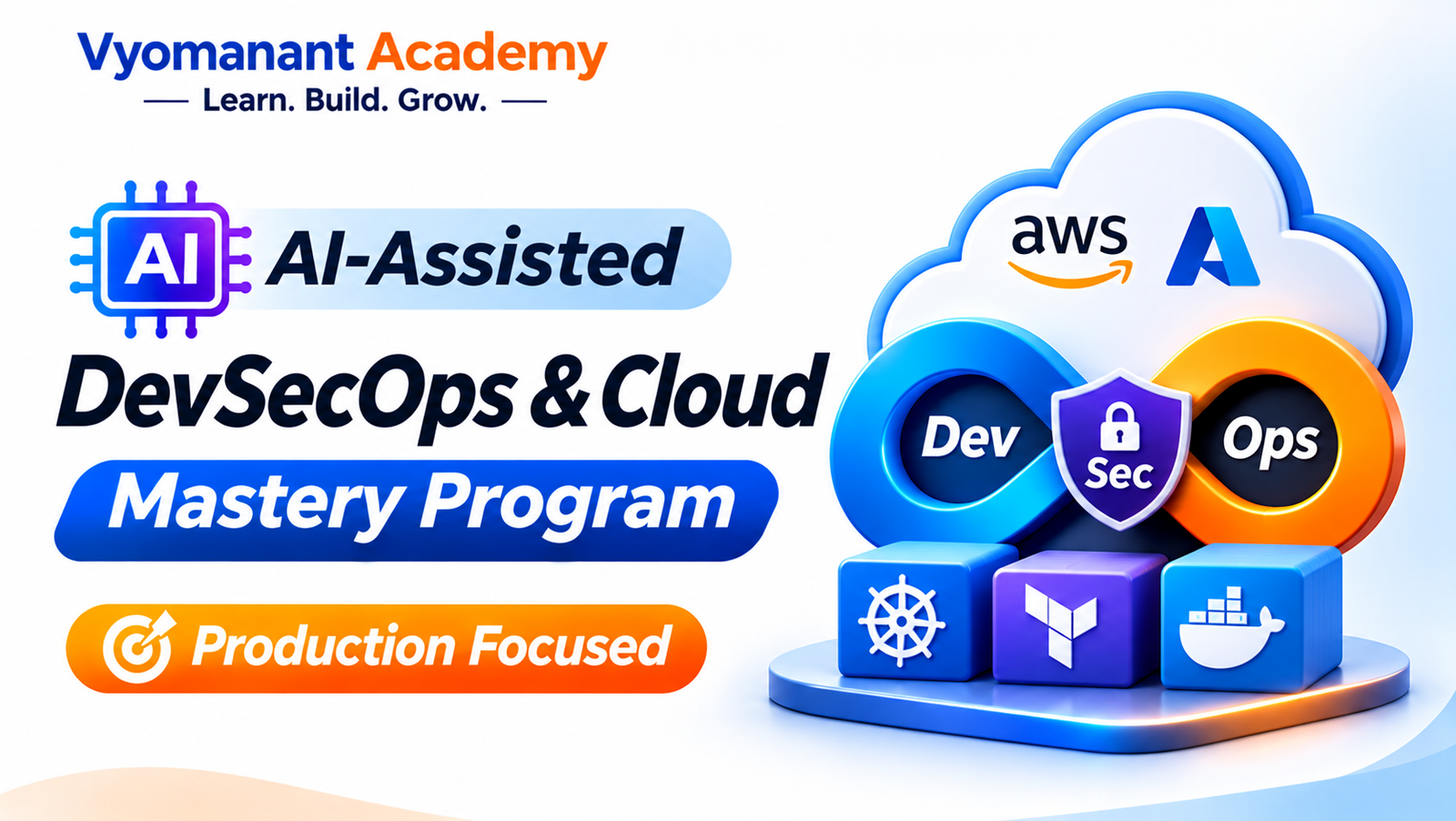
AI-Assisted DevSecOps & Cloud Mastery Program
Master DevSecOps, Cloud Engineering, CI/CD, Kubernetes, and AI-powered automation through hands-on training and real-world projects.
- Duration
- 120 Hrs
- Delivery mode
- Live Online
- Level
- Advanced
- Module
- 20 Modules
- Lesson
- 333 Lessons
- Project
- 5 Projects
- Capstone
- 1 Capstone
Learning Experience
- Hands-on Labs
- Real Projects
About This Course
AI-Assisted DevSecOps & Cloud Mastery Program
Become a job-ready DevSecOps and Cloud Engineer through comprehensive, hands-on, project-based training covering modern DevOps tools, cloud platforms, security automation, and AI-assisted engineering workflows.
This program is designed to help learners build practical skills in Linux, AWS, Azure, containerization, Kubernetes, Infrastructure as Code, CI/CD, GitOps, DevSecOps, monitoring, and production troubleshooting.
Learn how modern engineering teams build, secure, deploy, monitor, and manage cloud-native applications using industry-standard tools and real-world workflows.
What You Will Learn
- DevOps Foundations: Understand SDLC, Agile, DevOps principles, lifecycle stages, and modern engineering practices.
- AI-Assisted DevOps: Use AI assistants for scripting, configuration generation, troubleshooting, automation, and engineering productivity.
- Linux Administration: Master essential Linux commands, server administration, shell scripting, and production troubleshooting.
- Networking Fundamentals: Understand IP addressing, DNS, HTTP/HTTPS, ports, firewalls, and cloud networking.
- AWS Cloud: Work with EC2, IAM, VPC, S3, load balancing, and essential AWS cloud services.
- Microsoft Azure: Understand Azure resources, virtual machines, networking, identity, and cloud infrastructure.
- Git and GitHub: Manage source code, branches, pull requests, collaboration, and version control workflows.
- Docker: Build container images, manage containers, volumes, networking, and Docker Compose applications.
- Kubernetes: Deploy and manage containerized applications using Pods, Deployments, Services, ConfigMaps, Secrets, and Ingress.
- Terraform: Provision and manage cloud infrastructure using Infrastructure as Code.
- Ansible: Automate server configuration, software installation, and infrastructure management.
- Jenkins: Implement automated build, testing, and deployment pipelines.
- GitHub Actions: Build modern CI/CD workflows using GitHub-native automation.
- GitOps with Argo CD: Automate Kubernetes deployments using Git-based delivery workflows.
- DevSecOps: Integrate security checks into development and deployment pipelines using Gitleaks, SonarQube, Snyk, and Trivy.
- Monitoring and Observability: Monitor applications and infrastructure using Prometheus, Grafana, and related monitoring tools.
- Production Troubleshooting: Diagnose deployment failures, container issues, Kubernetes problems, and CI/CD pipeline errors.
Hands-On Practical Training
- Configure Linux-based DevOps environments.
- Provision and manage AWS and Azure cloud resources.
- Build and manage Git repositories and collaborative workflows.
- Containerize applications using Docker.
- Deploy applications to Kubernetes clusters.
- Provision infrastructure using Terraform.
- Automate server configuration with Ansible.
- Build CI/CD pipelines using Jenkins and GitHub Actions.
- Implement GitOps deployments using Argo CD.
- Integrate automated security scanning into CI/CD pipelines.
- Configure infrastructure and application monitoring.
- Troubleshoot real-world DevOps and cloud engineering scenarios.
- Build end-to-end DevSecOps projects integrating multiple tools.
Tools and Technologies
Linux, Networking, AWS, Microsoft Azure, Git, GitHub, Docker, Kubernetes, Terraform, Ansible, Jenkins, GitHub Actions, Argo CD, Gitleaks, SonarQube, Snyk, Trivy, Prometheus, Grafana, Shell Scripting, YAML, and AI Assistants.
Program Highlights
- 100+ Hours of Practical Training
- 200+ Hands-On Labs
- 5+ Real-World Projects
- 1 End-to-End Capstone Project
- Live Instructor-Led Training
- Beginner to Advanced Learning Path
- AI-Assisted DevOps Workflows
- Production-Focused Troubleshooting
- Certificate of Completion
Real-World Project-Based Learning
Work on practical projects that combine Git, CI/CD, Docker, Kubernetes, cloud infrastructure, automated security scanning, GitOps, and monitoring.
Learn how to design and implement complete DevSecOps workflows from source code management to secure production-style deployments.
Who Should Enroll?
- Beginners aspiring to become DevOps or Cloud Engineers.
- Students and fresh graduates pursuing cloud careers.
- System administrators transitioning into DevOps.
- Software developers interested in CI/CD and automation.
- Cloud engineers expanding into Kubernetes and DevSecOps.
- IT professionals seeking hands-on infrastructure and automation skills.
- Engineers interested in AI-assisted DevOps workflows.
Learning Outcomes
By completing this program, learners will be able to provision cloud infrastructure, containerize and deploy applications, build automated CI/CD pipelines, integrate security scanning, implement GitOps, configure monitoring, and troubleshoot common production-style engineering challenges.
Vyomanant Academy — Learn. Build. Grow.
Structured learning path
Course Curriculum
20 Modules 5 Projects 1 Capstone
Core Learning Modules
Module 0 DevOps, DevSecOps and AI Fundamentals
- 01Software Development Life Cycle (SDLC)
- 02Introduction to DevOps
- 03Introduction to DevSecOps
- 04DevOps vs DevSecOps vs SecOps
- 05DevOps and DevSecOps Lifecycle
- 06Traditional vs Modern Software Delivery
- 07Continuous Integration and Continuous Delivery
- 08Shift-Left Security
- 09Security as Code
- 10Introduction to AI-Assisted DevSecOps
- 11DevSecOps Tools Ecosystem
- 12Real-World DevSecOps Architecture
Module 1 Linux Administration and Security
- 01Linux Architecture and File System
- 02Linux Directory Structure
- 03Essential Linux Commands
- 04File and Directory Management
- 05Users, Groups and Permissions
- 06Linux Process Management
- 07Linux Service Management using systemd
- 08Linux Package Management
- 09SSH and Remote Server Access
- 10Linux Networking Commands
- 11Linux Logs and Troubleshooting
- 12Linux Security Fundamentals
- 13System Hardening Basics
- 14Bash Scripting Fundamentals
- 15AI-Assisted Linux Troubleshooting
Module 2 Networking Fundamentals for DevSecOps
- 01Introduction to Computer Networking
- 02OSI and TCP/IP Models
- 03IP Addressing and Subnetting
- 04Public and Private IP Addresses
- 05TCP and UDP Protocols
- 06Common Network Ports
- 07DNS and Domain Name Resolution
- 08HTTP and HTTPS
- 09SSL/TLS Fundamentals
- 10Firewalls and Network Security
- 11Load Balancers and Reverse Proxies
- 12Network Connectivity Testing
- 13Network Troubleshooting Commands
Module 3 Git, GitHub and Repository Security
- 01Introduction to Version Control
- 02Git Installation and Configuration
- 03Git Repository Management
- 04Git Clone, Add, Commit, Push and Pull
- 05Git Branching and Merging
- 06Git Conflict Resolution
- 07GitHub Repository Management
- 08Pull Requests and Code Reviews
- 09GitHub Branch Protection
- 10GitHub Secrets and Access Management
- 11Introduction to Secret Scanning
- 12Detecting Hardcoded Secrets using Gitleaks
- 13Secure Git and GitHub Best Practices
Module 4 Python and Bash Scripting for DevSecOps
- 01Introduction to Python Programming
- 02Python Installation and Environment Setup
- 03Variables and Data Types
- 04Conditional Statements and Loops
- 05Lists and Dictionaries
- 06File Handling
- 07JSON and YAML Processing
- 08REST API Integration using Python
- 09Bash Scripting Fundamentals
- 10Linux Task Automation
- 11Introduction to Security Automation
- 12AI-Assisted Python and Bash Scripting
Module 5 AWS Cloud Computing and Cloud Security
- 01Introduction to Cloud Computing
- 02AWS Global Infrastructure
- 03AWS Shared Responsibility Model
- 04AWS Identity and Access Management (IAM)
- 05IAM Users, Groups, Roles and Policies
- 06Principle of Least Privilege
- 07Amazon EC2 Instances
- 08Amazon EC2 Instances
- 09Amazon VPC Architecture
- 10Public and Private Subnets
- 11Route Tables and Internet Gateways
- 12Security Groups and Network ACLs
- 13Amazon S3 and Storage Security
- 14AWS CloudTrail Fundamentals
- 15Cloud Security Best Practices
- 16AI-Assisted Cloud Security Analysis
Module 6 Infrastructure as Code using Terraform
- 01Introduction to Infrastructure as Code
- 02Terraform Architecture and Workflow
- 03Terraform Installation and Configuration
- 04Terraform Providers and Resources
- 05Terraform Variables and Outputs
- 06Terraform State Management
- 07Terraform Modules
- 08Terraform Project Structure
- 09AWS Infrastructure Provisioning
- 10Provisioning VPC, Subnets and EC2
- 11IAM and Network Security Configuration
- 12Infrastructure Validation
- 13Terraform Resource Cleanup
- 14AI-Assisted Terraform Code Generation
- 15Terraform Security Best Practices
Practical Projects
Project 1 Secure AWS Infrastructure using Terraform
Core Learning Modules
Module 7 Docker and Container Security
- 01Introduction to Containerization
- 02Virtual Machines vs Containers
- 03Docker Architecture
- 04Docker Installation and Configuration
- 05Docker Images and Containers
- 06Docker Lifecycle Commands
- 07Dockerfile Fundamentals
- 08Building Custom Docker Images
- 09Docker Volumes
- 10Docker Networking
- 11Docker Compose
- 12Multi-Stage Docker Builds
- 13Docker Image Optimization
- 14Containerizing Microservices
- 15Secure Dockerfile Best Practices
- 16Running Containers as Non-Root Users
- 17Container Vulnerability Scanning using Trivy
- 18Vulnerability Report Analysis and Remediation
- 19AI-Assisted Dockerfile Security Review
Practical Projects
Project 2 Secure Microservices Containerization
Core Learning Modules
Module 8 Kubernetes and Kubernetes Security
- 01Introduction to Kubernetes
- 02Kubernetes Architecture
- 03Control Plane and Worker Nodes
- 04Kubernetes Cluster Components
- 05Kubernetes Installation using Kind or Minikube
- 06kubectl Commands
- 07Kubernetes Pods and ReplicaSets
- 08Deployments and Services
- 09Namespaces and Labels
- 10ConfigMaps and Secrets
- 11Kubernetes YAML Manifests
- 12Kubernetes Networking
- 13ClusterIP, NodePort and LoadBalancer
- 14Kubernetes Ingress
- 15Persistent Volumes and Persistent Volume Claims
- 16Deploying Microservices on Kubernetes
- 17Kubernetes Troubleshooting
- 18Kubernetes Role-Based Access Control (RBAC)
- 19Kubernetes Service Accounts
- 20Security Contexts and Pod Security Standards
- 21Kubernetes Network Policies
- 22Kubernetes Secrets Security
- 23Introduction to Kubernetes Security Scanning
- 24Introduction to Amazon EKS
- 25Secure Application Deployment on Kubernetes
- 26AI-Assisted Kubernetes Troubleshooting
Module 9 CI/CD Pipeline Engineering
- 01Introduction to Continuous Integration
- 02Continuous Delivery vs Continuous Deployment
- 03CI/CD Pipeline Architecture
- 04Jenkins Architecture
- 05Jenkins Installation and Configuration
- 06Jenkins Jobs and Build Execution
- 07Jenkins Declarative Pipelines
- 08Jenkinsfile Structure
- 09Pipeline Stages and Steps
- 10Jenkins Credentials Management
- 11Jenkins Integration with GitHub
- 12GitHub Webhooks
- 13Automated Application Build and Testing
- 14Docker Image Build Automation
- 15Amazon Elastic Container Registry (ECR)
- 16Docker Image Push to ECR
- 17Kubernetes Deployment using Jenkins
- 18Automated Rollouts and Rollbacks
- 19Introduction to GitHub Actions
- 20GitHub Actions Workflows and Runners
- 21Secure CI/CD Pipeline Fundamentals
- 22AI-Assisted Pipeline Troubleshooting
Practical Projects
Project 3 End-to-End CI/CD Pipeline
Core Learning Modules
Module 10 Cybersecurity and Application Security Fundamentals
- 01Introduction to Cybersecurity
- 02Confidentiality, Integrity and Availability (CIA Triad)
- 03Threats, Vulnerabilities and Risks
- 04Authentication and Authorization
- 05Encryption and Hashing
- 06Public Key and Private Key Cryptography
- 07OWASP Top 10 Web Application Security Risks
- 08Injection Vulnerabilities
- 09Broken Access Control
- 10Security Misconfiguration
- 11API Security Fundamentals
- 12JWT and OAuth 2.0 Fundamentals
- 13Secure Coding Practices
- 14Vulnerability Management
- 15CVE, CWE and CVSS
- 16Vulnerability Severity Classification
- 17Risk-Based Vulnerability Prioritization
- 18Secure Software Development Life Cycle
- 19Threat Modeling Fundamentals
- 20Introduction to SAST, SCA, DAST and IaC Security
Module 11 Static Application Security Testing (SAST)
- 01Introduction to Static Application Security Testing
- 02SAST Architecture and Workflow
- 03SonarQube Architecture
- 04SonarQube Installation and Configuration
- 05SonarQube Project Setup
- 06Source Code Security Scanning
- 07Security Findings and Vulnerability Analysis
- 08SonarQube Quality Gates
- 09Jenkins and SonarQube Integration
- 10AI-Assisted SAST Report Analysis
Module 12 Software Composition Analysis (SCA)
- 01Introduction to Software Composition Analysis
- 02Third-Party Dependency Security
- 03Open-Source Dependency Vulnerabilities
- 04OWASP Dependency-Check Architecture
- 05Installation and Configuration
- 06Dependency Vulnerability Scanning
- 07SCA Report Analysis
- 08Vulnerability Remediation
- 09Jenkins Pipeline Integration
- 10AI-Assisted Dependency Vulnerability Analysis
Module 13 Dynamic Application Security Testing (DAST)
- 01Introduction to Dynamic Application Security Testing
- 02SAST vs DAST
- 03OWASP ZAP Architecture
- 04OWASP ZAP Installation and Configuration
- 05Web Application Security Scanning
- 06Baseline Security Scanning
- 07DAST Report Analysis
- 08Security Findings and Remediation
- 09Jenkins Pipeline Integration
- 10AI-Assisted DAST Report Analysis
Module 14 Infrastructure and Container Security Scanning
- 01Introduction to Infrastructure as Code Security
- 02Common IaC Security Misconfigurations
- 03Checkov Installation and Configuration
- 04Terraform Security Scanning
- 05IaC Security Findings and Remediation
- 06Container Image Vulnerability Scanning
- 07Trivy Security Reports
- 08CVE-Based Vulnerability Prioritization
- 09Automated Security Gates
- 10Integrating Checkov and Trivy into CI/CD Pipelines
- 11AI-Assisted Security Report Analysis
Practical Projects
Project 4 End-to-End DevSecOps Security Pipeline
Core Learning Modules
Module 15 Secrets Management and Software Supply Chain Security
- 01Introduction to Secrets Management
- 02Risks of Hardcoded Credentials
- 03Environment Variables and Secrets
- 04GitHub Secrets
- 05Jenkins Credentials Management
- 06AWS Secrets Manager Architecture
- 07Creating and Managing Secrets
- 08IAM-Based Secrets Access
- 09Secure Secrets Retrieval
- 10Secrets Rotation Fundamentals
- 11Introduction to Software Supply Chain Security
- 12Third-Party Dependency Risks
- 13Software Bill of Materials (SBOM)
- 14SBOM Generation using Syft
- 15Introduction to SLSA
- 16Introduction to Sigstore and Cosign
- 17Container Image Signing
- 18Container Image Signature Verification
- 19Secure Software Release Practices
Practical Projects
Project 5 Secure Software Supply Chain
Core Learning Modules
Module 16 AI Fundamentals and AI-Powered DevSecOps
- 01Introduction to Artificial Intelligence
- 02Machine Learning Fundamentals
- 03Generative AI Fundamentals
- 04Large Language Models
- 05Tokens and Context Windows
- 06Prompt Engineering Fundamentals
- 07AI-Assisted Linux Troubleshooting
- 08AI-Assisted Python and Bash Scripting
- 09AI-Assisted Terraform Code Review
- 10AI-Assisted Dockerfile Security Review
- 11AI-Assisted Kubernetes Configuration Review
- 12AI-Assisted Jenkinsfile Optimization
- 13AI-Assisted Secure Code Review
- 14AI-Based Vulnerability Analysis
- 15AI-Assisted Security Report Summarization
- 16Risk-Based Vulnerability Prioritization using AI
- 17Python Integration with LLM APIs
- 18Secure LLM API Key Management
- 19Building a Python-Based AI Security Assistant
- 20Automated Security Report Generation
- 21Human-in-the-Loop Security Automation
- 22AI Security Risks and Responsible AI Usage
Module 17 Monitoring, Logging and Incident Response
- 01Introduction to Monitoring and Observability
- 02Infrastructure Monitoring
- 03Application Monitoring
- 04Linux System Logs
- 05Docker and Kubernetes Logs
- 06Security Events and Audit Logs
- 07Prometheus Architecture
- 08Prometheus Metrics Collection
- 09Grafana Dashboard Configuration
- 10Infrastructure Monitoring Dashboards
- 11Basic Alert Configuration
- 12Amazon CloudWatch
- 13AWS CloudTrail
- 14Amazon GuardDuty
- 15Cloud Security Monitoring
- 16Introduction to Security Incident Response
- 17Incident Detection and Classification
- 18Security Alert Investigation
- 19Incident Triage
- 20Root Cause Analysis
- 21AI-Assisted Log Analysis
- 22AI-Assisted Incident Investigation
- 23Automated Incident Reporting
- 24AI-Generated Remediation Recommendations
Module 18 Enterprise DevSecOps Project Integration
- 01Enterprise DevSecOps Architecture Design
- 02Microservices Application Architecture
- 03GitHub Repository Configuration
- 04AWS Infrastructure Provisioning
- 05Terraform Infrastructure Automation
- 06IAM and Network Security
- 07Docker Image Build and Optimization
- 08Amazon ECR Integration
- 09Kubernetes Application Deployment
- 10Jenkins CI/CD Pipeline Configuration
- 11SAST Integration
- 12SCA Integration
- 13Container Security Scanning
- 14IaC Security Scanning
- 15DAST Integration
- 16Automated Security Gates
- 17Secrets Management Integration
- 18SBOM Generation
- 19Container Image Signing
- 20AI-Powered Vulnerability Analysis
- 21Automated Security Reporting
- 22End-to-End Pipeline Validation
- 23Production Troubleshooting
Module 19 Final Capstone Project and Career Preparation
- 01Capstone Project Requirements and Planning
- 02AWS Infrastructure Architecture Design
- 03DevSecOps CI/CD Architecture Design
- 04Terraform Infrastructure Provisioning
- 05Microservices Containerization
- 06Kubernetes Application Deployment
- 07Jenkins CI/CD Pipeline Implementation
- 08Security Scanning Tool Integration
- 09Automated Security Gate Validation
- 10Secrets Management Implementation
- 11Software Supply Chain Security
- 12AI-Powered Vulnerability Analysis
- 13AI-Assisted Remediation Recommendations
- 14Security Monitoring and Reporting
- 15Production Troubleshooting
- 16Project Documentation
- 17Architecture Diagrams
- 18GitHub Project Portfolio
- 19Capstone Project Demonstration
- 20DevSecOps Interview Preparation
- 21Resume and Career Guidance
Capstone Projects
Capstone AI-Powered Enterprise DevSecOps Platform
Projects & Labs
Practical Projects
Project 1 Secure AWS Infrastructure using Terraform
Project 2 Secure Microservices Containerization
Project 3 End-to-End CI/CD Pipeline
Project 4 End-to-End DevSecOps Security Pipeline
Project 5 Secure Software Supply Chain
Capstone Projects
Capstone AI-Powered Enterprise DevSecOps Platform
Instructor-led learning
Upcoming Live Batches
Choose from the currently published live batch schedules for this course.
Live batch
AI-Assisted DevSecOps & Cloud Mastery Program
- Start date
- Dec 9, 2026
- Repeats
- Weekly
- Days
- Monday to Friday
- Time
- To be announced
- Timezone
- Asia/Kolkata
Announcement times use the timezone shown. Enquiry status does not confirm seat availability.
Ready to get started?
Take the next step in your learning journey.
Register your interest in AI-Assisted DevSecOps & Cloud Mastery Program.
